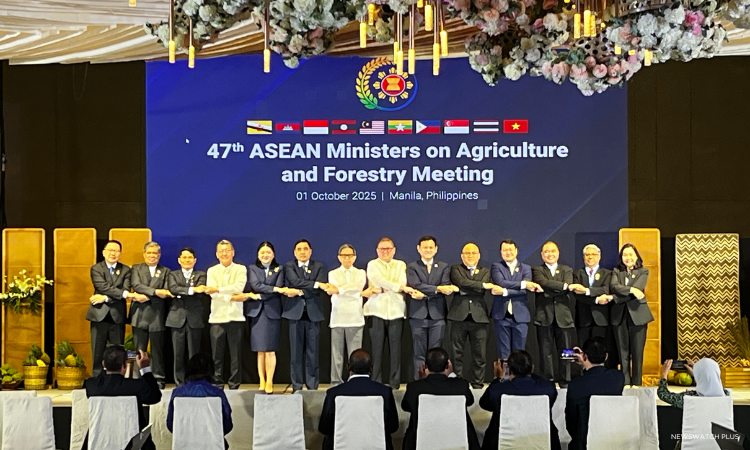


Metro Manila, Philippines – Agriculture ministers of the Association of Southeast Asian Nations (ASEAN) pledged to increase trade while each member holds tariff talks with the United States.
Agriculture Secretary Francisco Tiu Laurel Jr. said his counterparts agreed that enhancing trade within the bloc would make them “rely on each other first rather than relying on others that are far away.”
“Technically, we agreed we should increase processing and trade within our members in order to build up resilience,” Tiu Laurel told reporters after the 47th Meeting of the ASEAN Ministers on Agriculture and Forestry on Thursday, Oct. 2.
“The discussion was also [finding] other markets around the world for ASEAN products,” he said.
ASEAN agriculture ministers reaffirmed their commitment to the 2045 vision, and pushed for a strategic framework to significantly enhance food and nutrition security, boost climate resilience, and accelerate rural development.
It was noted during the meeting that the region still imports 30 percent of its food requirements, pushing member states, especially the Philippines, to “work our own deficits first” for food security, said Tiu Laurel.
The agriculture chief said he raised the issue in informal talks, particularly asking some ASEAN members if they have resolved or closed a deal with the United States.
Asked about his view on the regional sentiment, Tiu Laurel said: “ Definitely, I’m quite sure the region can overcome the US tariffs.”
US President Donald Trump slapped Philippine exports with a 19 percent tariff, already a negotiated rate from the previous 20 percent.
Cambodia, Malaysia, and Vietnam have the same duty rate.
The US set 10 percent on products from Indonesia and Singapore, 20 percent on Vietnam, 25 percent on Brunei, and 40 percent on Laos and Myanmar.
Tiu Laurel said the country will be pushing for other goods to be exempted from the US tariff rate.
“In the bilateral meeting with the US-ASEAN Business Council, they have mentioned that there is openness, there’s a possibility of exemptions on certain products that are not produced, planted, manufactured, or processed in the US,” he said.
Amid Trump’s reciprocal tariffs, Tiu Laurel said there was no “real discussion” with China about additional trade with the Philippines.
“China has been open generally to accept more of our durians and other ASEAN countries’ produce,” he said.