

WASHINGTON/DUBAI/DOHA (Reuters) – The United States is withdrawing some personnel from bases in the Middle East, a U.S. official said on Wednesday, after a senior Iranian official said Tehran had warned neighbours it would hit American bases if Washington strikes.
With Iran’s leadership trying to quell the worst domestic unrest the Islamic Republic has ever faced, Tehran is seeking to deter U.S. President Donald Trump’s repeated threats to intervene on behalf of anti-government protesters.
A U.S. official, speaking on condition of anonymity, said the United States was pulling some personnel from key bases in the region as a precaution given heightened regional tensions.
“All the signals are that a U.S. attack is imminent, but that is also how this administration behaves to keep everyone on their toes. Unpredictability is part of the strategy,” a Western military official told Reuters later on Wednesday.
At the White House, however, Trump suggested he was adopting a wait-and-see posture toward the crisis.
Trump told reporters that he has been told that killings in the Iranian regime’s crackdown on the protests were subsiding and that he believes there is currently no plan for large-scale executions.
Asked who told him that the killings had stopped, Trump described them as “very important sources on the other side.”
The president did not rule out potential U.S. military action, saying “we are going to watch what the process is” before noting that his administration had received a “very good statement” from Iran.
Iranian Foreign Minister Abbas Araqchi said on Wednesday “there is no plan” by Iran to hang people, when asked about the anti-government protests.
“There is no plan for hanging at all,” the foreign minister told Fox News in an interview on the “Special Report with Bret Baier” show. “Hanging is out of the question,” he said.
According to the Norway-based Iran Human Rights Society, hangings are common in Iranian prisons.
TIMING REMAINS UNCLEAR
Two European officials said U.S. military intervention could come in the next 24 hours. An Israeli official also said it appeared Trump had decided to intervene, though the scope and timing remained unclear.
Qatar said drawdowns from its Al Udeid air base, the biggest U.S. base in the Middle East, were “being undertaken in response to the current regional tensions”.
Three diplomats said some personnel had been told to leave the base, though there were no immediate signs of large numbers of troops being bussed out to a soccer stadium and shopping mall as took place hours before an Iranian missile strike last year.
Britain was also withdrawing some personnel from an air base in Qatar ahead of possible U.S. strikes, The I Paper newspaper reported. The British defence ministry had no immediate comment.
Trump has repeatedly threatened to intervene in support of protesters in Iran, where thousands of people have been reported killed in a crackdown on the unrest against clerical rule.
Iran and its Western foes have both described the unrest, which began two weeks ago as demonstrations against dire economic conditions and rapidly escalated in recent days, as the most violent since the 1979 Islamic Revolution that installed Iran’s system of Shi’ite clerical rule.
An Iranian official has said more than 2,000 people have died. A rights group put the toll at more than 2,600.
Iran has “never faced this volume of destruction”, Armed Forces Chief of Staff Abdolrahim Mousavi said on Wednesday, blaming foreign enemies.
French Foreign Minister Jean-Noel Barrot described “the most violent repression in Iran’s contemporary history”.
Iranian authorities have accused the U.S. and Israel of fomenting the unrest, carried out by people it calls armed terrorists.
IRAN ASKS REGIONAL STATES TO PREVENT A US ATTACK
Trump has openly threatened to intervene in Iran for days, without giving specifics. In an interview with CBS News on Tuesday, he vowed “very strong action” if Iran executes protesters. He also urged Iranians to keep protesting and take over institutions, declaring “help is on the way”.
The senior Iranian official, speaking on condition of anonymity, said Tehran had asked U.S. allies in the region to prevent Washington from attacking Iran.
“Tehran has told regional countries, from Saudi Arabia and UAE to Turkey, that U.S. bases in those countries will be attacked” if the U.S. targets Iran, the official said.
Direct contacts between Iranian Foreign Minister Abbas Araqchi and U.S. Special Envoy Steve Witkoff have been suspended, the official added.
The United States has forces across the region including the forward headquarters of its Central Command at Al Udeid in Qatar and the headquarters of the U.S. Navy’s Fifth Fleet in Bahrain.
GOVERNMENT DOESN’T SEEM NEAR COLLAPSE, WESTERN OFFICIAL SAYS
The flow of information from inside Iran has been hampered by an internet blackout.
The U.S.-based HRANA rights group said it had so far verified the deaths of 2,403 protesters and 147 government-affiliated individuals, dwarfing tolls from previous waves of protests crushed by the authorities in 2022 and 2009.
The government’s prestige was hammered by a 12-day Israeli bombing campaign last June – joined by the U.S. – that followed setbacks for Iran’s regional allies in Lebanon and Syria. European powers restored U.N. sanctions over Iran’s nuclear programme, compounding the economic crisis there.
The unrest on such a scale caught the authorities off guard at a vulnerable time, but it does not appear that the government faces imminent collapse, and its security apparatus still appears to be in control, one Western official said.
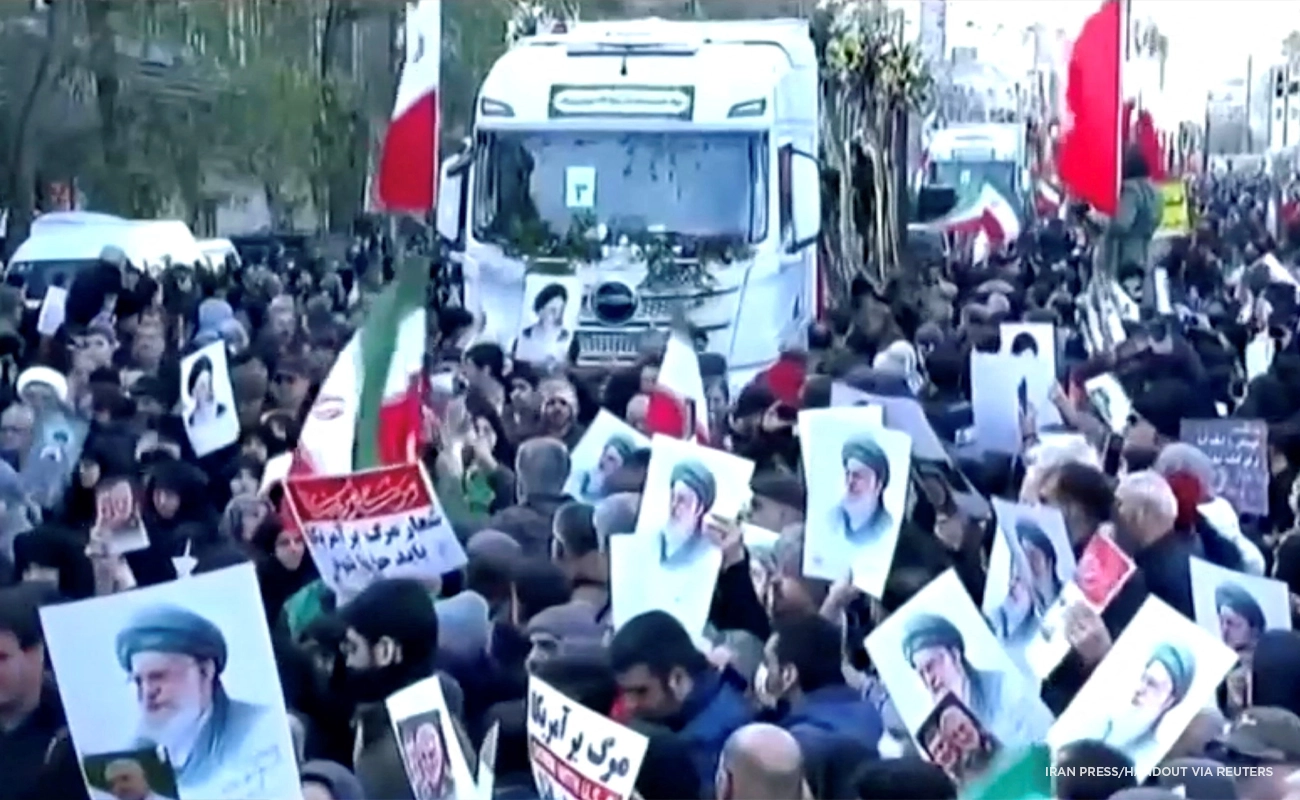
The authorities have sought to project images showing they retain public support. Iranian state TV broadcast footage of large funeral processions for people killed in the unrest in Tehran, Isfahan, Bushehr and other cities.
People waved flags and pictures of Supreme Leader Ayatollah Ali Khamenei, and held aloft signs with anti-riot slogans.
(Reporting by Elwely Elwelly and Jana Choukeir in Dubai, Bassam Masoud in Doha, John Irish in Paris, Lili Bayer in Brussels, Bo Erickson in Detroit, Susan Heavey, Joey Roulette and Doina Chiacu in Washington, Michelle Nichols at the United Nations, Bhargav Acharya in Toronto; writing by Tom Perry, Peter Graff, Mark Heinrich and James Oliphant; editing by Frances Kerry, Alexandra Hudson, Gareth Jones, Diane Craft and Michael Perry)