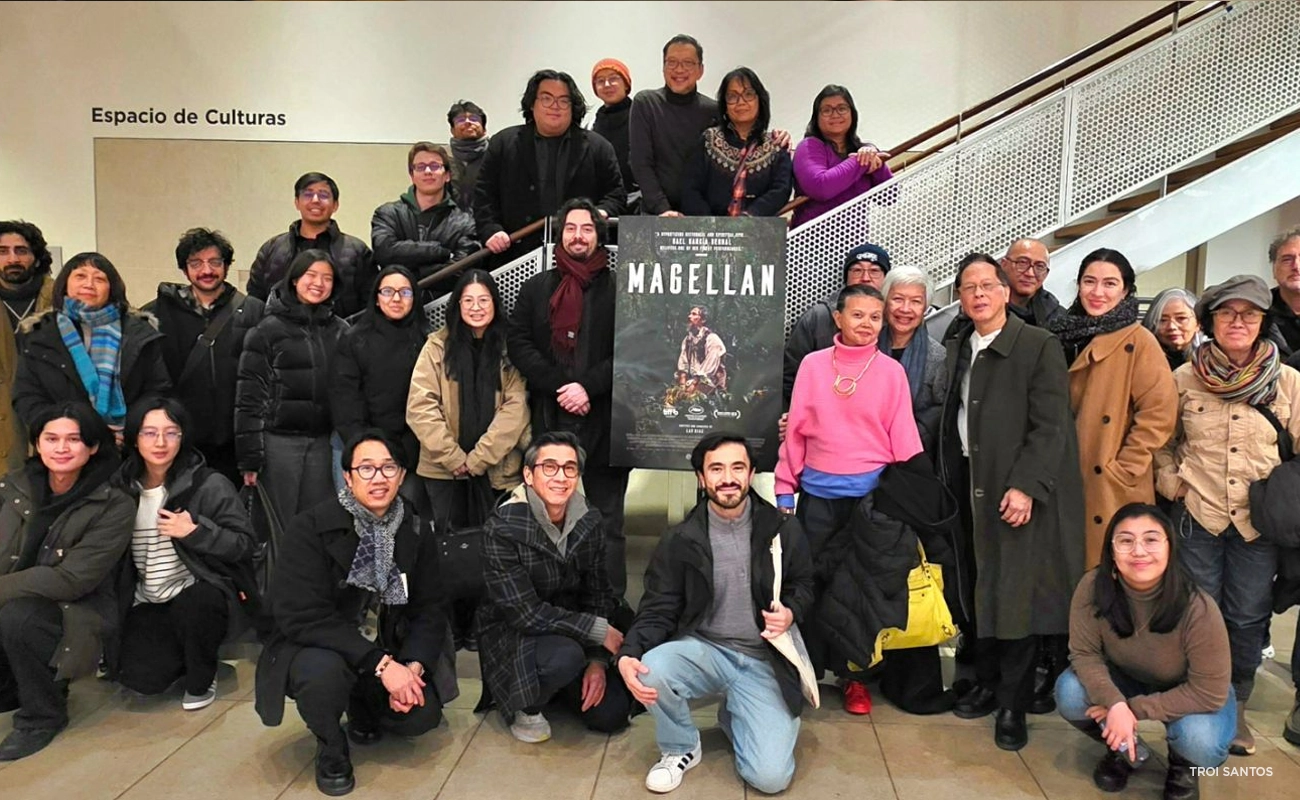


NYU Espacio de Culturas featured a selection of short works by Filipino filmmaker Lav Diaz on Dec. 5, at an event organized by Sulo: The Philippine Studies Initiative together with the New York Southeast Asia Network
It took place weeks ahead of Janus Films opening of Diaz’s new feature, “Magellan,” at IFC Center. While Janus is preparing for the film’s US release and Oscar campaign, the NYU program focused on earlier short pieces that rarely appear in commercial venues.
The timing placed attention on a part of Diaz’s practice that is often overshadowed by the long-form films that defined his international reputation.
The screening was curated by Gil Quito, who has worked for years to present Philippine cinema in New York. Quito opened the evening by acknowledging that many viewers first encounter Diaz through multi-hour features that circulate through festivals.
Here, he said, the goal was to introduce shorter films that show Diaz working at different scales and with different aims. Some run just a few minutes. Others approach an hour. The works, taken together, present a cross-section that is less familiar than his major titles and more accessible to audiences who may not enter a six-hour screening without some preparation.
Quito also noted that this was an appropriate moment to revisit the shorts, since “Magellan” is moving toward release and discussion. Janus provided a trailer for the evening, and Quito mentioned that the film opens at IFC Center on Jan. 9.
Showing the trailer served a practical function. It linked the shorts to Diaz’s current work and gave audiences a first look at the feature before it entered theaters. It also underscored that new projects continue to arrive even as earlier films remain in circulation through festivals and academic venues. The clip offered a point of reference for viewers who may encounter “Magellan” next month and helped place the shorts within the larger context of an ongoing body of work.
Though he focused mainly on the shorts themselves, Quito briefly acknowledged that early theatrical turnout matters for specialty releases. He suggested that viewers who respond to the shorts might consider seeing the feature when it opens, adding that the Philippines has submitted the film for international feature consideration this awards cycle.
The program began with “Prologue to the Great Desaparecido” (2013), which follows Gregoria de Jesus in her search for the remains of Andres Bonifacio after his killing during the Philippine Revolution. Diaz shot the film in spare compositions, using black-and-white imagery and extended takes. Quito told the audience that this piece introduced several concerns that recur in Diaz’s work, including an interest in historical memory and a refusal to use fast editing as a way of moving viewers toward quick conclusions. Students in attendance asked about the historical context, and Quito explained that the film also refers to Emilio Jacinto, another figure affected by internal conflicts among revolutionary factions.
Shorter and more experimental works followed. “The Boy Who Chose the Earth” (2018) focuses on a child surrounded by printed material. “The Firefly” (2013) presents a moment of walking on a European street. “The Day Before the End” (2016) shows poets reciting lines from Shakespeare while navigating rising water and unstable weather. Each piece lasted only a few minutes. Quito described them as examples of Diaz working outside narrative structure, letting simple actions stand without plot development. These titles, he said, reveal how Diaz approaches duration even when the length is compressed.
“Himala: A Dialectic of Our Times” (2020) documents people watching Ishmael Bernal’s 1982 film “Himala” on laptops and phones during pandemic lockdowns. Diaz recorded their reactions rather than restaging the original film. Watching others watch a canonical Filipino title raised questions about collective viewing, cultural familiarity, and how national cinema circulates among diaspora and domestic audiences. Viewers at the screening responded to the concept of filming reception rather than reenactment, and several mentioned the role of at-home viewing in recent years.
The evening ended with “Butterflies Have No Memories” (2009), an hourlong work about a town affected by the departure of foreign mining interests. Diaz focuses on a small community facing depleted resources and shifting social structures. The film connects economic concerns to everyday experience without foregrounding didactic commentary. For many viewers, it suggested lines of inquiry that continue in Diaz’s later work, including “Magellan,” which examines early encounters between European explorers and Philippine communities.
Though the event included a brief mention of the forthcoming feature, the shorts remained at the center. Their importance at NYU was not simply as preview material, but as works that expand understanding of Diaz beyond his longest films. Quito reminded the audience that most US access to Diaz occurs through festival retrospectives, museum programs, and occasional theatrical releases. The shorts add dimension to that picture. They circulate less often and appear mainly through academic venues, making NYU a natural location for their return.
Attendance included university viewers, cinephiles, and community members who follow international programming in New York. Conversations afterward focused on how seldom these shorts are shown and how valuable it is to see them in a collective setting. Some attendees said that they had only seen clips or heard about the films through panel discussions or classroom references. Others noted that the shorts give context that reframes “Magellan” not as an isolated project but as part of a long development of historical themes within Diaz’s practice.
Throughout the evening, Quito described Diaz as a filmmaker whose work continues to move between festivals, academic venues, and specialized distributors. He mentioned that Diaz’s films have screened at major festivals and that Diaz has a long record of international recognition. He also noted that Diaz maintains ties to New York and to Philippine cultural institutions. These remarks placed the short films within a broader cross-regional history rather than positioning them simply as stepping stones to “Magellan.”
The significance of showing the shorts at NYU rested on several levels. For students and researchers, the program offered material rarely available for study. For general audiences, it provided a point of entry into Diaz’s work at a manageable scale. For those following the Philippine submission to the international feature race, it gave early context before the feature arrived. Films that exceed six hours cannot always serve as an opening encounter, and the shorts allow viewers to approach Diaz through smaller commitments that still carry his signature concerns.
As people gathered around a poster for “Magellan” after the screening, the atmosphere remained informal. Attendees discussed their own paths to Diaz’s work, whether through diaspora connections, classroom study, or incidental discovery. The evening signals how academic programming sustains international cinema in New York and how the shorts, despite their limited visibility, contribute to a fuller understanding of a major figure in contemporary Philippine film.
The shorts at NYU did not present themselves as promotional material for “Magellan.” They demonstrated how Diaz’s body of work occupies multiple forms. As the feature moves toward release, these earlier pieces give audiences an expanded sense of the filmmaker’s concerns and methods. That context matters, not only for the upcoming opening but for understanding Diaz as a persistent presence in New York’s cultural and academic life.