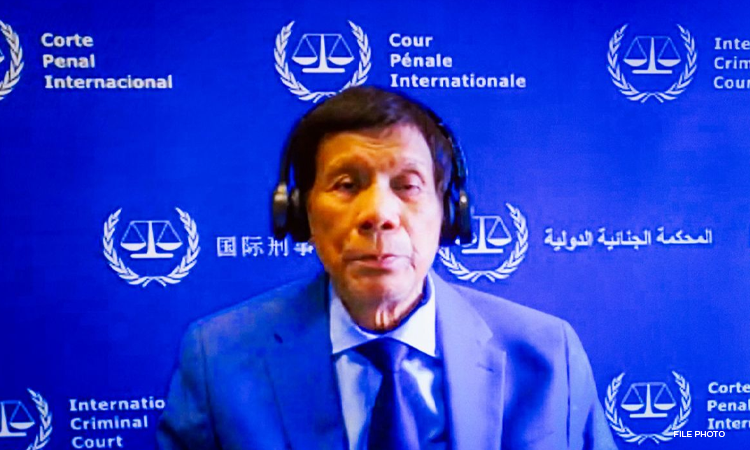


Metro Manila, Philippines – The International Criminal Court’s Office of the Prosecutor has called on the Appeals Chamber to dismiss former Philippine President Rodrigo Duterte’s challenge to the Court’s jurisdiction, arguing that the country’s withdrawal from the Rome Statute does not shield him from accountability for alleged drug-war crimes committed while the Philippines was still a member of the Court.
In a 22-page filing, prosecutors said the Pre-Trial Chamber had already “confirmed the Court’s lawful exercise of jurisdiction in this situation,” and that the judicial consensus “is unsurprising given the Court’s clear mandate, the plain terms of the Rome Statute, and the interests of States in acceding to it.”
The prosecution emphasized that the ICC retains authority because the alleged crimes occurred when the Philippines was still a State Party.
“The Court can exercise its jurisdiction over crimes allegedly committed on the territory of the Philippines while it was still a State Party, because the Prosecution had commenced the preliminary examination before the Philippines had either notified its intention to withdraw or before that withdrawal became effective,” the filing said.
Prosecutors argued that Manila’s 2019 withdrawal cannot retroactively cancel the country’s acceptance of ICC oversight.
“Finding that the withdrawal from the Statute would now bar the Court’s exercise of jurisdiction would strike at the heart of the Philippines’ status as a State Party at the time of the alleged crimes,” the document stated.
The prosecution said such an interpretation would constitute an “ex post facto act” that undermines the purpose of the Rome Statute.
Preliminary examination a formal legal process
Duterte’s legal team has argued that the ICC’s preliminary examination was too informal to qualify as a “matter under consideration” under Article 127(2) of the Rome Statute. The prosecution rejected that assertion, saying a preliminary examination is “undoubtedly a statutory process,” and that any claim to the contrary is “unsustainable.”
The filing cites multiple statutory provisions—including Articles 15 and 53, and Rules 46–50—to argue that prosecutors are legally obligated to examine information before requesting authorization to open an investigation. As the document notes, the Prosecutor “shall analyse the seriousness of the information received” and “shall consider” the relevant factors when deciding whether to investigate.
Because the preliminary examination was already underway when the Philippines withdrew, prosecutors said it remained a protected “matter under consideration.” The term “matter,” they argued, is intentionally broad. The Chamber was correct to conclude it is “clearly broad enough to incorporate the subject of the preliminary examination in this case.”
The prosecution also responded to arguments that references to “the Court” in Article 127 apply only to judges. Citing Article 34 of the Rome Statute, prosecutors said the term “the Court” encompasses all four organs, including the Office of the Prosecutor.
“It is the Prosecution that would be expected to be considering matters that form the subject-matter of preliminary examinations and investigations,” the filing said.
Ultimately, the prosecution urged the Appeals Chamber to reject all four grounds raised by Duterte’s team. “The Appeals Chamber should dismiss the Appeal in its entirety, and thereby affirm the Court’s exercise of jurisdiction in the present case,” the filing concluded.
If upheld, the ruling would allow the ICC’s investigation into thousands of alleged extrajudicial killings during Duterte’s anti-drug campaign to proceed.