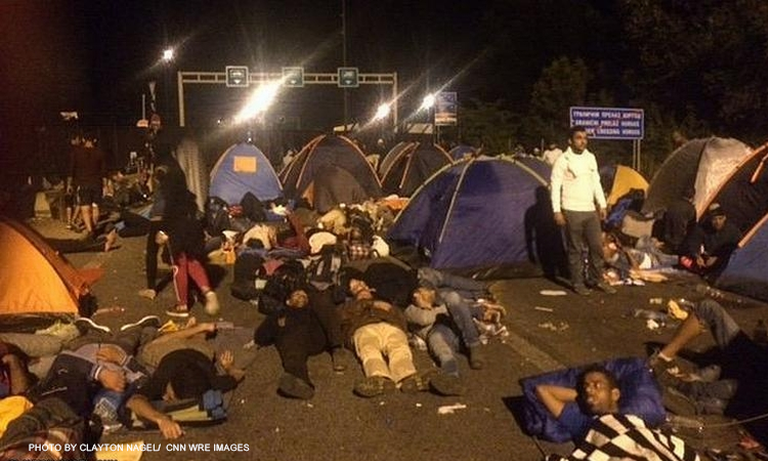

At the Hungarian-Austrian border (CNN) — The directions from police were terse: “Follow us.”
Hundreds of refugees from the Middle East made the final leg of their trip through Hungary on foot, walking the 4 kilometers (2.5 miles) to the Austrian border in the middle of the night, unsure of what was going to happen to them when they got there.
After a train ride from the Croatia-Hungary border, about 300 to 400 people were trekking through the dark early Sunday with Hungarian police as their guides through the village of Hegyeshalom.
It had already been a long day for the refugees. They had been on the train since the morning. There was very little food or water. When they stepped off the train, they had no idea where they were or where they were going.
Austria lay ahead. Thousands a day before them have poured over that border from Hungary.
Countries squabble
Hungary has found a basic approach to new migrants knocking at their doors — drive them back with razor wire, tear gas and uniformed men, or shuttle them quickly to the Austrian border.
Among the European countries bearing the brunt of the overwhelming flow of migrants, Hungary and its neighbor Croatia have squabbled over the response to the crisis.
Croatia started with a welcoming stance but faltered as more than 20,000 migrants crossed into its territory. And an attitude of resentment and frustration seen in other European nations spread there as well.
“Croatia will not be turned into Europe’s refugee center,” Prime Minister Zoran Milanovic said Saturday. “How convenient this must be for some in Northern Europe to say well, these migrants are now in Croatia — have the hundreds of thousands of people stay there. That’s impossible.”
Croatia began transporting thousands to Hungary, which scolded the action as illegal and extended its razor wire fence the length of its 41 kilometer border with Croatia. Then it passed the migrants on to Austria and Germany.
Europe muddled
In the EU centers of Brussels and Luxembourg, member countries remain deadlocked and divided over a common policy to shoulder the burden.
Further along the migrant route, Germany is appearing less of a beacon of hope than it did not long ago. The government is working to reduce aid to asylum seekers in country and deport more quickly those who don’t meet the official designation of political refugee.
Asylum homes are reportedly stretched beyond capacity.
And in spite of sympathy from the vast majority of Germans, bands of far-right protesters have shouted hate and venom at refugees upon arrival, throwing bottles at their buses. Dozens of empty, waiting shelters have been torched by arsonists.
At the other end of the migrant trail, many more thousands of weary, hungry, helpless and forsaken men, women and children, pour in from the war-ravaged lands of Syria, Iraq and Afghanistan.
Hunger and misery is driving Syrian refugees in the Middle East out of tent cities pitched in neighboring countries that have taken in millions of destitute. As international generosity has worn thin, the World Food Program has had progressively cut food rations for lack of funding.
Great migration
Europe is facing its largest refugee and migrant crisis since World War II. People fleeing the violence in Syria account for the largest portion of those arriving on European shores, but there are many others on the move from African nations and elsewhere.
Nearly 475,000 migrants have crossed by boat into Europe seeking safety and sustenance so far this year, according to the International Organization for Migration. More than 2,800 have drowned or disappeared during the perilous journey.
Nearly 350,000 of the desperate travelers have landed in Greece, and more than 120,000 in Italy. From there, they try to reach the more sought-after EU nations for migrants, such as Germany and Sweden.
Germany is expecting 1 million asylum applications this year and has a backlog of more than 260,000 cases.
France has agreed to take tens of thousands, Britain 20,000 and the United States 10,000 refugees in addition to those already admitted. Switzerland said that if Europe can come to agreement, it will take 1,500 refugees. Most of Eastern Europe has resisted committing to a number.
CNN’s Ben Wedeman reported from Hegyeshalom, Hungary and Ben Brumfield wrote from Atlanta. CNN’s Ivan Watson and Steve Almasy contributed to this report.
This report was first published on CNN.com, “Europe struggles to cope with migrants’ march of misery.”