
Metro Manila (CNN Philippines) — Government workers may get an average pay hike of P3,000 monthly if the proposed national budget gets approved as it stands, because it includes a P50.6 billion allocation set aside for that purpose.
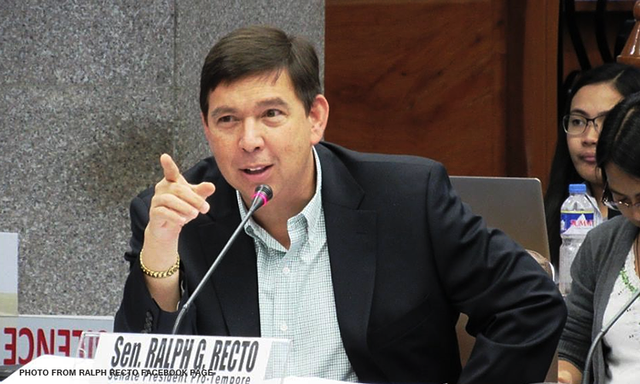
Senate President Pro Tempore Ralph Recto made the announcement in a statement issued on Wednesday (August 12).
He said he arrived at that figure by dividing the proposed P50.6 billion by 1,295,056 employees in the government payroll and using 13 compensable months in a year.
“I think a P3,000 average per month increase is the floor being sought,” Recto said. “And I have to stress the fact that I am using an average here. It may not also be uniform kasi iba-iba ang rates ng sweldo [because they have different salaries], Recto said.
“Secondly, I am assuming a January starting date. So if the increase would take effect July, then we’re looking at an average P6,000 monthly adjustment. Kaya nga maraming variables [So there are many variables].”
The Palace has not said anything about the particulars, which lawmakers would still have to tackle when they deliberate on the bill.
Implementation may be in phases
The proposed pay hike, he added, might just be “the first installment of a bigger pay adjustment that will be implemented in phases.”
This, he recalled, was similar to what happened to the initial implementation of Salary Standardization Law (SSL) III: “The public sector pay guide in current use was spread out over four years.”
According to Recto, Budget Secretary Florencio Abad confirmed before senators on Wednesday that his agency was drafting an SSL IV based on a commissioned study on the state of public sector pay.
Recto urged the Department of Budget and Management to submit the bill as soon as possible so it could be tackled “in unison” with the national budget.
“You can’t divorce the two,” Recto said. “Twenty-seven centavos for every budget peso in 2016 is for PS,” Recto said.
PS stands for personal services, a budgeting term for the “pay, perks, and premium contributions of government workers and the pension of retired uniformed personnel.”
Lawmakers would have to consult stakeholders, particularly government employees, on the proposal, he said.
Funding would, of course, be a key issue.
“It is easy to pick a figure,” he said. “The challenge is to raise the cash to fund the increase.”
Prioritizing workers at the lowest level
Government expenses for personal services will rise from the current P745 billion to P810 billion, Recto pointed out.
In 2010, when President Benigno Aquino III started his term, PS expenses amounted to P457.6 billion. So by 2016, with its projected P810 billion, PS costs will have grown by 77.2%.
“We’re going to spend P2.2 billion a day for PS next year,” he said.
The priority for the hike, he stressed, should be teachers, policemen, firemen, and soldiers, because these workers account for 80% of the government work force.
These are mostly workers at the lowest level, under Salary Grade 11 to 13 brackets, with a basic monthly pay ranging from P18,549 to P21,436.
“These are the people who are in need of a salary hike,” Recto said.
The government’s Compensation and Position Classification System, he explained, has 33 salary grades, each grade with eight steps — except for Grade 33, which is occupied only by the president.
“So there are a total of 257 pay categories which must be studied and adjusted,” he said. “There must be distinctions and differentiation between and within the salary grades.”
“What makes the job harder is that all of these 257 pay categories must be accommodated within a ceiling, which at present is P120,000 a month — the salary the president gets.”
At the lowest level — that is, Salary Grade 1, Step 1 — an employee gets a monthly salary of P9,000.