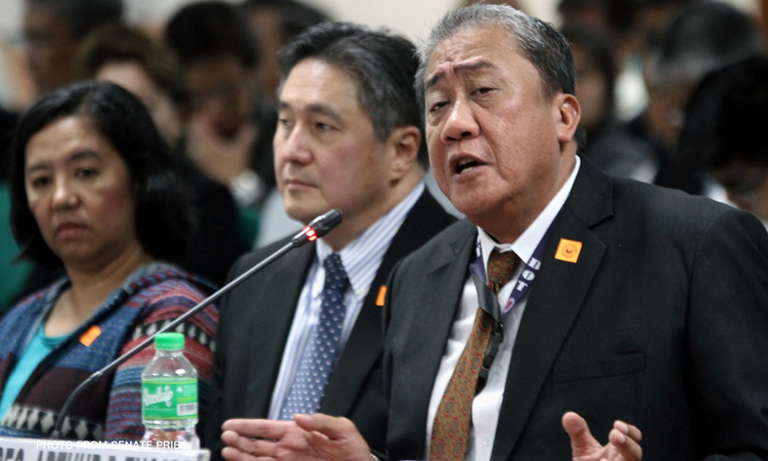


Metro Manila (CNN Philippines) – Senators, Transportation Secretary Arthur Tugade and heads of various transport agencies met in a hearing Wednesday to discuss giving President Rodrigo Duterte emergency powers to address the country’s worsening transportation problems.
Senate Bills No. 11 and 154, filed respectively by Senate President Pro Tempore Franklin Drilon and Senator JV Ejercito, both grant the president the authority to go around standard bidding and procurement procedures under Section 10 of Republic Act 9184 or the “Government Procurement Reform Act.” The proposed measures also prohibit restraining orders against transportation projects unless issued by the Supreme Court.
In her opening statement, Senate Committee on Public Services chair Grace Poe said that although emergency powers – which President Duterte requested from Congress in his State of the Nation Address last month – will allow the Executive branch to quickly implement much-needed transport solutions, these must be subject to very strict guidelines like Freedom of Information (FOI) regulations to prevent abuse.
Read: Emergency powers must be FOI-compliant
“The FOI rule must permeate and penetrate all activities, contracts, projects, biddings, documents, awards, payments made pursuant to the act of granting emergency powers,” she said.
Poe also said projects implemented through emergency powers must not only provide the best deal to the taxpayers, but also be specific and time-bound.
“There must be no hidden costs, or undeclared conditional debts that will be passed on to several generations,” she said. “We will not go for vague powers or blank checks. I assure you there will be elbow room and wide latitude given but not wide enough for thieves to sneak in.”
Temporary and transparent
Responding to Senator Poe, Tugade said he will ensure that all projects implemented through emergency powers will be completely transparent and will not last longer than two years.
“I give you my word, whatever we do, not only in relation to the emergency power, we shall be FOI compliant,” he said. “I stand on the spirit of accountability and transparency. It shall be done.”
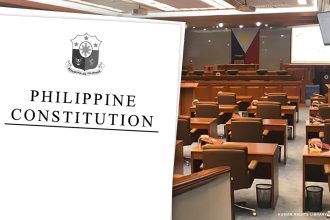
Drilon meanwhile said under the Constitution, Congress could grant emergency powers for up to three years.
Beefing up public transport
Tugade said a synchronized and uniform traffic system managed by a single entity reporting solely to the president will help reduce conflicts between the national government and local-government units (LGU) in terms of implementing traffic rules.
In addition, DOTr Undersecretary for Roads and Infrastructure Anne Lontoc presented solutions to lessen traffic congestion in Metro Manila. These include:
Prohibiting bus terminals along major thoroughfares
Rationalizing public-utility-vehicle routes
Encouraging car drivers to commute
Developing an alternative transport system, which includes cable cars, double-decker buses, point-to-point buses and cargo rail transport
Lontoc also said emergency powers would allow them to fast-track the procurement of 6.7 million driver’s licenses and 5.4 million license plates in backlog, the latter of which are still subject to a temporary restraining order and a notice of disallowance by the Commission on Audit.
Decongesting NAIA
Both Tugade and DOTr Undersecretary for Air Sector Bobby Lim told the senators that emergency powers will be needed to redistribute flights out of Ninoy Aquino International Airport (NAIA), a move they said will greatly lessen congestion there.
Lim also said the powers would allow them to purchase much-needed aeronautical equipment at NAIA, as well as transfer general-aviation aircraft to other airports.
Better rail-sector supply chain
Finally, DOTr Undersecretary for Rail Noel Kintanar told senators how the regulations that only allow annual procurement has caused a very serious supply-chain problem in the rail sector, leading to a lack of spare parts that would keep trains running.
He said the emergency powers would allow them to establish a long-term supply-chain relationship with train manufacturers, thus allowing them stock up on spare parts early before the manufacturers phase the components out.
In addition, Kintanar said the powers would greatly help in reducing delays caused by temporary restraining orders from losing bidders and to plan ahead when building train depots by asserting government right-of-way.
Poe hopes to pass an emergency-powers law before they go on Christmas break in December by holding at least two sessions a week.
The next hearing will be on August 24, where the senators will talk to other government agencies like the National Economic Development Authority and the Department of Public Works and Highway, as well as members of the transport sector.