

Manila (CNN Philippines Life) — Growing up Catholic taught me to be very creative with contraband. Back in high school, we had these awful uniforms that were good for one thing: sneaking books into the pockets. A book was the only thing I could bring to First Friday Mass that wouldn’t get me into too much trouble but would tide me over through the long homilies. While my classmates compared “studio pics” (professionally shot group portraits of barkadas that had been all the rage at the time) or discussed the next fair at a nearby all-boys school, I buried my nose in a book.
And when I had nothing new to read, I always brought any of my copies of Meg Cabot’s “The Princess Diaries” books (all seven of them, at that time). I didn’t mind reading them out of order, as if starting a conversation mid-sentence. It always felt like catching up with an old friend.
I don’t know what I found so compelling about the story of Mia Thermopolis, a young misfit who finds out that she’s the heir to a fictional European throne. She had a lot of things I wanted to have (such as a tiara) and a lot of things I did have (such as weird friends and a crazy grandmother). I may not read “Diaries” as often as I used to, but I still do once in awhile, especially the latter books in the series. (I tried to read the very early books, and I actually cringed, as though I were reading my own horrid blog in 2003.) Whenever I want it to keep my company in the background, I play the first film adaptation, also titled “The Princess Diaries,” while hunched over my work, like an old crone who listens to AM radio at five in the morning.
Produced by Walt Disney Pictures and written by Gina Wendkos (whose notable writing credits include the cult guilty pleasure “Coyote Ugly”), the film version unsurprisingly has a much lighter, more family-oriented story. That it does largely has to do with the fact that it was directed by the late Garry Marshall, who was known for the kinds of movies that have potentially darker themes but end as fairy tales. (See: “Pretty Woman,” in which Julia Roberts plays a hooker who fights for her right to shop in thigh-high boots on Rodeo Drive. Roberts’s character was originally meant to have a more realistic ending, but Marshall fought to end it on a happier note.) His take on “Diaries” is no different. He spun it into a more touching, heartwarming story (to which Mia’s father’s death is key, as opposed to the books, in which her father is very much alive) with the help of a pretty stellar cast, including the great Julie Andrews.
When I had nothing new to read, I always brought any of my copies of Meg Cabot’s “The Princess Diaries” books (all seven of them, at that time). I didn’t mind reading them out of order, as if starting a conversation mid-sentence. It always felt like catching up with an old friend.
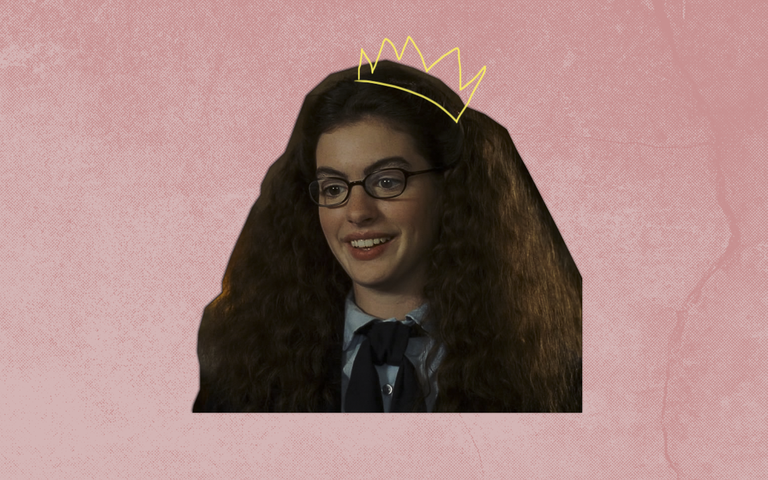
The then newbie Anne Hathaway might have been too pretty to be Mia (who took more than a few books to grow into her looks), but she pulled it all off with a lot of well-acted discomfort. In frizzy hair and unflattering glasses, Hathaway’s star-making take on Mia churned lines like, “Shut up!” or “I can’t be a princess! I’m still waiting for normal body parts to arrive!” to represent the collective consciousness of puberty. Even when Mia got a makeover, Marshall managed to demonstrate that she was still her awkward self underneath the makeup. This was especially apparent when she first revealed her sleek hair and polished look to her outspoken best friend, who accused her of looking like a popular girl wannabe.
Granted, Marshall made sure that Mia didn’t get shortchanged in the love department so we nerds could live vicariously through her. The actor Robert Schwartzman played her love interest, Michael Moscovitz, and fulfills the book character’s trifecta of hot, smart, and Jewish. (Schwartzman also seemed like the perfect Michael because he had real-life cool points as the lead vocalist of the rock band Rooney.) Unfortunately, Marshall and the cruel gods of cinema replaced him with Chris Pine in the film sequel, “The Princess Diaries 2: Royal Engagement,” probably for fear that Schwartzman’s subculture hotness would threaten the world order. Chris Pine, to this day, remains generically good-looking.
While one can objectively say that “The Princess Diaries” merits no legitimate awards as either a book or a movie, it remains to be an empowering force for me — both as a writer and as a person. When it comes to work, I consistently cite “The Princess Diaries” as one of my main influences, along with Bridget Jones’s potty mouth. It’s a good mix, I suppose, of fantastical optimism and the occasional battle between StairMaster and Jägermeister.
In more personal terms, I learned to appreciate imperfection as a source of humor rather than an unattainable standard of happiness. Mia might have been painfully shy and despised her lack of cleavage, but she was still herself. She would’ve loved to write furiously in her journal or pass notes to her best friend if forced to go to a school-sanctioned Mass. I suppose that emboldened me to sneak in a book whenever I could all those years ago. If she could be OK with herself, I guess I could too.