


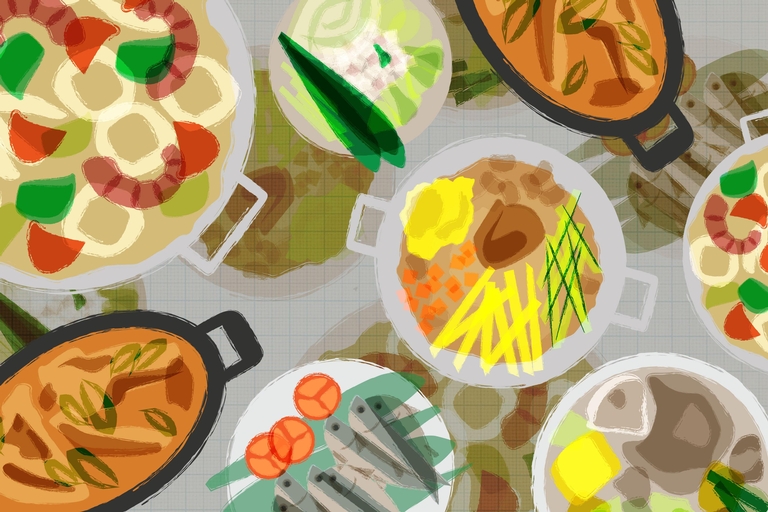


Manila (CNN Philippines Life) — The first time I did a food crawl was in 2009. In the golden city of Salamanca, Spain, we hopped from one tapas bar to another, nibbling tortilla de patatas and jamon iberico and downing them with sweet, intoxicating wine, all the while learning a little bit of Spanish. Elena, our red-haired guide in cheerful pigtails, led the way, both in speech and dégustation.
In Spain, food crawls — usually tapear (“to have tapas”) — are part of the culture as is having afternoon siesta or sangria with one’s meal. In the Philippines, we don’t do food crawls — not really — but we call them “food trips.” The distinction, as of now, is not clear. Is it because in Spain, the crawl is more leisurely and relaxed, a fitting end to a long work day? Or is it because in the Philippines, to hop from one place to another to find new things to eat is a journey in itself, and not merely an ending?
In any case, the Philippines does not lack places where one can embark on such kinds of culinary journeys. Just outside of Manila is Tagaytay, home of Taal Lake (and the tawilis within) and hot, savory bulalo. Citizens of the city must have perfected the art of brewing the comforting soup as a necessity when temperatures drop too low. The cult favorite for the best bulalo in town, I was told, is Green ATS Bulalohan and Restaurant — but on a cold mountain morning, one cannot go wrong with the basic version in Amacena, the first in a six-stop food crawl with a tight-knit group of food crawlers in Manila.
The first thing you have to remember about a food crawl is the need to pace yourself while eating, as you would in a buffet — take only measured bites.
The first thing you have to remember about a food crawl is the need to pace yourself while eating, as you would in a buffet. Don’t eat too much in one restaurant; take only measured bites. So in Amacena, we took only spoonfuls of everything that’s good, among others: the creamy dinakdakang chicharon (a yellowish, crispy sisig) and the sizzling bulalo, served on a hot plate, the beef still oozing smoke. The beef, says the chef, is sourced locally, as it should be: Batangas beef is supposed to be one of the best-tasting in the country.
Between gulps of the piping hot bulalo in the bowl and bites of sizzling bulalo in a hot plate, to “pace myself” was a tip I forgot to take to heart. (The roast chicken in Amacena was also good.) By the time we reached Taaleña, a homey, spacious, Barrio Fiesta-style restaurant which had a great view of the lake, I was just about done with lunch. But the fried tawilis and crispy crablets were too good to pass up: the tawilis, a small local sardine, is paid homage to by visitors, and most swear by the crablets that came in attractive mounds on our table. The saving grace came in the form of a companion bringing out a good bottle of white wine. Food crawl tip number two: a glass of wine is a good idea, and helps you eat less if you plan to eat all day. (Maybe the Spanish got it right with their generous servings of wine along with their tapas.) The wine, incidentally, helps one warm up a bit in the chill of the Tagaytay air. And white wine pairs quite well with crab and fish.
There were four stops to go.

In 1st Colonial, I chose to simmer down and to satisfy myself with some ice cream. But the restaurant — if you’ve been to the branch in Naga — serves some of the weirdest ice cream flavors locally, the most outrageous of which is its sili ice cream, which comes in three spice levels, and one called the “volcano,” which is supposedly the most explosive ice cream of them all. Having tasted the basic sili ice cream in Naga before, I tried the volcano. It’s the ice cream version of spicy laing and is surprisingly delectable, though of course it might not be for everyone.
Just across 1st Colonial is Balay Dako, which means “big house” in Negros, modeled after large family homes in Bacolod. In Balay, the emblematic Taal view is even more breathtaking: the second floor, especially, is a fitting frame to the majestic greenery of the mountain that rolls down to reach the small fish pens below. To be in Balay is to inhabit Sunday afternoons in your grandparents’ house, or those precious few seconds in the morning, set in slow motion, before the day stretches its arms and starts to set down to work. It’s one of the most beautiful, frozen-in-time restaurants I’ve been to.
The view and the ambiance was punctuated by a seafood paella made more malinamnam with taba ng talangka (crab fat), which flavors the rice so richly that one has no need for the meat. Not to be missed is the kansi, a cross between sinigang and bulalo, soured with batwan and laced with atsuete oil, with hefty hunks of both pork and beef. We left Balay as it was nearing sunset.
A glass of wine is a good idea, and helps you eat less if you plan to eat all day.
In a Tagaytay side street, we stumbled onto Lime and Basil, a Thai restaurant which looks like someone’s garden home. A large tent was being set up at the front yard as we arrived, and inside are wide splashes of purple and mauve, five golden plates installed as a cross in the wall, and an illustration of three elephants made of grass. We had pad thai, assembled ground pieces of chicken with some vegetables to form rolls, and dipped several shrimp blankets in plum sauce. A bottle of red wine was being passed around.
Night fell. In Bowstring, the last stop which is near the rotunda, a few drinks were had and a few glasses raised. There was pho-lalo — a portmanteau of Vietnamese pho soup and native bulalo — and Thai buffalo wings, glazed with Sriracha honey butter sauce, to have last-minute bites on.
To eat and digest food from six local restaurants for 12 hours is no mean feat, and Filipino fare, in terms of size and serving, are not tapas. But one needs only to take bites, which is the beauty, I think, of a food crawl: a glimpse of how life would look like if everything was made new, a taste of strange and familiar food for the passing moment, and essential, temporal connections made with people you may never meet again, if not for the love of food.