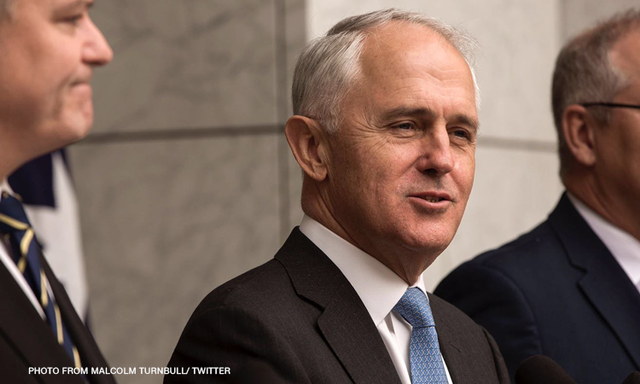


(Reuters) — Australia’s Prime Minister Malcolm Turnbull said on Monday (November 14) that resettlement of the 1,200 asylum seekers on Papua New Guinea and the tiny Pacific Island of Nauru to the United States will begin after President-elect Donald Trump has assumed office.
Whether Trump honors the deal Australia reached with the outgoing Obama administration, and announced earlier this month, will provide an early test of Trump’s anti-immigration stance.
Campaigning for the presidency, Trump had started by advocating a blanket ban on Muslims entering the United States, but later adjusted his stance to propose that the ban should apply to people from nations that had been “compromised by terrorism.”
Turnbull said on Sunday (November 13) that the United States had agreed to take a “substantial” number of those held on Manus Island and Nauru. Many of them are Muslims who have fled conflicts in Iraq, Syria, Afghanistan, and Pakistan.
“The process will continue for some months, it’s not something that the United States won’t be short-cutting their security or health checks, but they have to begin and the U.S. officials will be arriving in Australia, and then going to Nauru, in the course of this week they will be arriving in Australia,” he said on Monday, adding:
“So we have a very long history of cooperation with the United States where we, in matters of this kind, where we are able to pursue our mutual and our respective humanitarian and indeed, national security objectives.”
Under Australia’s tough border security laws, asylum seekers intercepted trying to reach the country by boat are sent for processing at the camps on Papua New Guinea’s Manus island and Nauru.
The resettlement deal with United States came after Turnbull’s government agreed in September to accept people from Guatemala, Honduras and El Salvador as part of Australia’s annual intake of 18,750 asylum seekers, to support a resettlement plan for Central Americans drawn up by Washington.
Over the weekend, Trump said his administration would deport up to 3 million immigrants in the country illegally who have criminal records. While campaigning, Trump said he would deport 11 million illegal immigrants.
Should Trump veto the deal with Australia, the detainees would be left with the choice of returning to their home countries or remaining in Nauru or Papua New Guinea.
A veto would force Turnbull to search for another country willing to take them while facing growing outrage both at home and internationally over the treatment of the refugees.
Turnbull said he remained confident that the new U.S. administration would stand by the deal, stressing that it didn’t require any increase in the United States’ annual intake of asylum seekers.