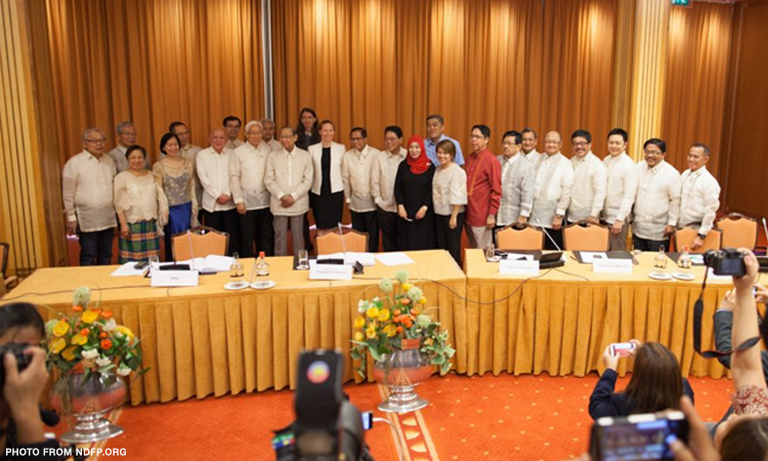


Metro Manila (CNN Philippines, April 7) — The government and communists agreed to declare a ceasefire, distribute free land and release prisoners at the end of the fourth round of peace talks in The Netherlands on Thursday (Philippine time).
The four-day talk between the National Democratic Front of the Philippines (NDFP) and the government (GRP) in the Netherlands had a “successful conclusion,” said NDFP Chief Political Consultant Jose Maria Sison.
Although both parties agreed on an interim joint ceasefire, Presidential Adviser on the Peace Process Jesus Dureza said it is not effective yet.
Read: Gov’t, Reds agree on interim ceasefire
“I think as we work towards coming up with the guidelines and the details, we are confident that both sides, in spite of the fact that there is no ceasefire in place, we will see to it that there is an enabling environment that would move us closer to what we want to achieve in this country, which is just and lasting peace,” Dureza said during his closing remarks.
Representatives from both panels will meet in the Philippines in between formal talks to finalize the guidelines, which, according to Dureza, is the challenging part.
“We have just agreed on framework agreements, but the difficult parts would be how to look at specific details. How to come up with the guidelines, how to come up with the mechanisms that will make our bilateral ceasefire and our work on the CASER really workable in actuality,” Dureza said.
Sison said the guidelines will include the “creation of buffer zones and the definition of a prohibited hostile and provocative acts,” among others.
A “ceasefire monitoring and verification mechanism” will also be provided “to oversee the ceasefire implementation and handle alleged violations.”
Sison also emphasized the Comprehensive Agreement on Social and Economic Reforms (CASER) must be signed before, or simultaneously with, the interim joint ceasefire agreement.
Giving land for free
Some of the provisions of the CASER both parties have agreed on is the distribution of land for free to landless and poor farmers with just compensation to the owners.
The panels will also work to amend the existing agrarian reform law to reflect the agreements.
Militant peasant group Kilusang Magbubukid ng Pilipinas (KMP) said specific statements should be in the final CASER document to “genuinely effect social justice.”
“One of the chief reasons for the failure of all previous programs on agrarian reform is the refusal of past administrations to distribute land to the farmers for free,” the KMP said in a statement.
One of the contested lands is the 6,000-hectare sugar plantation Hacienda Luisita in Tarlac, owned by the family of Former President Benigno Aquino III.
A 2012 Supreme Court decision has already ordered the distribution of Hacienda Luisita, but farmers have yet to receive their land.
Call for national industrialization
Sison also said moves toward national industrialization should also begin.
“The priority industries to be established to lay the foundation of the Philippine economy should be listed up, in consultation with the industrial networks and prospective Filipino investors,” Sison said.
National industrialization aims to shift the Philippines from exporting raw materials to processing them inside the country, which is believed to generate more jobs.
The NDFP and the GRP panels will meet in Manila to finalize the guidelines of the ceasefire agreement before the fifth round of talks on May 27 to June 1.