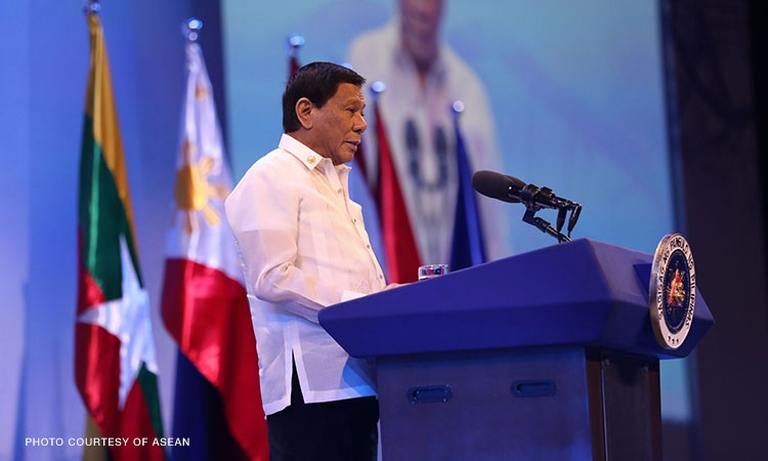


Metro Manila (CNN Philippines, April 29) — President Rodrigo Duterte stressed the importance of non-interference in his opening speech at the 30th Association of Southeast Asian Nations (ASEAN) Summit on Saturday, two days after an international human rights organization urged regional leaders to take a stand against killings in the Philippines.
“Relations bear fruit when they are based on mutual respect and benefit,” Duterte said. “Dialogue relations can be more productive, constructive, if the valued principle of non-interference in the internal affairs of ASEAN states is observed.”
Duterte said the principle of non-interference is a “cornerstone” of international law. Non-interference in each other’s internal affairs is also a time-honored tradition of ASEAN which has sometimes drawn controversy.
“The cornerstones form part of time-honored principles of international law: Mutual respect for the independence, sovereignty, equality, territorial integrity, and national identity of all nations and non-interference in the internal affairs of one another,” he said.
Amnesty International on Thursday called on ASEAN leaders to condemn what it estimated to be 9,000 killings since Duterte launched a bloody war on drugs in July 2016.
Related: Amnesty Int’l urges ASEAN leaders, PH gov’t to act on bloodshed
In response, Foreign Affairs spokesperson Robespierre Bolivar said ASEAN recognizes “the sovereign right and responsibility of each country to decide on the best approach to address its drug problem, taking into consideration the context and norms of its society.”
In 1976, ASEAN adopted fundamental principles. According to the Treaty of Amity and Cooperation, the first three principles are “mutual respect for the independence, sovereignty, equality, territorial integrity, and national identity of all nations,” “the right of every State to lead its national existence free from external interference, subversion or coercion,” and “non-interference in the internal affairs of one another.”
“Relations also remain solid if all stakeholders learn to respect and value the peaceful resolution of disputes,” Duterte added.
ASEAN Foreign Ministers and officials are finalizing a framework for a code of conduct with China in handling rival claims in the South China Sea. The framework is expected to be finished by June.
“In an era where there can be much uncertainty, we must faithfully adhere to the supremacy of the law and rely on the primacy of rules as responsible members of the international community,” Duterte continued.
Duterte’s reference to recognizing “the supremacy of law” echoes a phrase supposedly used in a draft of the ASEAN Chairman’s statement on South China Sea.
However, the reference has since been dropped from the draft statement on the request of China, who understood this to refer to the arbitral tribunal ruling that favored the Philippines’ claim over the contested islands.
The next ASEAN summit will be held in Clark, Pampanga from November 10-14. Apart from ASEAN heads of state and government, the second summit also expects leaders from Japan, South Korea, Russia, United States, New Zealand, China and Australia.