




Manila (CNN Philippines Life) — A Michelin star is one of the greatest awards a restaurant can receive. These stars are given according to the Michelin guide, the Bible of all dining guides, as people in the food industry call it. The guide was originally made by the French company Michelin in 1900 to boost the demand for cars and tires, by providing French motorists and drivers useful information on where to change tires and where to eat. And back then, it took you days to change tires.
As Michelin guides were being made for other countries, and more restaurants around the world were being recognized by it, more chefs strived to get stars, in hopes of changing their restaurants’ fate. One star means that the restaurant is very good in its category, two stars say that the cooking is excellent and the place is worth a detour, while three stars stand for exceptional cuisine, and that the restaurant is worth a special journey.
“During that time, there was a lot of flak given to the Michelin guide, saying that, how come you’re only awarding Michelin stars to restaurants that have white linen, 300 dollar or 300 euro-cost per table — how come? That was an issue,” says Filipino-Chinese entrepreneur Eric Thomas Dee, the managing director of Foodie Global Concepts.

At that time, a humble dim sum restaurant was beginning to attract the palate of the people of Mongkok in Hong Kong. Alongside Chef Leung Fai Keung, Chef Mak Kwai Pui — formerly of the prestigious three Michelin-starred Lung King Heen restaurant in Hong Kong’s Four Seasons Hotel — opened Tim Ho Wan in 2009. It was a 20-seater space where people fell in line for two hours and ordered from the get-go. Re-orders were not allowed.
Tim Ho Wan has since then been praised for its promise of “affordable luxury.” A year after it opened, it earned its first Michelin star. This was how the Michelin guide reacted to the “flak” it drew, says Dee, “by awarding its first ever most reasonable Michelin star in the world to Tim Ho Wan.”
A Singapore business group approached Mak to help him expand the restaurant to other countries, and it wasn’t long before Foodie Global Concepts, Dee’s family business, built a franchise in the Philippines. Dee took on the task of managing it. Tim Ho Wan now has several branches in Manila, with its latest located at Uptown Mall in Fort Bonifacio.


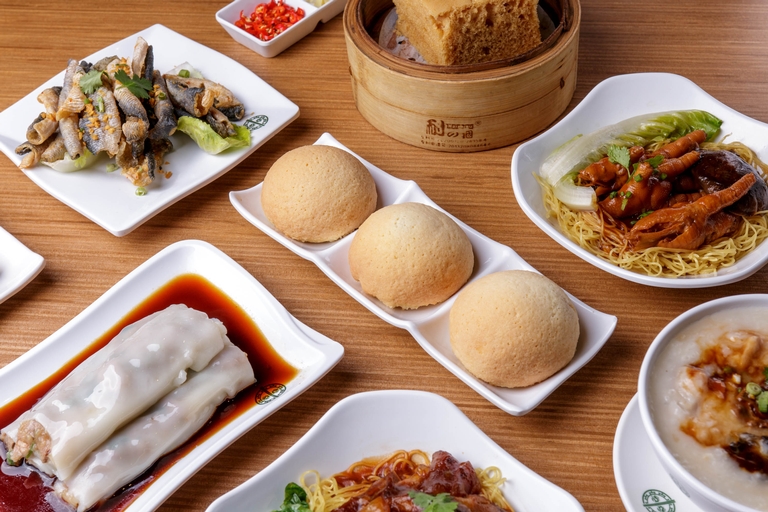
“The pork buns really got me,” says Dee, remembering the first time he visited the original Tim Ho Wan in Mongkok. He tells that the pork bun is done in a special way wherein it’s light and fluffy, and is one of the restaurant’s “Big 4 Heavenly Kings,” along with the pan fried radish cake, the steamed egg cake, and the vermicelli roll with pig’s liver, which Dee describes as “tricky.” “The tricky part of vermicelli roll is being thin enough that it melts in your mouth, but being strong enough that it doesn’t break through your chopsticks,” he says.
Tim Ho Wan’s menu is straightforward, offering typical dim sum material “but the way [the restaurant does] it [is through] execution excellence — there’s only a few components in the dish, but just focusing on making it perfect,” says Dee. “Gone are the days where you have 20-page menus or 150-item menus. Now, this one’s 25, but 25 done right. Now, we’re moving from quantity to quality.”
Putting an emphasis on quality is how Tim Ho Wan balances its goal of affordable luxury. Dee elaborates, “We give you all the luxuries of a nice restaurant but with an affordable price.” Dee also takes pride in how the restaurant bridged the gap between cheap street dim sum and expensive hotel dim sum. “When Tim Ho Wan came, it was a game changer, because it was the only one that actually elevated dimsum. Before, your dimsum was kind of like in kiosks, the small Chinese stores. This one was able to bring it to the mass.”

Among the many challenges of putting up a franchise, Dee welcomes the task of localizing Tim Ho Wan to fit to the Filipino palate. For instance, “Tim Ho Wan originally don’t allow us to sell rice,” he says. “Most of the Tim Ho Wans don’t have the spare rib rice, they only have the spare rib. And this is the most sikat meal as far as dimsum is concerned for Filipinos. We are the only one that actually has spare rib rice in all the Tim Ho Wans in the world. And that was specifically done for the Philippines.”
Aside from the pork bun and the spare rib rice, Dee says that Filipinos also mostly order siomai and hakao, which are also his personal favorites. He says, “I [may] look as Chinese as hell, but I was born and raised here. I’m very Filipino so I tend to follow what the Pinoys like to eat. I’m definitely a siomai person, a hakao person.”
The Tim Ho Wan in Uptown Mall is special in the sense that it is the only branch open until 3 a.m. For Dee, this is a matter of localizing further, in line with Fort Bonifacio’s growing nightlife. Around the area, there are nightclubs and BPOs, who flock to the dim sum restaurant for a midnight snack or a nightcap. Dee says, “Eventually, we’ll open 24 hours.”
***
Tim Ho Wan is on the ground floor of Uptown Mall, 36th Street corner 9th Avenue, Fort Bonifacio, Taguig. For more info, check out Uptown Bonifacio on Facebook, Instagram, and Twitter.