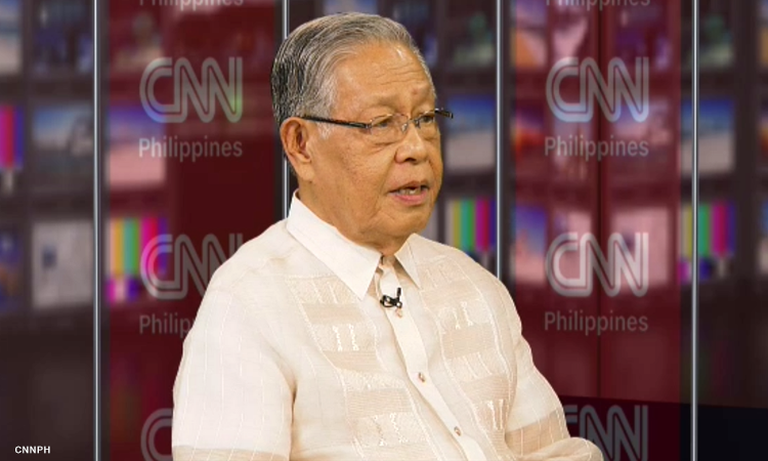


Metro Manila (CNN Philippines) — Implementing a federal form of government is a “disastrous move” for the Philippines, and will burden Filipinos with more taxes and bureaucracy in each region, a former chief justice warned.
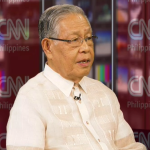
“We have never experienced federalism. Everybody is ignorant of how it will work. Even the proponents, probably, do not even understand exactly how it should work for the sake of our people,” Hilario Davide, Jr. told CNN Philippines’ The Source.
“It is therefore a disastrous move. It is what I would call fatal for the country,” said Davide.
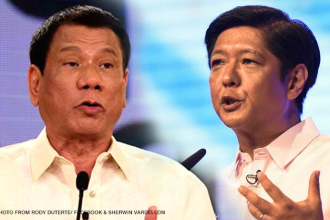
House Speaker Pantaleon Alvarez and other leaders in Congress have intensified their campaign to shift to a federal form of government, which President Rodrigo Duterte has endorsed since his campaign period.
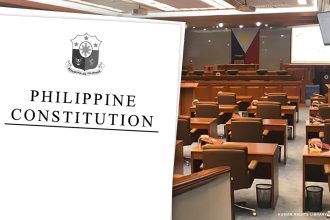
About 20 house bills have been filed in Congress calling for reviews and revisions in the Constitution. Another, House Resolution 32, calls for a study on how the law can “best be revised considering the clamor for a shift to federalism.”
Federalism, its proponents argue, can address inequality in growth across regions instead of concentrating on accumulated progress in Metro Manila.
However, its critics maintain that it could empower political dynasties even further. Skeptics of federalism also say the Philippines cannot afford it.
Related: Solons say yes to charter change, mixed reactions to federalism
Against federalism
Davide is among these critics, being one of the 48 framers of the 1987 Constitution that federalism wishes to overhaul. He also served as Chief Justice from 1998 to 2005.
He also warned that new taxes will be imposed under this new government format.
“It’s anti-poor in a sense that under a federal system, you have… to impose two kinds of taxes: a federal tax to support the federal government, and the state taxes to support each state. “
He also noted that certain government structures have to be put in place in each region.
Davide noted that the Philippines does not share the common origin of federalist nations, which usually formed an overseeing government only after being established separate states.
If the country implements the system, its evolution would happen in reverse, emerging from a central government that splits into state governments.
“This will be the only instance that one single country is divided into various states to form into a federal government,” Davide said. “The origin of federalism is [traditionally] that a group of sovereign states form together… a confederation precisely for their own benefit and better development,” he added.
“If you divide the Philippines into various territories or states, then you will be practically multiplying poor people and poor states,” he said.
“It’s not easy to maintain various states because each state will have its own constitution… its own national assembly… [and] its own judiciary,” said Davide. “[It is] burdensome.”
Implement Constitution
Davide believes that instead of changing the Constitution, the law must be properly implemented to be effective.
“We have not even implemented the majority of the provisions there, and Congress should pay more attention to its full implementation instead of changing it… to a form of government which cannot be an ideal one for the Republic of the Philippines,” he said.
Davide described the 1987 Constitution as “pro-God, pro-people, pro-Filipino, pro-life, pro-poor, pro-environment, pro-family, and pro-marriage,” and “the best Constitution for the Philippines.”
“As one of the framers of the 1987 Constitution… I would be the first to object to any attempt to change or to amend or to revise certain portions of the Constitution,” Davide said.