

Manila (CNN Philippines) — Roughly a decade after Filipino pop rock band Sugarfree tugged the heart of the nation with their tear-jerking hits, and a couple of years after their farewell concert, there is realized proof that their songs live on, taking the form of “Sa Wakas,” a theatrical play about heartbreak.
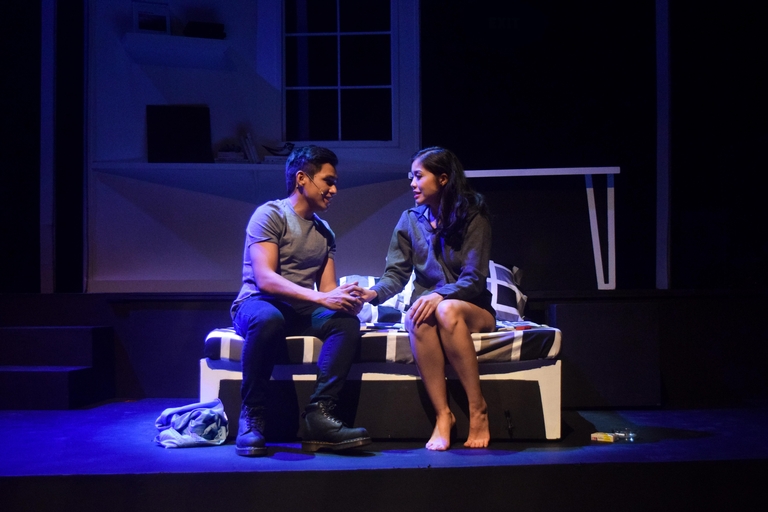
From its first run in 2013, “Sa Wakas” has been acclaimed for its verisimilitude and earnestness in portraying a love story — of a love triangle, in particular — that is far from the typical formula of Pinoy romance. The story revolves around the gradual downfall of the relationship of Topper, a budding photographer (alternately played by Pepe Herrera and Victor Robinson), and Lexi, a medical practitioner (Cara Barredo and Caisa Borromeo), as well as Topper’s lover, a magazine editor named Gabbi (Justine Peña and Maronne Cruz). The narrative unfolds in backwards chronological order, from the breakup of the relationship to its starry-eyed beginning.
And now, the musical, co-written by Andrei Nikolai Pamintuan and Mariane Abuan and produced by Charissa Pammit, is going through a restaging, with more songs, a revised script, and, as people say, more “feels.” This may be largely attributed to the orchestrified rearrangements of the songs by Ejay Yatco, the show’s musical director. This year’s rerun, he says, features live strings, an elegant jump from when Yatco first transcribed the songs by ear with his laptop, in the confines of his bedroom.

But audiences should expect the same experience of realism and the same relatable nuances that “Sa Wakas’” previous edition had, as members of the cast say. “They should expect their hearts to be broken once again,” says Robinson on CNN Philippines’ New Day. Peña adds, “I would recommend for them to bring tissue, and I say this as a cast member who still cries at every rehearsal.”
Though the restaging promises to bring more tears, Pammit says that the characters are still as “charming and vulnerable” as ever, bringing to life an honest non-black-and-white narrative that comes in different layers and hues, to make sure that like the classic songs of Sugarfree, the story hits close to home.
CNN Philippines Life talks to Pammit and Yatco about the rerun of “Sa Wakas,” the musical arrangement process, and the support they receive from Sugarfree’s Ebe Dancel himself. Below are edited excerpts from the interview.
“During the course of the backwards storyline, you realize that it’s not as clear-cut or black-and-white as you initially thought. There are a lot of factors that break a couple apart. As we say on the show: Hindi ito parang isang singaw lang na bigla na lang lumitaw.”
Why did you choose the songs of Sugarfree, particularly?
Charissa Pammit: I’ve been a big fan of Sugarfree since college when my professor, Quark Henares, did the “Mariposa” music video with a bunch of people from our class. I’ve followed them ever since and was [there for] the band’s breakup concert in Eastwood. Back in 2012, I first thought of making a musical film out of their songs, but eventually decided to stage it instead with the help of my former orgmates from Ateneo Blue Repertory. Kind of like “The Last Five Years” meets “American Idiot,” but featuring Filipino culture and characters.
Even though our inspiration was “The Last Five Years,” we wanted to do something different and decidedly Filipino — hence the urban love triangle set in Manila. But we didn’t want the characters to be caricatures that we often see in typical Pinoy dramas. We actually turn that stereotype on its head because of the inverse chronology. At the beginning of the story, you see these three characters — the two-timing jerk, the victimized girlfriend, and the kabit. But during the course of the backwards storyline, you realize that it’s not as clear-cut or black-and-white as you initially thought. There are a lot of factors that break a couple apart. As we say on the show: Hindi ito parang isang singaw lang na bigla na lang lumitaw.
Do the songs shape the narrative or do you have ways of tweaking or selecting the songs to fit the story?
Charissa: The story comes first and foremost. We think of what we want to say in a scene and find the perfect song to accompany it. That way, it doesn’t feel forced. The characters burst out into song because they couldn’t contain their feelings any longer, and what they are singing is actually what they want to say or couldn’t say.

How does the process go for arranging the original songs and translating them for the theater?
Charissa: We just gave [Ejay] the song list and he made magic out of it.
Ejay Yatco: In musical theatre, songs are treated as either dialogues or inner thoughts of the characters, so I had to rearrange the songs to fit the context of the scenes and to match the general tone of the show. Since there were no pre-existing scores of Sugarfree songs, I had to first transcribe the songs by ear then rearrange them later.
The whole story is told in reverse, so the whole score was inspired by the image of a clock turning backwards faster and faster until it breaks and the gears and springs pop out.
Does Ebe Dancel have a hand in the production or did he allow you free rein?
Ejay: Ebe drops by our rehearsals from time to time to give suggestions on how to go about the music. He recently went to our band rehearsal where he helped us with the musical treatment of “Bawat Daan.” He’s been really encouraging and supportive of our project.
Charissa: Ebe is very respectful of us and our creative process, in the same way that we’re very respectful of his music. He would occasionally show up at rehearsals so he could see the work in progress and give a note or two. But generally he’s given us a free rein with his songs, and we’ll be eternally grateful for that. When we first sent him the song list, he was surprised to see a few in there that was relatively unknown or unpopular — like “Wala” or “Ang Pinakamagaling na Tao sa Balat ng Lupa.” But when he saw how it was laid out in the story, he realized why we needed those songs.
What’s the hardest part of rearranging the songs of Sugarfree?
Ejay: I’ve been listening to musicals ever since I was a kid and I was trained as a classical pianist since I was five. So there wasn’t a single rock bone in my body until I took on this project. I would describe my sound as having a very contemporary off-Broadway feel with a Disney influence that lost its innocence.
I guess the [hardest part is the] pressure that Sugarfree has a huge fanbase. I didn’t want to disappoint their fans so I knew I couldn’t change the songs intrinsically. I had to find a way to combine my own sound with the Sugarfree flavor that everyone has grown to love.
The restaging of “Sa Wakas” features more new songs than from its previous edition four years ago. How else is it different from the original production?
Charissa: Yes, we’ve added two new songs — “Kung Ayaw Mo na sa Akin” and “Huling Gabi,” deleted some scenes that dragged down, and fleshed out the characters and the story more. Our number one question when we were doing the revisions was: “Is it real? Is it something that people would actually say or do in real life?” Because even though people don’t really burst out into songs in real life, the emotions felt whenever one listens to Sugarfree’s songs really strike your heart. And I think that’s why people have connected to this show so much.
What’s your favorite Sugarfree song?
Ejay: My favorite Sugarfree song is “Mariposa.” I had a lot of fun rearranging it because I could relate a lot to the message of the song. The arrangement for the show was inspired by raindrops.
Charissa: It’s like making me choose between ice cream or cake! [Laughs] But I would say “Tulog Na.” I cried buckets when I heard Sugarfree play that with the Philharmonic Orchestra (my dad had just passed away at that time). It’s such a tender, hopeful song that, put in the context of our story in “Sa Wakas,” breaks people’s hearts.
***
“Sa Wakas” runs until Feb. 12 at the Power Mac Spotlight Theater in Circuit Makati. For tickets and more info, visit the “Sa Wakas’” website.