

Metro Manila (CNN Philippines, December 27) — What can happen in 365 days?
The year opened with the Philippines hosting the pageant for the most beautiful ladies in the world. All year long, we also witnessed world leaders and other high-profile personalities come and go, leaving behind strengthened partnerships.
But we also saw a shooting incident that killed at least 38 people at a luxury hotel and casino, a five-month war in the South which killed hundreds and displaced thousands, and typhoons claiming lives, to cap off the year.
Surely, 2017 caught most Filipinos off guard.
Whether we like it or not, some of these events will be carried over to 2018.
Here’s a rundown on what to expect in the coming year:
Jeepney modernization
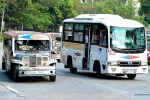
President Rodrigo Duterte, in a strongly worded speech, said jeepney modernization will roll out by January 1 — no matter what.
“January 1, pag hindi niyo na modernize yan, umalis kayo. Mahirap kayo, p***** i**, sige. Magtiis kayo sa hirap at gutom, wala akong pakialam,” he said.
[Translation: January 1, if you haven’t modernized, get out. If you’re poor, son of a b****. Wallow in your misery and hunger, I don’t care.]
The President hit jeepney drivers and operators who participated in a number of nationwide strikes to protest the public utility vehicle modernization plan replacing vehicles older than 15 years.
The new units are estimated to cost around P1.3 million each, which, jeepney drivers said, would put most – if not all – of them without a job or in debt.
“Ang winawasiwas ng (Department of Transportation or DOTr) na Omnibus Franchising Guideline ay hindi modernisasyon kundi isang iskema para makabenta ng sasakyan ang mga malalaking korporasyon,” George San Mateo, president of Pinagkaisang Samahan ng mga Tsuper at Operator Nationwide, said. “Layunin lang nitong pilitin kaming bumili ng mga bagong unit na hindi namin kayang bayaran.”
[Translation: The Omnibus Franchising Guideline being waved around by the DOTr is not modernization, rather, a system which allows huge companies to sell vehicles. It will force us to buy vehicles we cannot pay for.]
Higher take home, higher prices?
Tax reform, President Duterte said, was the government’s “biggest Christmas gift to Filipinos.”
In the package: higher take-home pay but also the possibility of a surge in the price of fuel and some sweetened beverages, among others.
The passage of the Tax Reform for Acceleration and Inclusion (TRAIN) law updates the country’s tax system and will generate income to fund several government programs like the P8 trillion Build, Build, Build infrastructure plan.
In a nutshell, it relieves lower-income earners of the burden of paying taxes, shifting it to those who can better afford to pay: those who earn P8 million and above annually, can buy cars, or want to undergo cosmetic enhancements.
The law, signed on December 19, will take effect in January 2018.
10-year passport validity
The Foreign Affairs Department will start issuing passports with a 10-year validity, instead of the current five years, starting January 2018.
Foreign Affairs Secretary Alan Peter Cayetano earlier said there will be no increase in the fee from the current P950, as the same regular passports will be issued.
There are restrictions, though. Passports of those below 18 years old will be valid for only five years, as their facial features may still change, hence the need to update their photos.
Graduation of the first batch of K-12
The first batch of mandatory senior high school students will receive their diplomas in either March or April 2018.
The K-12 program added Grades 11 and 12 to the Philippines’ former 10-year basic education program. The last two years, known as senior high school, allow students to choose one from the four strands: accountancy, business, and management, humanities and social sciences, science, technology, engineering, and mathematics, and general academics.
The additional two years, the Department of Education said, will ensure students have the “standard knowledge, skills, and competencies needed to go to college.”
The K-12 law was signed by former President Benigno Aquino in 2013.
Sereno impeachment
Chief Justice Maria Lourdes Sereno might face the same fate as her late predecessor, after seven hearings in the House of Representatives.
No less than her colleagues in the Supreme Court testified against her, accusing Sereno of going beyond her powers by creating new offices, delaying the transfer of cases against suspected terrorists, and even treason.
The Chief Justice skipped all the hearings in the House panel and delegated cross-examination to her lawyers – which the committee refused to allow.
Sereno’s lawyers want to fast-track the proceedings and bring it to the Senate, where they can “defend the Chief Justice consistent with her constitutional rights.”
The House Justice panel initially wanted to determine probable cause before Congress went on recess on December 15, but decided to push back its schedule until January.
Barangay elections
Barangay elections has been postponed twice already. Will May 2018 finally allow Filipinos to cast their votes for the leaders of the smallest unit of government?
Originally scheduled on October 31, 2016 and then October 23, 2017, barangay officials elected in 2013 are still in power, despite a three-year term.
The President postponed the elections on worries that drug money would fund local campaigns.
Bangsamoro Basic Law
After years of battling with the constitutionality of the proposed Bangsamoro Basic Law (BBL), will Mindanao finally have a Bangsamoro state?
A new version of the draft BBL, the result of the peace deal between the government and the Moro Islamic Liberation Front which seeks to replace the Autonomous Region in Muslim Mindanao (ARMM), is now up for scrutiny in both houses of Congress.
The bill addresses decades-old grievances of the Moros resulting to years of insurgency in the hope of lasting peace in the South.
Lawmakers promised a BBL which is ready for the plenary by March.
Bangsamoro Transition Commission member Maisara Dandamun-Latiph said the new version would provide for a “genuine fiscal and political autonomy,” unlike the ARMM, which only provided devolution of powers.
The proposed BBL has a history of its own: 20 years have passed since it was first initiated, and fast forward to 2015, it failed to make it through Congress after the bloody Mamasapano encounter which killed 44 elite troops of the national police.
President Duterte himself promised he will “work very hard” for the BBL, which he said was “sacred” to him.
Massive Marawi rehabilitation
After troops cleared Marawi of terrorists, the government is trying to help residents to move forward with the city’s rehabilitation.
The government initially earmarked P50 billion to rebuild the war-torn city which was left in ruins, but officials admitted the amount is not enough. Clearing operations will cost millions, and more would be needed in constructing houses.
Task Force Bangon Marawi, an inter-agency unit spearheading the effort, said the government received assistance from different countries like Canada, China, Germany, Korea, India, Thailand, Singapore, as well as organizations like the Association of Southeast Asian Nations and USAID.
Martial law in Mindanao
After the five-month crisis in Marawi concluded, the President thinks martial law is the answer to ending years of terrorism in Mindanao – hence the request to extend military rule for another year.
Lawmakers, in a joint session on December 13, overwhelmingly approved the President’s request to extend martial law again on the basis of “continuing actual rebellion,” citing “intensified” attacks of the New People’s Army (NPA), as well as a possible regrouping of alleged terrorists who remain at large.
“A further extension of the implementation of Martial Law and suspension of the privilege of the writ of habeas corpus in Mindanao will help the AFP, the PNP, and all other law enforcement agencies to quell completely and put an end to the on-going rebellion in Mindanao and prevent the same from escalating to other parts of the country,” Duterte said in his letter of request for the extension.
There was widespread opposition to continued military rule in the South, which was supposed to end on December 31. Former solicitor general Florin Hilbay said the extension was unjustified since the crisis in Marawi already ended in October.
“It is unconstitutional. There is no such thing as a preventive martial law,” Hilbay said.
Some lawmakers asked the Supreme Court to issue a temporary restraining order on the extension, saying the second extension “defies the unequivocal intent and mandate of the Constitution of having a limited duration of martial law and its extension.”
The oppositors also argued that the inclusion of the NPA as a reason for the extension could be a prelude to declaring martial law in the whole country.
The communist rebels have units all over the country. Duterte also classified them as a terrorist group in December.
Asked if he is closing the doors to a nationwide martial law given how he sees the terrorist groups, President Duterte on December 13, the same day the Congress approved the extension, said “all options are on the table.”
“There’s only one rationale there, the existence of the Republic of the Philippines. You threaten the existence of the Republic of the Philippines, I am sure that everybody will react and do what he must do to prevent it,” Duterte stressed.