


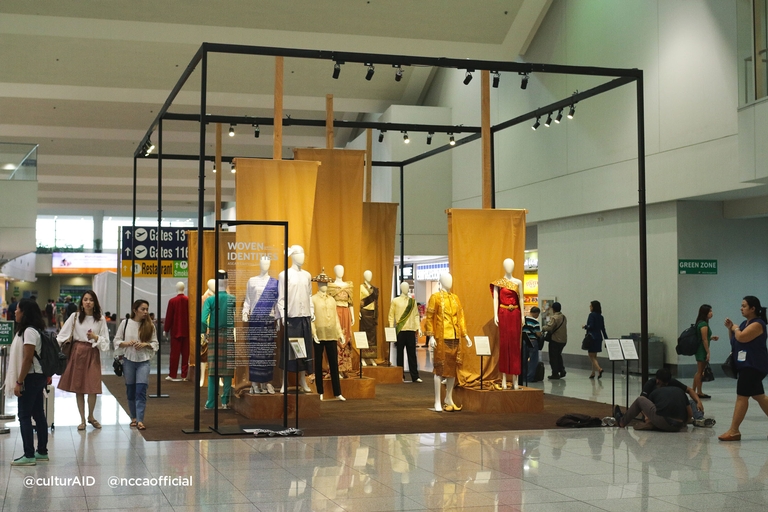
Manila (CNN Philippines Life) — The weaving tradition of the Philippines is closely interlinked with its neighboring countries. For example, the collective use of ikat or the tie-dye resist method, golden and silver threads, naturally-dyed cloths, and backstrap loom tell of a shared cultural heritage, says Charisse Aquino-Tugade of CulturAid. “Due to proximity, these nations have closely influenced each other, thus weaving techniques and modes of dress throughout this region share a common structure and history.”
CulturAid is a group that “aims to popularize and give new meaning to Philippine cultural identity and heritage.” Tugade is part of the team that put together an interactive exhibition of clothing traditions of the 10 ASEAN countries, now on view at the domestic departure area of NAIA Terminal 3. A collaboration of CulturAid with the National Commission for Culture and Arts (NCCA), “Woven Identities: Clothing Traditions of the ASEAN” is one of the many exhibitions mounted in the airport to celebrate the 50th anniversary of ASEAN and the Philippines’ chairmanship this year.
On display at the airport is a mix of traditional attires for special occasions (such as weddings) and daily wear. The exhibit highlights Indonesia’s brillliant Surakarta wedding attire; Cambodia’s traditional wedding attire made of chong kiet (ikat silk) or hol (weft ikat or twill pattern silk); Myanmar’s requisite daily wear of yinzi and paso; the ubiquitous Filipino baro’t saya; Singaporean Peranakan attire; and the royal outfits of Thailand, among others.
The exhibit is an offshoot of an earlier exhibition Tugade created in 2014 for the 47th ASEAN Day celebration, for the NCCA and Department of Foreign Affairs. “We wanted to highlight the rich woven traditions that exist within the ASEAN countries. After receiving requests, we decided to run it as a travelling exhibit for 2015,” she says. Among others, the exhibit has been mounted in various malls and other places for greater public access.
Tugade, together with The Public School Manila and Fabricca Manila, created a special design for the airport exhibit, which, in line with ASEAN’s goals, hopefully adds value to locals’ and tourists’ travel experiences. “For any country, the airport is a person’s first and last stop. Our impression of an airport influences the perception we will eventually form on the country,” she adds.
Mounting the exhibit required a deep understanding of the role each country’s traditional attire plays in society. “Depicting tribal affiliation, social status, and religion, traditional attire not only serves as ornamentation but also embodies the development and heritage of a nation and transforms an individual person into a bearer of tradition,” says Tugade. “You must do the research because every single piece of embroidery or fold means something.”
Tugade says she has visited many of these countries, and has consulted sources at the NCCA’s ASEAN library. She is also working with different weaving communities in the Philippines, including the T’boli, Ifugao, Meranaw, and Iranun. “This has helped me in understanding the wider textile landscape within ASEAN.”
If you’re not traveling or visiting the airport soon, take a look at the roving exhibit here:


