
Manila (CNN Philippines Life) — What Asian horror cinema seemed to understand a lot better than Hollywood horror ever will is that fear is irrational, and that the more irrational things get, the more terrifying things are.
The pull Asian horror always had with me, aside from obligatory defiance to the hegemonic narratives, are the specific varieties of irrational unease that have become rough ordinance with most Asian horror cinema, one which Hollywood has nothing but disdain for. Perhaps it’s a residue from how Eastern cultures have a more pervasive, more insidious spiritual firmament than America: the spatial displacement, the overhang of dread, the dreamlike languor and casual surrealism, the often brutal lack of closure, and the gnawing sense that the supernatural was a matter of fact.
Asian horror isn’t above solving its own mysteries, but Hollywood horror seems in the grip of a compulsion to constantly whip the mask off the monster to reveal a backstory: Indian burial grounds, Scooby Doo endings, whistling past graveyards, all that.
Western critics gregariously upheld the heady, volcanic surge of Asian horror films in the 90s as a “new wave” poised to rehabilitate and reinvigorate the genre, even if the exaltation smacked of hegemony and hubris, if only for the implication that Asian horror had somehow “caught up” and that Hollywood was somehow “in charge” of the genre to waylay it — circumventing the fact that Asian horror has been trumping Hollywood horror for decades, and still does. Arguably, the two 90s horror films that game-changed the genre didn’t come out of Hollywood — Myrick and Sanchez’s “Blair Witch Project” and Hideo Nakata’s “Ringu” — and most post-90s horror films run on the modified engines of either of these two films, and oftentimes a confluence of both.
Japan, Thailand, and Korea have been undergoing fluctuations in quality since. The combined outputs of Hong Kong, Malaysia, Vietnam and Indonesia are still occasional at best. The Philippines, meanwhile, remains stupidly, stubbornly determined to bash out the same old wine without even bothering to put it in new bottles, with mainly vengeful spirits terrorizing young actors, for some of whom no amount of workshopping can make them worthy of being called one.
Despite this, Asian horror cinema is still an embarrassment of riches, if you know where to look and what to look for. The list below is meant to be a spanner in the works, throwing props long overdue and much deserved, but is also an index of possible new pleasures.
Obviously, they barely scratch the surface, but if you’ve had it with the same-old and your curiosity is piqued by the list, here’s a few more to look up, of varying quality and flavors and temperaments: “Mystics In Bali” (H. Tjut Djalil), “Wild Zero” (Tetsuro Takeuchi), “Pasiyam” (Erik Matti), “Exte: Hair Extensions” (Sion Sono), “How To Disappear Completely” (Raya Martin), “The Red Shoes” (Kim Yong-gyun), “The Forbidden Door” (Joko Anwar), “Pridyider” (Rico Ilarde), “Salvage” (Sherad Sanchez), “Matangtubig” (Jet Leyco) , “Dream Home” (Pang Ho-cheung) and “Noroi” (Koji Shiraishi).
“Akuma Tantei” (“Nightmare Detective”) by Shinya Tsukamoto
“Akuma Tantei” (2005) pivots on the pulpiest of setups: an emotionally crippled and borderline suicidal young man who has the ability to walk into people’s dreams and somehow fix them, is recruited by the police to thwart a creepy serial killer who has the ability to walk into people’s dreams and coerce them into suicide. The surprise here is not that Shinya Tsukamoto would take on such relatively straightforward material. Nor is it in the way he finds much to mine within the parameters of his outlandish premise, and not least being its discomfiting overlaps between waking life and dream state. But rather, it’s the fearful symmetry he strikes between his usual transgressive surrealism and his newfound pop efficiency. Tsumakoto, of course, also made the Tetsuo movies, which is to say that the few times he does, he makes the sort of superhero movies we deserve: deranged, chaotic, resonant, thrilling as fuck.
“Di Ingon ‘Nato (Not Like Us)” by Brandon Relucio and Ivan Zaldarriaga
“Di Ingon ‘Nato” (2011) is rough around the edges, sure, but one can argue that it’s more appropriately primitive because of it, given how everything hinges on its transposition of first world zombie tropes into far-flung third world boondocks, where people get around on cheap mopeds, an under-manned and under-equipped clinic passes for a hospital, combat-readiness boils down to jungle knives and single-shot rifles, and no one knows zombie lore enough to go for a head shot.
The zombies here are not the undead of legend, the sort these superstitious folk have names for and dispatch with magic, but rather the ones borne of contagion, the sort these medically naïve folk can’t quite fathom. The first half, set in a remote forest, is all bucolic desolation; the second, almost meta-recursive apocalyptic desperation. For all their social-realist pontifications, there may not be a single poverty porn indie that has tapped as potently into how fatally ill-prepared we are for calamity quite like how this under-seen zombie riff has.
“Marebito” by Takashi Shimizu
No pun intended but I slot “Marebito” (2004) in here, grudgingly, if only because its nonchalant misogyny still bugs me, and also because it is a terribly flawed and terribly shallow work, one I hesitate to recommend heartily. Approach with caution, then. After thrashing this the first time I saw it, calling Takashi Shimizu the Gore Verbinski of J-Horror of all things (though I’m not sure if that’s unfair to Shimizu or to Verbinski), I might actually prefer the film’s Lovecraftian dissonance to the routine spookiness of his beloved, and certainly more polished, Ju-on/Grudge films. The anxiety and displacement evoked by the subterranean world that the perverted cameraman hero stumbles on remains every bit as distressing as the last time I couldn’t take my eyes off it.
“Pascalina” by Pam Miras
Pascalina, the eponymous social klutz, is a fuck-up of the poignant sort, well-meaning and down on her luck. Her aunt, who is dying and may or may not be a monster, is the only one who loves her enough to say it.
Pam Miras tends to rub her fluency with the genre against her bigger fish to fry, harnessing horror tropes to slant the realities she wants to confront at an angle, for a view that’s oddly purer and truer the more heightened it gets. Shooting with a toy camera comes off as outlaw impulse at first blush, but the jittery muck it attains becomes both verisimilitude and metaphor, elucidating the dance her stumblebum heroine does with the devil she knows, as she comes into her own by springing the catch on her own secret monstrosity. The film won a Best Picture prize at the 2012 Cinema One Originals awards, then all vanished without a trace. That’s one way to boost your underrated stock; another is to be as good a debut feature as it is.
“The Unseeable” by Wisit Sasanatieng
“The Unseeable” (2006) is atypical Wisit Sasanatieng, but only if you go by the velocity with which his candyland visuals ran riot in his last two films before this. But look at “Tears of the Black Tiger” and “Citizen Dog” again, and you realize what he really has a knack for is the way he twists over-familiar environments into weird off-key shapes, like balloon animals. This traditional ghost story is a lot more sedated, the mood dripping rather than shouting, but that’s mostly because ghost stories are supposed to get by on the sedated drip of mood alone. The gorgeous crumble of that haunted countryside manse, and its sprawling garden, may be a calmer palette than what we’re used to from Sasanatieng, but it is every bit as florid and intoxicating an artifice as any he’s ever manipulated, oldfangled but thick with feed.
“Uzumaki” by Higuchinsky
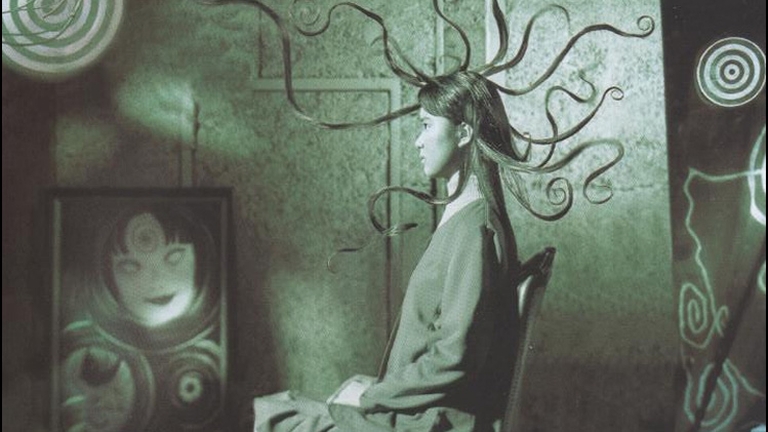
Lazy as it sometimes is to brand horror manga artist Junji Ito as the ‘Japanese Lovecraft,’ it’s also rather apt, right down to how much of a bitch it is to adapt his work to film. Those ubiquitous Tomie films, about a dead schoolgirl who regenerates over the centuries to wreak all manner of revenge, often feel homogenized, and as gorgeous as “Kakashi” was (made into a film by Norio Tsuruta in 2001), it was a little too complacent, even for a film about haunted scarecrows. Higuchinsky’s adaptation by way of “Uzumaki” (2000) is by far the only film taken from Ito’s work that perfectly nails all his potencies: the bleak nihilism, the demented strangeness, the psychedelic rot. This film is about a seaside town driven mad by an invasion of spirals, and there really is no way to approach any work that boils down to that synopsis except to take it literally.