


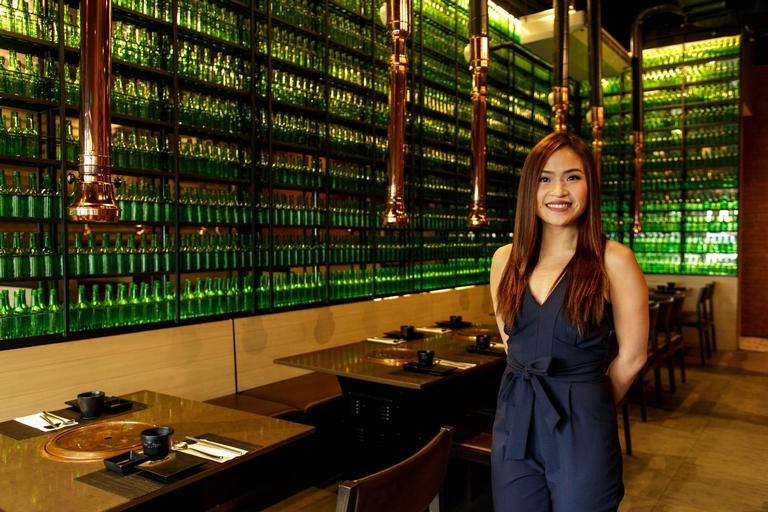


Manila (CNN Philippines Life) — Soju bottles, bricks, and birch trees — these were the things that caught the eye of Filipino-Chinese entrepreneur Karen Kho, when she stumbled upon a sleek-looking barbecue restaurant in Seoul, Korea. “We were just traveling,” she said. “I was traveling with my family for a business trip, and we stumbled upon Maple Tree House,” once a “quaint small house in Seoul,” and now a “must go” premium barbecue destination in South Korea. But when Kho tasted the food, that’s when she knew that she had to bring the experience back home to the Philippines with her.
Now, calmly situated on a street corner in Uptown Bonifacio in Fort Bonifacio, Taguig, Maple Tree House takes on another form: Namoo House. “We’re the first international franchise,” Kho says.


Like its parent restaurant, Namoo House is far from quaint and has adopted the same modern, industrial feel. The smooth leather couches lie beneath the glossy, green wall of Soju bottles sweeping across half of the room, giving everything a bright sheen, reflecting the brass exhausts that hover over the charcoal grillers at the center of each table. Among other barbecue restaurants, it’s the only one with brass exhausts, explains Kho. “Everything is [made of] brass.” From these exhausts, one can almost hear the sound of trumpets coming out, like smooth jazz music caressing the surface of the meat on the griller. Soft and sizzling, their meats are of the highest quality.
“We serve premium meats more than anything,” says Kho. “Most of our meats are prime grade. And if you’re familiar with the levels of steaks, you’d know that it’s good quality.” Though the cost of prime is high, Kho made sure to adjust to the local profile, and that the meat gives whoever walks into their restaurant a bang for their buck. “It may be a little bit more expensive, but we made sure to pull down the price compared to Korea, because we have a lower purchasing power here.”


The prime grade meats are handled by careful hands. Kho’s team works closely with the Korean principal owners of Maple Tree House, who are “very particular with quality.” They flew in to train the staff, and especially the chef, who always makes sure that their prime rib eye, which “must always be cooked at medium,” never exceeds a minute on the charcoal grill.
Aside from the prime rib eye, Namoo House also offers marinated boneless short ribs, chopped in bite sized pieces and best eaten with chunks of pineapple, to fully bring out the flavor. The Kurobuta pork belly may be wrapped in lettuce leaves and dipped in roasted salt and sesame oil. The sides — anchovies, kimchi, spring onions, spinach, egg rolls — can be enjoyed as standalone or with the samgyeopsal. Everything may be neutralized with a healthy vegetable bowl of bibimbap, or washed down with the spicy bean paste stew, and finally, plum juice to cleanse the palate and the senses.


There’s something relaxing about how the food and the interiors interact, but it’s not just all mere luck. Though the Chinese New Year is largely about feng shui and harnessing one’s luck, Filipino-Chinese entrepreneurs such as Kho believe that it takes more than luck to build a successful restaurant. For her, it’s all about hard work and patience. “There’s a lot of things you have to consider, a lot of elements, from the chopsticks to the spoons, to the table napkins,” she says. To aspiring restaurateurs, she advises to “grab every opportunity,” and to “not let slight bumps discourage you from pushing toward whatever dream you have.”
“People who are not in this industry are not aware of how meticulous this is,” Kho says. “So you really have to be hardworking, patient … And well, in everything, you should always give your all.”
***
Namoo House is at 38th Street corner 9th Avenue, Uptown Parade, Fort Bonifacio, Taguig. For more info, check out Uptown Bonifacio on Facebook, Instagram, and Twitter.