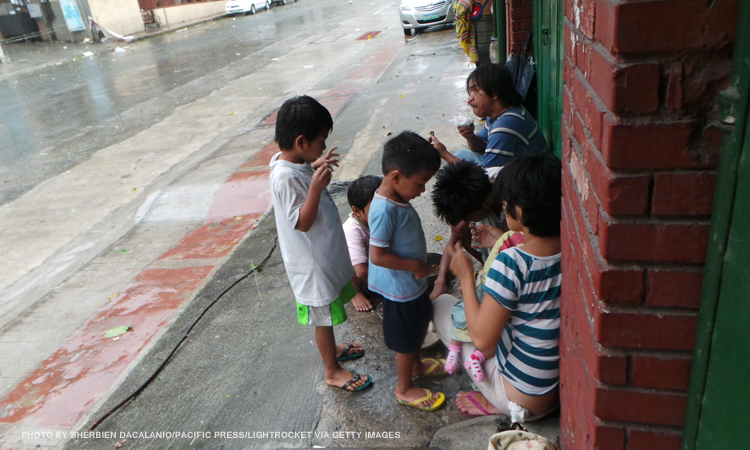

Metro Manila (CNN Philippines) — The conditional cash transfer (CCT) is only a lifeline to the poor, said a presidential adviser in a press briefing Thursday.
“Frankly, it does not really teach them how to fish, we’re just giving them the fish,” said Presidential Adviser on Entrepreneurship Jose Ma. Concepcion, III.
The CCT, otherwise known as 4Ps or the Pantawid Pamilyang Pilipino Program, was patterned in Latin American countries and was implemented during the term of former president Gloria Macapagal Arroyo in 2008.
Headed by the Department of Social Welfare and Development (DSWD), it gives cash grants to poor families provided they follow certain conditions set by the department. These include availing of pre- and postnatal care, attending family development sessions, regular check-up, vaccines, deworming and regular class attendance for children.
Director Leonardo Reynoso, National Program Manager of the 4Ps, told CNN Philippines in a phone interview, the program has 4,378,000 beneficiaries as of December 2016.
The beneficiaries can receive up to P2,500 a month, depending on their compliance with the program requirements, and the number of school children in the family. Aside from giving cash grants, the 2017 national budget also provided for a rice subsidy in the form of cash, Reynoso said.
The budget allocation for 4Ps, according to the 2017 General Appropriations Act, stands at around P78.2 billion — 92 percent of which is allocated to cash grants.
Instead of giving dole outs, Concepcion said funds should be given to those who “work hard,” and CCT should shift to entrepreneurship for the next 10 years, since the program cannot be cut overnight.
DSWD Undersecretary Malou Turalde said the 4Ps program, indeed, is not enough to alleviate poverty.
“Pantawid is only a social protection program,” Turalde said in a phone interview. “There should be different levels of intervention, and it should build up the capacity of the people to stand on their own,” she said in Filipino.
Pantawid roughly translates to “make ends meet.”
Lessening poverty, she added, should not be the sole effort of DSWD.
Even DSWD Secretary Judy Taguiwalo, Turalde said, is not for the institutionalization of 4Ps.
“Bakit ka mag-iinstitutionalize ng programa na hindi perpekto at maraming problema?” Turalde said.
[Translation: Why would you institutionalize a program that has many loopholes?]
The undersecretary said the department is currently reviewing the program while assessing how 4Ps help its beneficiaries.
“Inaaalam namin yung kasalukuyang kalagayan, kung nakatawid na, nakapagtapos na ba, at ano yung factors na nakapagcontribute. Hindi lang naman yung cash grant ‘yun,” Turalde said.
[Translation: We ask how they fare, if they have already crossed (poverty), if they have a child who has finished school, and what factors have contributed. I’m sure it’s not only the cash grant.]
The DSWD said poverty reduction measures should focus on creation of jobs and livelihood, as well as asset reforms.
This is also a point taken by Concepcion, saying the government must intervene, and shift the budget to job generation and small scale entrepreneurship. These would include programs of the Department of Trade and Industry and Department of Science and Technology.
Agriculture should also be a focus, Concepcion said, which can be done through giving small entrepreneur-farmers equipment.
“You can’t compete with the big guys who own 100, 200, 300 hectares and practice corporate farming versus a farmer who tills the land for 3 to 5 hectares. How can he compete?” he said.
Turalde said land ownership is also one of their focus, given that most beneficiaries of the CCT are farmers.
We also look at the assets, for example the farmers: do they own the land, and can they till it, Turalde said.