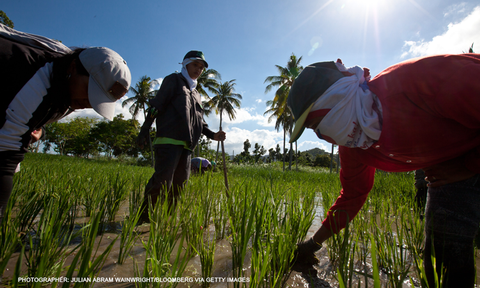


Metro Manila (CNN Philippines, October 22) – The Department of Agriculture (DA) has backtracked on its earlier announcement to raise tariff on imported rice to help ease the situation of farmers suffering from historic-low palay (unmilled rice) prices.
Agriculture Secretary William Dar, in a briefing on Tuesday about the Rice Competitiveness Enhancement Fund, said Cabinet members thumbed down the idea to at least double the duties on rice imports.
“We discussed in the Cabinet that there are safeguard duties being investigated by the Department of Agriculture. After a good discussion, ang [the] decision of the Cabinet, instead of that, ay magbigay [is to give] cash assistance,” Dar said.
Dar said P3 billion in cash aid would be provided to rice farmers instead.
The Cabinet official also said as a countermeasure, the Bureau of Plant Industry will be stricter in issuing sanitary and phytosanitary import clearance to ascertain that only good quality foreign rice would enter the country.
Dar said the bureau could check imported agriculture products against possible infestation such as the weevil beetle.
Earlier, the DA said in a statement it will release by the end of September or October an order raising duties on rice from Southeast Asian countries to 75 percent from the current 35 percent while tariff on rice from other countries will be increased to 100 percent from 50 percent.
Duties from rice tariffs help in funding the Rice Competitiveness Enhancement Program (RCEP), which is designed to assist farmers losing out from the flood of cheaper imported rice under the rice tariffication law. The average palay farmgate price hit an eight-year low at P15.82 per kilogram in the fourth week of September, according to a data from the Philippine Statistics Authority.
The program aims to cut rice production cost by half from P12 to P6 in six years. The DA budget for this is P10 billion per year until 2024.
₱3.2-billion support fund for rice farmers released
Thirty two percent of the ₱10-billion RCEP has been obligated to implementing agencies, Dar said. Obligated amounts are approved funding of projects.
These agencies are the Philippine Rice Research Institute (PhilRice), Philippine Center for Postharvest Development and Mechanization (PHilMech) the Agricultural Training Institute (ATI), the Technical Education and Skills Development Authority (TESDA), Development Bank of the Philippines (DBP) and Land Bank of the Philippines (Landbank).
Baldwin Jallorina, PhilMech director IV, said farmer cooperatives accredited with the Agriculture department under the Registry System for Basic Sectors in Agriculture (RSBSA) would benefit from the rice industry modernization through mechanization. PhilMec has an annual budget of ₱5.1 billion, the bulk of which will go to procurement of machinery and equipment.
Flordeliza Bordey, PhilRice deputy executive director for special concerns, said ₱3.1 billion would go to the seed program to increase rice yield of farmers to five to six metric tons per hectare. Dar said the current national average is four metric tons per hectare.
Bordey said 2.12 million bags of seeds which are expected to cover 1.06 million hectares will be distributed to farmers in 57 provinces. Each bag weighs 20 kilograms. Each accredited rice farmer is entitled to a bag of seeds per half hectare. PhilRice is targeting to distribute 80 percent of the seed bags within the year.
Landbank and DBP would each get P500 million each to implement the lending component. Landbank has 59 lending centers while DBP has 23, from which actual tillers and RSBSA members could borrow capital.
ATI and TESDA, meanwhile, will train rice farmers. ATI is mandated to develop farm schools while TESDA is in charge of providing scholarships to agricultural learning institutions.