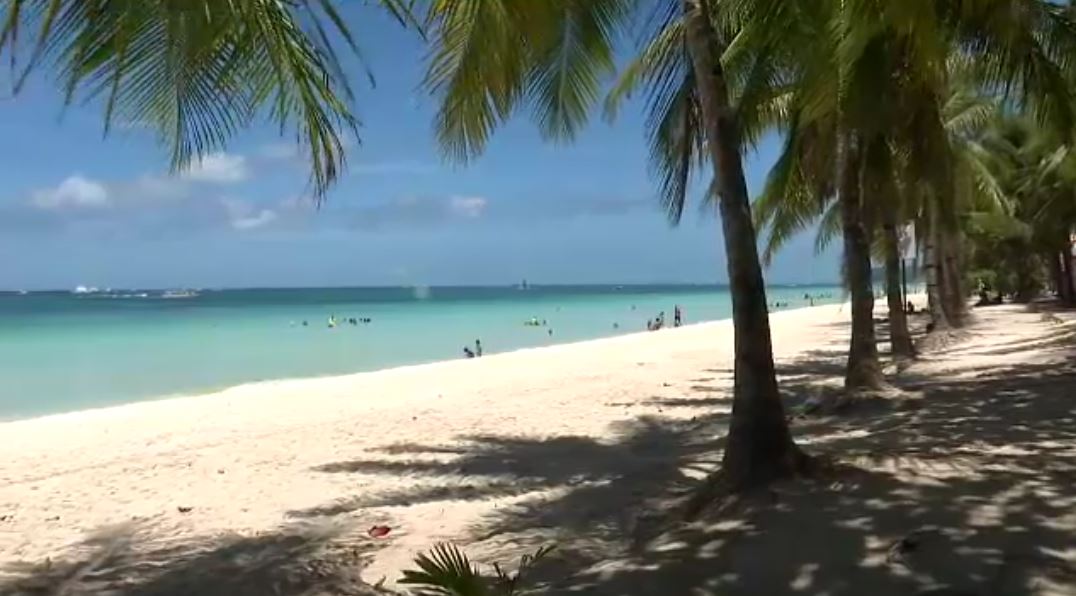


Metro Manila (CNN Philippines, May 28) – President Rodrigo Duterte gave added boost to the rehabilitation of Boracay Island, one of the country’s most popular tourist destinations, by extending the term of the Boracay Inter-Agency Task Force until May 8, 2021.
Duterte signed Executive Order No. 115 last May 11, that will allow the inter-agency task force to complete critical projects in Boracay Island in pursuant of the Boracay Action Plan.
Specifically, the President ordered the improvement of water drainage system, demolition of remaining establishments in forest land and wetland areas, enforcement of beach and road easements, and rehabilitation of the Boracay Circumferential Road.
In February 2018, Duterte called Boracay a cesspool due to worsening pollution and sewage conditions that overshadowed the pristine waters and fine white sand of the world-renowned tourist destination in Aklan province.
This prompted the President to issue Executive Order No. 53, which created the task force and enforced the shutdown of the island from April 26 to October 25 that year.
EO No. 53 gave a two-year term for the inter-agency task force, which ended last May 8, and crafted the Boracay Action Plan.
The Boracay Inter-Agency Task Force is composed of the Department of Environment and Natural Resources, Department of Tourism, and Department of Interior and Local government as well as other agencies concerned in Boracay are also part of the task force.
The President reported in EO No. 115 that based on the task force’s evaluation last March 31, around 33 percent of Boracay Island establishments are still not following the no-build zone standard of 25 meters plus five meters beach easement.
While 27 percent of the island’s establishments are also not complying with the road easement required under existing laws.
The executive order also noted that since its inception in 2018, the Boracay inter-agency task force implemented the demolition of 111 structures on wetlands, 227 structures on the beach easement, and 896 structures on the road easement.
Despite these efforts, the task force sought the need to demolish 723 structures built on forestland blocks, 112 structures on the beach easement, and 334 buildings on the road easement.
EO No. 115 also cited a 2018 study conducted by the DENR Ecosystems Research and Development Bureau and the University of the Philippines Los Baños, which concluded that Boracay had exceeded its physical carrying capacity.
It exceeded by 109.95 hectares or 4,712 units for residential structures, 194.90 hectares or 154 units for businesses with lodging or accommodation services, and 16.95 hectares or 878 units for other business establishments.
Boracay’s total population carrying capacity had also exceeded by 15,836 persons per day, according to the DENR and UPLB study.
Duterte instructed the Boracay inter-agency task force to have a full report of its accomplishments and budget used at the end of its term next year.
Last Tuesday, Presidential Spokesperson Harry Roque said Boracay is eligible to shift to a modified general community quarantine setup given the low presence of COVID-19 in the area and the need for more income among residents.
Under MGCQ, tourist spots are allowed to operate for up to 50 percent of its full capacity.
Duterte was supposed to visit Boracay last March 12 for a tourism promotional tour by DOT, but got cancelled due to the COVID-19 outbreak.