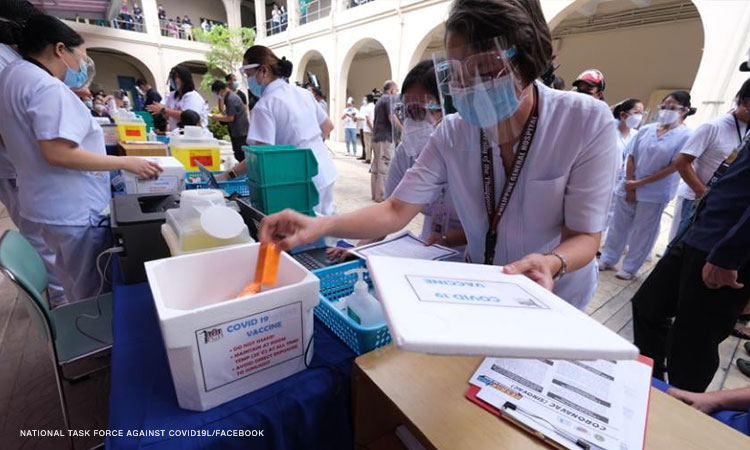

Metro Manila (CNN Philippines, August 31) — There is not enough evidence to say healthcare workers inoculated with Sinovac in March would soon need booster shots, Food and Drug Administration Director General Eric Domingo said Tuesday.
This is after an infectious disease expert said those injected with the Chinese brand may have to get boosters half a year after their second dose, as a study in Thailand found “waning” efficacy of the vaccine against the Delta coronavirus variant.
“So far naman, there’s not enough data to show that we actually need boosters,” Domingo told CNN Philippines’ News Night.
“Even the WHO (World Health Organization) is not advocating boosters, because we know that even if the antibody levels go down, it doesn’t mean we’re not protected,” he added.
Domingo explained those vaccinated still get an amount of protection “way above” those who haven’t gotten any shot at all.
According to Domingo, doctors at the Philippine General Hospital are still monitoring the antibody levels of those vaccinated in March to check if there has been a decline in immunity. The PGH is one of the government facilities first to receive the vaccines.
“I would say we would get data on that maybe in the next month or couple of months,” he said.
Still, the FDA chief maintained that vaccine availability remains crucial in even considering giving booster shots.
“We have to remember we’re not really at a position to give booster shots yet,” he said.
This is something other officials and health experts have also stressed, saying the priority is to ensure as many people as possible are inoculated first before using supplies as extra doses.
Once the country achieves a level of protection “high enough,” and when there’s sufficient vaccine supply, Domingo said that’s when the government can start thinking of redistributing some of the extra doses for those most at-risk. These are frontline healthcare workers as well as senior citizens, especially those with several comorbidities, he added.