

President Duterte only has a year left in power. With the looming threat of more variants, health and political experts say, the improvement of the COVID-19 situation in the country will depend on how the government will act in the next 12 months.
RELATED: Test, trace, treat: Finding the weakest link in PH’s COVID-19 response
RELATED: COVID-19 vaccination: Sourcing the shots that save
Metro Manila (CNN Philippines) — Emerging coronavirus variants are among the culprits in the second spike of COVID-19 cases in the country back in March.
The Philippines is one of the countries with the highest number of SARS-CoV-2 variants of concern: Alpha, Beta, Gamma, and Delta. Theta, a variant that is local in the Philippines, was also reported in January. These variants are either more infectious and/or could reduce the vaccine’s effectiveness.
Less than 1% of the total cases went through genome sequencing to determine the variant that caused COVID-19 infection.
So far, 15% of the 7,878 cases subjected to genome sequencing are Alpha, or the variant first discovered in the United Kingdom. But there are even more Beta cases, or the variant first discovered in South Africa, accounting for 17.5% of the samples checked. These were found among incoming travelers, and on samples from areas with clustering of cases.
In the past weeks, the government has also been raising concerns over the possible entry of the Delta variant, first discovered in India— which is said to be 60% more transmissible than any of the known variants. So far, all of the 19 Delta cases in the country involve overseas Filipino workers who returned to the Philippines.
Border control
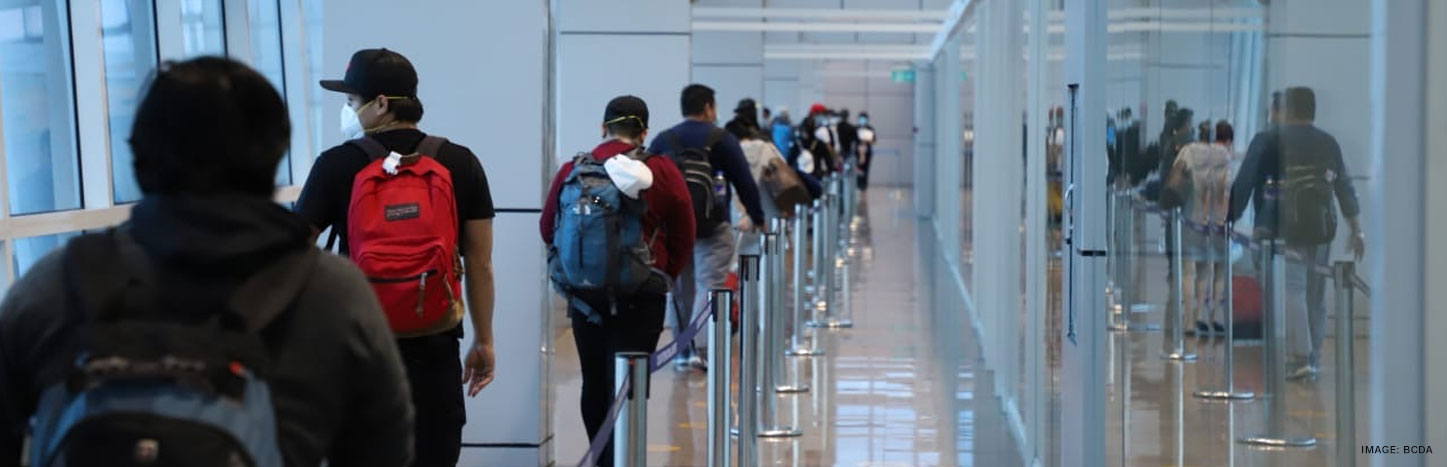
Health experts lament that the government has always been late in sealing its borders. Philippine College of Physician president Dr. Maricar Limpin says this is evident from the time China first reported its first novel coronavirus case back in 2020 and yet again when more transmissible variants were observed in other countries.
“Noong start pa lang ng pandemic, we were slow in closing our borders…Very, very fast in opening borders tapos mabagal naman magsara kapag kakailanganin. Kaya pumapasok sa atin ang iba’t ibang variants and we all know with the presence of variants in the country, mas transmissible ang sakit, mas mabilis, mas exponential ang transmission ng sakit, kaya mabilis ang ano, pagpeak ng may sakit dito sa ating bansa nitong March,” she says.
[Translation: Even at the start of the pandemic, we were slow in closing our borders. We are very, very fast in opening our borders but laggard when it comes to closing our borders when it is urgent. That is why variants enter our country. These variants are more transmissible, increase faster exponentially. This caused the peaks of the virus in the country last March.]
Former National Task Force special adviser Dr. Tony Leachon criticizes Health Secretary Francisco Duque III for failing to show concern about the now-feared Delta variant, which is blamed for the deadly surge in India.
“Yun India, nagsurge ‘yan early part ng April. Dapat nagtravel ban na nun. In-interview si Secretary Duque noon, hindi pa mag-ban sa India kasi wala pang nakikita. Ang problema kung nakapasok sa atin early on. I will not be surprised later on kung may (local case of) Indian variant tayo kasi hindi tayo proactive about it, at ang genomic surveillance ay kokonti,” he says.
[Translation: When India had a surge during the early part of April, we should have imposed a travel ban then. They interviewed Secretary Duque and he said we would not ban travel from India as the virus had not been noted. The problem is if the variant had already entered the country. I will not be surprised if later on, we would have local transmission of the Indian variant because we are not proactive and genomic surveillance is minimal.]
Health experts also note the need to upgrade the genomic sequencing capacity, citing the very low percentage of samples being checked for the variants. The Philippine Genome Center and the UP-National Institutes for Health are processing about 750 samples every week. Last May, infectious diseases expert Dr. Rontgene Solante said more sequencing tests are needed to know the “real picture,” so experts can say if the variants are driving the transmission.
But Health Undersecretary Maria Rosario Vergeire says a travel ban is not the only way to control the variant’s entry. She says the government has enough safeguards, such as improved testing and quarantine protocols for incoming travelers, to prevent the variant from reaching the country and spreading in the community.
Border regulations, testing rules, and quarantine protocols are also constantly changing, some haphazardly, resulting to public confusion. The government recently implemented a green lane or mandatory 7-day quarantine and testing on the fifth day for fully vaccinated international travelers. Meanwhile, individuals who have not received complete COVID-19 doses are required to undergo 10 days of facility-based quarantine and four days of home-quarantine, with an RT-PCR testing on the seventh day.
Despite criticisms, the World Health Organization says the Philippines has done a good job in handling the pandemic.
Pre-pandemic healthcare
Aside from being the biggest health crisis to hit the country in this century, Health Professionals Alliance Against COVID-19 (HPAAC) steering committee member Dr. Aileen Espina says the Philippines had a hard time responding to COVID-19 because the country’s healthcare system was already in a sorry state even before the pandemic.
In 2019, there was only one doctor for every 33,000 Filipinos, much less than the average 1:6,600 ratio. There was only one hospital bed for every 1,121 people.
“We had very limited capacity to respond, ‘yung healthcare system natin. We don’t have the ideal bed-to-population ratio to begin with. ‘Yung ating health human resource hindi rin ganun karami, which is quite an irony because we are a country known all over the world to be one of the top exporters of health human resource. And yet in our country, and statistics will show, that even before Covid-19, six out of 10 deaths in the Philippines were not medically attended to,” Dr. Espina says.
[Translation: We had very limited capacity to respond with our healthcare system. We don’t have the ideal bed-to-population ratio to begin with. We lack health human resources which is ironic as our country is known all over the world as among the top exporters of health human resources. And yet in our country, statistics will show that even before COVID-19, six out of 10 deaths in the Philippines were not medically attended to.]
She also noted that many healthcare facilities are not properly equipped.
President Rodrigo Duterte signed the Universal Health Care Law in February 2019. This aims to provide all Filipinos affordable access to healthcare. But, the pandemic hit the country before it was fully implemented.
With major public health emergency at hand, the government had to fast-track the execution of the UHC Law, and has so far put up a hospital referral system, the One Hospital Command Center, digitized the health data collection, and is still working on integrating the health response from barangay to national level.