

Meanwhile, the estimated damage caused by Tropical Storm Bising to agriculture and infrastructure has reached more than ₱270 million, the disaster management agency reported on Saturday.
Metro Manila (CNN Philippines, April 24)— Severe Tropical Storm Bising has weakened further into a tropical storm, state weather bureau PAGASA said on Saturday.
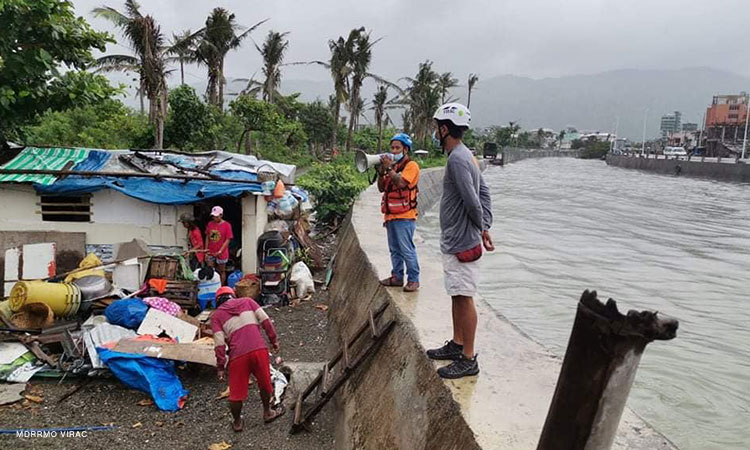
Losses incurred by farmers and fisherfolk hit ₱261,910,999 while damage to structures stood at ₱10,550,000, the National Disaster Risk Reduction and Management Council said in its 8 a.m. situational report. Bising also reportedly damaged two seawalls, one tower base, and one port in CARAGA, the NDRRMC added. The tropical cyclone completely destroyed 147 houses and partially damaged 1,603 homes in Bicol, Eastern Visayas, and CARAGA, the agency reported.
At least 85,570 families or 344,958 individuals from 1,099 villages in Cagayan Valley, Bicol, Eastern Visayas, and CARAGA have been affected by the weather disturbance, the agency said. These include those who have sought shelter in evacuation centers or in the homes of relatives or friends.
Some 45,528 families or 173,179 individuals have been preemptively evacuated in Cagayan Valley, Bicol, Eastern Visayas, and CARAGA.
The NDRRMC also said 63 cities and municipalities in Bicol, Central Visayas, and Eastern Visayas experienced power outages amid the onslaught of Bising, which entered the country’s monitoring area as a typhoon a week ago. Of the number, 54 already got their electricity back.
As of 10 p.m., Bising was last spotted 1,175 kilometers northeast of Extreme Northern Luzon, with its maximum winds weakened to 75 kilometers per hour and gusts of up to 90 kph while moving southeastward at 20 kph. The tropical storm is seen to exit the Philippine area of responsibility Sunday morning.
PAGASA added Bising will not have a direct effect on the country and is expected to lose more strength due to “unfavorable atmospheric and oceanic conditions.”