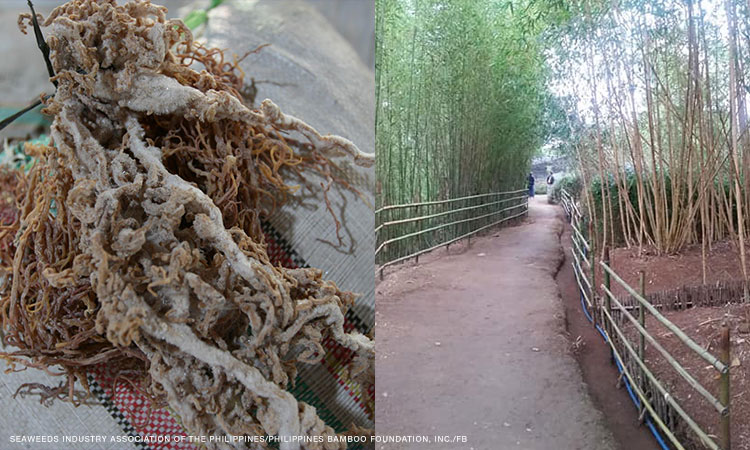


Metro Manila (CNN Philippines, September 2) — Leaders from the bamboo and seaweed industries on Friday called for more funding from the new administration to support local production.
“Ang critical dito is government support, the budget. Ang industry po namin for the longest time, stands on its own, private initiative ito,” Seaweeds Industry Association of the Philippines chairman Alfredo Pedrosa III said at the monthly media forum of the Philippine Chamber of Agriculture and Food, Inc. “What we are reaping and enjoying now in the industry, private sector ang nag-initiate nito.”
[Translation: What’s critical here is government support, the budget. Our industry for the longest time, stands on its own as a private sector initiative. What we are reaping and enjoying now in the industry is all private sector-initiated.]
Citing government data, he said the country has a total of 500,000 hectares of farm area available for deep sea seaweed farming. Of that number, 102,000 hectares of municipal waters are along coastlines with a potential yield of 765,000 metric tons, he added.
With enough funds, Pedrosa said the country can use deep sea seaweed farming in the 85,000 hectares of untapped waters. He, however, admitted this is a costly undertaking and private public partnerships (PPP) may be an option.
“Sa seaweed po, way back in 2012, we used to have a budget allocation of ₱250 million. Ngayon po, mga ₱40 million na lang. Ibalik lang po yun sa dati, malaki na po itutulong, it will go a long way para sa industriya,” he said.
[Translation: For the seaweed industry, we used to have a budget allocation of ₱250 million way back in 2012. Now it’s just about ₱40 million. If they can bring it back to the old figure, it would be a big help and would go a long way to help the industry.]
Meanwhile, Philippine Bamboo Foundation, Inc. President Edgardo Manda cited a similar problem in the local bamboo industry.
He said the Philippine Bamboo Industry Development Council — chaired by the Department of Trade and Industry — has no budget. Local bamboo production is dwindling, he added, causing prices of some products to increase.
“Pagdating sa DBM (Department of Budget and Management) nawawala (yung budget) o cut. Ang nangyayari sa bamboo industry, may emerging industry pero private sector lang ang nagpupush. Konti-konti may nag-iinvest. Hindi tayo makaadvance sa mass production,” he explained.
[Translation: When the budget arrives at the DBM, it disappears or gets cut. What’s happening to the bamboo industry is that it’s emerging but it’s only being pushed by the private sector. Only a few invest. We can’t advance mass production.]
Manda said the Philippines currently ranks fourth in bamboo world trade behind China, Indonesia, and Vietnam, earning 30 million dollars a year.
He flagged the lack of commercial plantations and education among farmers, causing wrong harvesting.
“Kung ibabalik sa ₱2.7 billion, ang hihingin namin ay ₱2 billion lang. Kasi diba sa 13 regions niyan mga tig-₱100 million plus yan. Malaking bagay ito doon sa paggawa ng ating planting materials, pagdevelop sa ating mga bamboo plantation at napakalaking tulong sa livelihood ng rural farmers,” he explained.
[Translation: If they will bring back the ₱2.7 billion, we will just ask for ₱2 billion for the bamboo industry. Because if there are 13 regions, they need about ₱100 million each. This will be a big help to create planting materials, develop bamboo plantations, and help the livelihood of rural farmers.]
Manda said boosting the bamboo industry will help create more jobs in rural areas and mitigate climate change impacts.
The Department of Agriculture is seen to have a 44% increase in its 2023 budget, ending the “funding drought.”
With President Ferdinand “Bongbong” Marcos Jr. concurrently serving as Agriculture Secretary, the department will get ₱102.15 billion next year, higher than the ₱71 billion budget for this year.
The President has put boosting agriculture and food security as one of his priorities in his socioeconomic agenda.