

Before dawn, explosions lit up the sky as Russia targeted the city with missile strikes, according to a Ukrainian government adviser. A CNN team reported hearing two large blasts in central Kyiv and a third loud explosion in the distance, followed by at least three more explosions to the south-west of the city a few hours later.
“Strikes on Kyiv with cruise or ballistic missiles continued,” Anton Gerashchenko, adviser to the Head of the Ministry of Internal Affairs of Ukraine told reporters via text message Friday.
Meanwhile, US officials warned lawmakers Russian forces that had entered Ukraine through Belarus were around 20 miles (32 kilometers) away from Kyiv, sources told CNN.
(CNN)— Ukrainians in the capital Kyiv huddled in air raid shelters Friday morning, as a battle for the city raged overhead with claims of a Ukrainian fighter jet shot down and troops blowing up a bridge to stop an advance of Russian forces.
The Ukrainian Defense Ministry said airborne assault troops blew up a bridge over the Teteriv River at Ivankiv, about 50 kilometers (30 miles) north of Kyiv, in an effort to prevent a Russian column of forces from advancing towards the capital. The ministry said the Russian advance was stopped.
For now, Ukraine’s democratically elected government remains intact but President Volodymr Zelensky warned in a video address late Thursday that “enemy sabotage groups” had entered this city and he is their No. 1 target.
“They want to destroy Ukraine politically by destroying the head of state,” he said. In a separate address, he said the resistance continues.
“Russian forces continued to launch missile strikes on the territory of Ukraine. They say that they are only targeting military facilities, but these are lies. In fact, they do not distinguish in which areas they operate,” he said. “Such attacks on our capital haven’t occurred since 1941.”
Ukrainian Deputy Interior Minister Evgeny Yenin told CNN a Ukrainian Sukhoi Su-27 fighter jet was shot down over Kyiv in the early hours. Photos tweeted by the emergency forces appear to show a fire at a two-story private house after fragments of a plane fell on it. It is unclear if those are the remnants of the jet.
The battle for Kyiv
Just a day earlier, Russian forces entered Ukraine by land, sea and air, prompting a barrage of international condemnation and sanctions amid questions about Russian President Vladimir Putin’s wider ambitions for the country and the capital Kyiv.
Russian forces appeared to be encircling the city and looked poised to move in, Ukraine’s deputy interior minister told CNN on Thursday. Officials in the country believe Russia’s plan is to overthrow the Ukrainian leadership and install a pro-Russian government.
Those fears were shared with US Secretary of State Anthony Blinken, who said Thursday that he’s “convinced” Moscow is going to try to overthrow the Ukrainian government.
If that happens, Blinken said he believes “Moscow has developed plans to inflict widespread human rights abuses — and potentially worse — on the Ukrainian people.”
The fighting in Ukraine appears to be some of the worst conventional warfare Europe has seen since World War II and the conflicts in the Balkans in the 1990s. Preliminary figures showing 137 Ukrainian solders have been killed, including every soldier defending an island in the Black Sea that was taken over by Russian troops, according to President Zelensky.
The Ukrainian Defense Ministry said its armed forces had caused around 800 casualties among Russian forces since the attacks started early on Thursday. It was not immediately clear whether the ministry was referring solely to the number killed and CNN is not able to independently verify Ukraine’s figures.
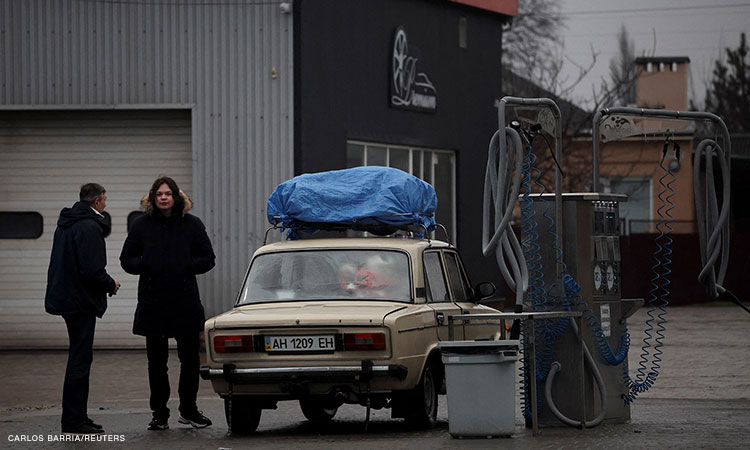
By the end of Thursday, Putin’s forces had launched “in total more than 160 missiles for airstrikes,” a senior US defense official said, prompting a response reminiscent of the late 1930s, with vulnerable children evacuated by train from eastern Ukraine and packed subway stations turned into makeshift bunkers as air raid sirens wailed.
As missiles exploded over the capital, millions of residents remained inside under a government-ordered curfew from 10 p.m. to 7 a.m. local time. Overnight, in an ominous sign a ground war could escalate, Zelensky barred male citizens between the ages of 18 and 60 from leaving the country, according to the State Border Guard Service.
Zelensky also ordered a general military mobilization “in order to ensure the defense of the state, maintaining combat and mobilization readiness of the Armed Forces of Ukraine and other military formations, in a declaration signed late Thursday.
More than 100,000 people have already fled areas most at risk of attack within Ukraine, according to the United Nations refugee agency. The mass movement followed warnings from the US Ambassador to the UN, who said Russia’s actions in Ukraine could create one of the largest refugee crises facing the world today, displacing as many as five million people.
Putin’s wider ambitions
Meanwhile, French President Emmanuel Macron positioned himself as the mediator between Moscow and Kyiv for a potential ceasefire.
“I think it is my responsibility, first of all, to take such initiatives when they are requested by Ukraine, and then, while condemning, while sanctioning, while continuing to decide and act, to leave this path open so that the day when the conditions can be met, we can obtain a cessation of hostilities for the Ukrainian people,” Macron said at a press conference in Brussels Friday.
Macron was the first major western leader to speak with Putin after Russian military actions began.
His comments came as the European Union announced new sanctions on Russia, designed to have “maximum impact on the Russian economy and political elite.”
European Commission President Ursula von der Leyen said the sanctions would hit Russia’s financial, energy and transport sectors, visa policy, and include export controls and export financing bans.
Speaking in Brussels on Thursday, NATO Secretary-General Jens Stoltenberg described Russia’s attack on Ukraine as a “brutal act of war.”
A big concern for NATO is whether Putin’s intentions lie beyond Ukraine, a prospect that risks drawing in all 30 members — including the United States, the United Kingdom, Canada, France and Germany — into a wider conflict on European soil.
“You don’t need intelligence to tell you that that’s exactly what President Putin wants. He has made clear he’d like to reconstitute the Soviet Empire, short of that he’d like to reassert a sphere of influence around the neighboring countries that were once part of the Soviet bloc,” said Blinken on CBS Evening News.
Blinken said NATO would stand in the way if those were Putin’s ultimate goals.
“Now, when it comes to a threat beyond Ukraine’s borders. There’s something very powerful standing in his way. That’s article five of NATO, an attack on one is an attack on all,” the top diplomat said.
On Thursday, the US Secretary of Defense ordered the deployment of 7,000 US service members to Europe, comprising an armored brigade combat team, “to deter Russian aggression,” a senior defense official told reporters. The deployment brings the number of US troops moved towards eastern Europe at more than 14,000.
In his address announcing Russia’s “military operation” in Ukraine Thursday, Putin threatened “those who may be tempted to intervene” on Ukraine’s behalf, saying Russia’s response would be “immediate” and lead to “such consequences as you have never experienced in your history,” he said.
This story was first published on CNN.com, “Ukrainian capital hit with ‘cruise or ballistic missiles’ as Russia attempts to encircle Kyiv.”