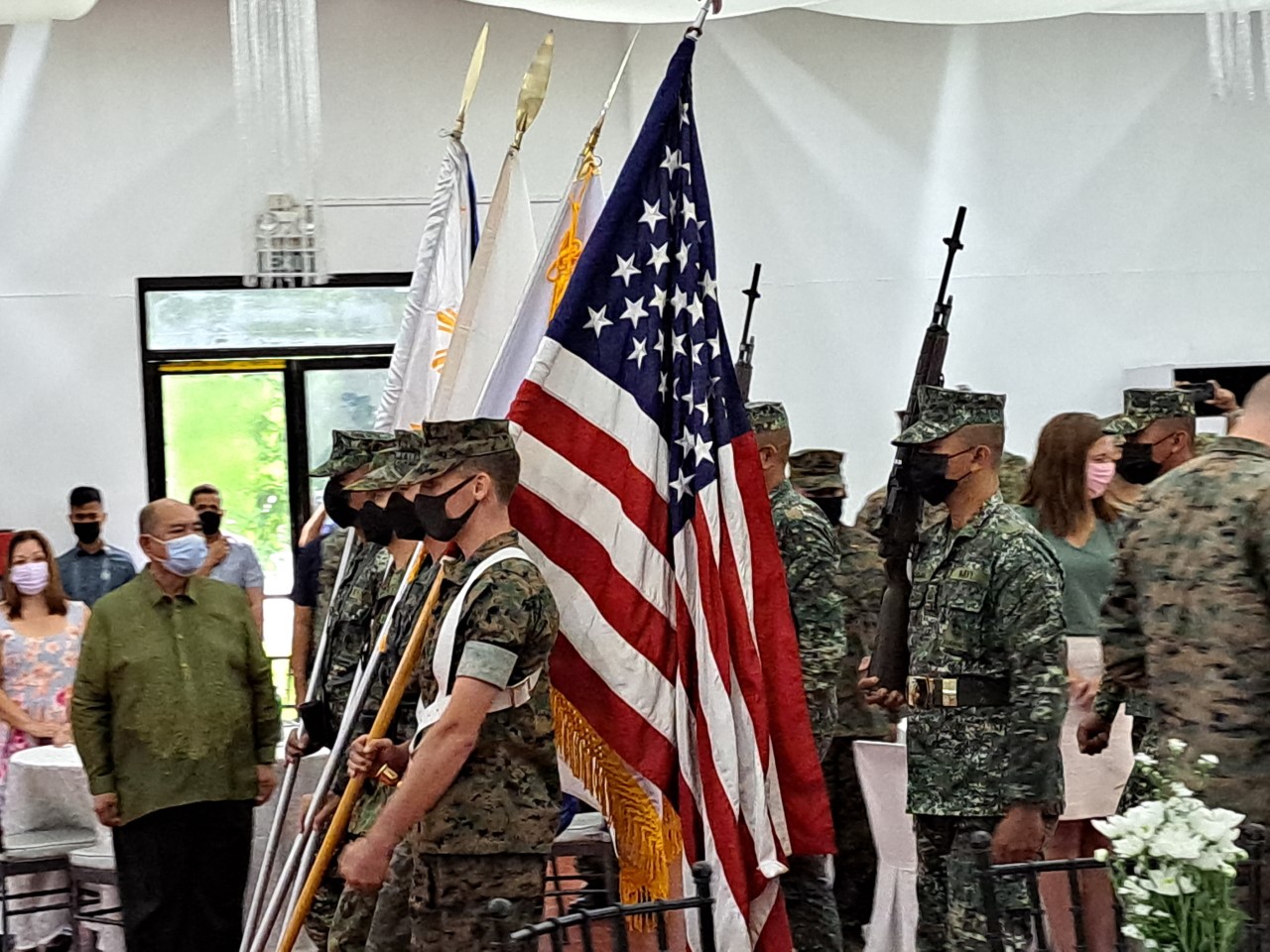


Metro Manila (CNN Philippines, October 3) — Filipino and American troops continue amphibious combat drills in areas in Luzon facing the West Philippine Sea (WPS) and Taiwan, with officials insisting that the exercises are not aimed at targeting any specific country or mission.
“This is an exercise that we planned since last year and the purpose of it is to exercise our doctrines and exercise our collaboration between our allies,” Rear Admiral Caesar Bernard Valencia, Philippine Navy acting chief, told reporters on Monday.
KAMANDAG or “Kaagapay ng mga Mandirigma mula sa Dagat” (Cooperation of the Warriors of the Sea), which is now on its sixth year, is an annual combined training exercise between the Philippine and U.S. Marine Corps. It formally opened on Monday and will run until Oct. 14.
Earlier this year, Filipino and American troops also held a beach landing exercise in the coastal town of Claveria in Cagayan in northern Luzon, which is facing Taiwan, as part of the annual Balikatan wargames. Several joint military maneuvers have also been held in the past, in a number of areas in Luzon facing the West Philippine Sea.
More than 3,700 troops, majority from the US, are taking part in the KAMANDAG exercises. A small contingent from the Republic of Korea is joining Japan’s Ground Self-Defense Force for the first time as observers.
Similar to previous KAMANDAG drills, which highlighted amphibious, live fire and disaster response training missions, this year’s iteration will focus on coastal defense.
Some of the exercises will be held within and outside military camps in Luzon, such as in Zambales and Palawan, which are primarily tasked to serve as the country’s frontline defense against potential threats emanating from the West Philippine Sea, amid China’s continuous aggressive actions.
Other drills would also have been held in Cagayan in Northern Luzon, amid concerns that the Philippines could be drawn into a conflict over Taiwan.
Valencia, however, reiterated that KAMANDAG was planned a year ahead, pointing out that “it is not dependent on what the regional situation is,” nor is it meant to address “any of the geopolitical issues.”
But on the sidelines of the exercises, participants will also hold “humanitarian assistance” projects in the northernmost island province of Batanes, particularly in Mavulis Island, which lies near the maritime border with Taiwan.
Aside from combat exercises, Filipino forces will also be trained by their US counterparts on how to react against chemical, biological, radiological, and nuclear (CBRN) incidents.
Rear Admiral Derek Trinque, commander of the US Navy’s 7th Fleet Amphibious Force, said that CBRN classroom discussions and decontamination demonstrations are not geared towards specific threats. But experts have previously expressed fears on how countries with nuclear arms, including North Korea, could pose a danger to the region.
“We never want to use those capabilities. We never want them to become necessary. But it is something that you want to practice. You have a plan, and you know what you want to enact if, God forbid, anything would ever require those capabilities,” Trinque explained.