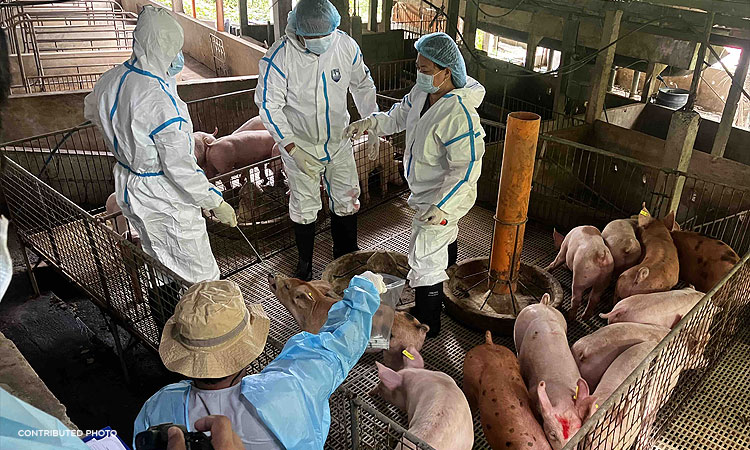

Metro Manila, Philippines — The controlled vaccination trial for African Swine Fever (ASF) began on Friday, Aug. 30, amid more areas with active cases, the Department of Agriculture (DA) said in a statement.
It said agriculture officials launched the program with 41 hogs from two farms in Barangay Malapad na Parang in Lobo, Batangas, using the Vietnam-made AVAC ASF Live vaccine.
The pigs of Vicente Manalo, the farm owner, tested negative for ASF — a requirement to participate in the vaccination program.
“Obserbahan muna po dahil nga ngayon pa naman nag-ano eh, pero, confident po ako kung tutuusin,” Manalo said of the ASF vaccination.
[Translation: We will observe since we only started the vaccination, but in some sense, I’m confident with it.]
Lobo town was reportedly “ground zero” for the current ASF outbreak — a disease affecting the local swine industry since 2019.
As of Aug. 21, BAI data showed 458 barangays recorded active ASF cases, or an 82% increase from 251 on Aug. 8.
READ: Over 400 barangays log active cases of ASF
The vaccine rollout is expected in red zones or areas with active ASF cases, prioritizing small-hold and backyard hog raisers. The DA said it was voluntary.
The DA made an emergency procurement of 10,000 vaccines to stem the ASF outbreak.
Dante Palabrica, agriculture assistant secretary for swine and poultry, said the DA has an agreement with the Food and Drug Administration (FDA) and stakeholders that the ASF vaccine should show it can fight against the virus.
“Calculated risk ang ginagawa natin para maipakita natin na kaya nitong bakuna,” Palabrica said.
[Translation: We are doing a calculated risk to show that the vaccine is effective.]
WATCH: The Department of Agriculture (DA) starts today its controlled vaccination program for African Swine Fever (ASF) in Lobo, Batangas. The DA is using Vietnam-made AVAC ASF Live vaccine | @JeloMantaring pic.twitter.com/JgrKfikpC2
— NewsWatch Plus PH (@newswatchplusph) August 30, 2024
The AVAC vaccine got regulatory approval in July, only for the Bureau Animal Industry’s use and still not for commercial release.
Maria Cecilia Matienzo, a director of the FDA, advised the public to report ASF vaccines being sold online. She also said other vaccines are still undergoing clinical studies.
Agriculture Secretary Francisco Tiu Laurel Jr. said ₱350 million was allocated for the 600,000 doses and supplies for the government-led trial.
Agriculture spokesperson Arnel de Mesa said the BAI is conducting competitive bidding for the next 150,000 doses.
According to the DA, a minimum of 50 eligible pigs per farm or cluster must be identified for vaccination. Pigs must be at least 4 weeks of age or older.
DA: Pork supply stable
Patrick Ong, a representative of the National Federation of Hog Farmers, said his group would monitor the vaccination program.
“Napakalaki na po ng lugi, at alam ko pong nagsisikap tayo at pinipilit lang ng iba nating mga hog raisers, pero huwag po mawala ng pag-asa,” said Ong, who is also the Rosario Batangas Hog Raiser Association president.
[Translation: I know there have been big losses and other hog raisers are persevering, but let us not lose hope.]
Ong said pork prices will hold steady “soon” but Metro Manila might feel an increase as “bottlenecks” in supply chains affect markets. He said there were “very few” confirmed ASF cases in Calabarzon.
De Mesa said the supply for meat remains stable.
“Ang nangyayari kasi, pag merong ASF, bumababa ‘yung presyuhan, but eventually, nag-stabilize naman agad.” De Mesa said. “So, ‘yung presyo sa 13 monitored na palengke natin sa Metro Manila, almost, ano, hindi gumagalaw for the last how many weeks.”
[Translation: When there is ASF, prices go down, but eventually the prices stabilize. So the prices in the 13 monitored markets in Metro Manila are not fluctuating for the last how many weeks.]
As of Aug. 29, the DA reported that pork kasim (shoulder) is sold in Metro Manila markets at ₱260-₱370 per kilogram (kg), while ₱290-₱400 per kg for pork liempo.
The country’s total meat import in the first half of 2024 was around 647 million kg led by pork products. This was a 9% increase from around 590 million kg in the same period last year.