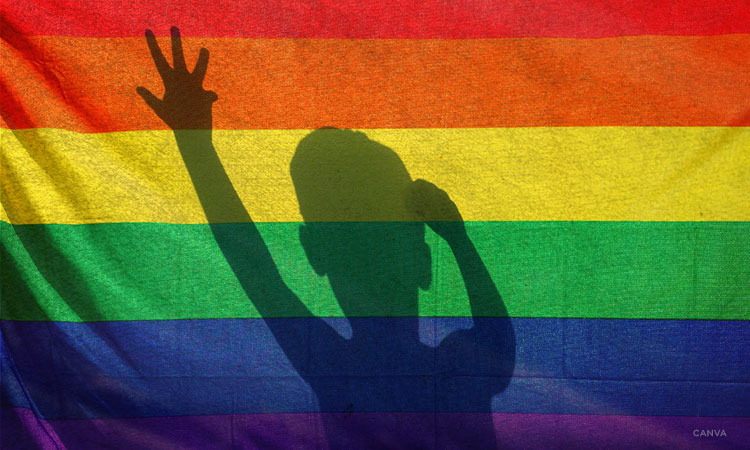

Metro Manila, Philippines – As the Filipino lesbian, gay, bisexual, and transgender (LGBT) community has grown more assertive over their rights, the general view has grown more favorable to their side.
A 2023 Social Weather Stations survey found that 79% of Filipinos believe that gays or lesbians are just as trustworthy as any other Filipino. Meanwhile, 73% believe that gays or lesbians have contributed a lot to the country’s progress.
While social acceptance has largely improved, the same study found that 40% of Filipinos would prefer that gay or lesbian family members turn heterosexual.
Coming out of the closet
For writer and LGBT advocate Lars Sia, coming out to his family was far from easy.
Sia, who identifies as a bisexual transgender man, recalled coming to terms with his sexuality and gender identity at 13 years old. However, growing up in a conservative Filipino-Chinese family meant that he and his loved ones, especially his mother, had opposing views on the LGBT community.
“At that age, if people feel like you’re misguided, misled, or going through a stage, they either ignore it or they try to impose certain norms para ma-stop [to stop] whatever they think they’re trying to stop. And as a child, you will always follow your parents or whoever is taking care of you,” he told NewsWatch Plus.
Sia had begun slowly coming out to his friends when he was 18. However, he kept his sexuality a secret from his family.
It was also around this time when he began secretly dating a girl. His mother, however, grew suspicious after going through his things and saw some scribbles that insinuated that he was in an LGBT relationship.
Things went to a head when his mother called up his girlfriend’s parents and arranged a meeting between both families. This confrontation forced the young couple to deny their relationship and damaged Sia’s trust in his mother.
“It was just so embarrassing… Sobrang sumama ang loob ko sa mom ko after. [It really hurt my relationship with my mom,]” he said.
It was not until Sia turned 26 when he officially came out to his family. By this time, he had moved out of the family home while his mother had migrated to the US.
Sia said he noticed his mother’s gradual change of heart while she was in the US. “Minsan, she would send me yung mga email na may rainbow [Sometimes, she would send me emails with rainbows] … So, I found that a little strange pero [but] I suppose she was trying to reach out.”
Now, Sia has a stronger relationship with his immediate and extended family. He added that he feels the strong support from his relatives on his mother’s side, many of whom identify as fellow members of the LGBT community.
Why families may struggle with a loved one’s coming out
When asked why some families may struggle with coming to terms with their loved one’s sexuality and gender orientation, Sia said his mother feared that being LGBT also posed limitations in achieving a successful career.
gender orientation, Sia said his mother feared that being LGBT also posed limitations in achieving a successful career.
He said that his mother believed that masculine-presenting women were limited to working as a bus conductor, janitor, or fast-food crew. Meanwhile, gay men must stick to working in a salon.
Sia recalled, “Ang sabi ng mom ko sa’kin before I came out, ‘Wag kang ganyan, kasi magiging konduktor ka lang sa bus… Frankly speaking, I don’t have any issue doon sa kind of work because work is work but options would be limited. [My mom told before I came out, ‘Don’t be like that or you’ll just be a bus conductor… Frankly speaking, I don’t have any issue with that kind of work because work is work but options would be limited.]”
As for family counselor Carla Siojo, parents may fear that their children would be severely bullied for their sexuality and/or gender orientation.
“The time in the seventies, when a guy would find out that their classmate had a different gender orientation or sexual orientation, you know what they would do? They would beat them up,” she said.
Coming to terms with their loved one’s identity
So what must families do to accept their loved one’s LGBT identity? Siojo advised that, first, true straight allies must recognize that members of the LGBT community deserve respect.
She said, “For me, they must look at them as human beings regardless… And be open enough to try and understand where that person is coming from.”
Siojo said families must disregard stereotypes about the LGBT community as they also uphold the same values and principles: “From the [LGBT] people that I know, they value commitment. They value fidelity.
They value long-term relationships. Same as any heterosexual person.”
Sia summed up the support that would show care for family members.
“Unconditional love doesn’t mean that you choose for that person. It means that you guide that person through the choice that they make,” he said.