
Metro Manila, Philippines – European Union observers said they received reports of vote-buying and saw that voter secrecy was not upheld in polling precincts, among other issues, as they released on Wednesday, May 13, their initial assessments on #Eleksyon2025.
For the first time, the EU deployed an over 200-member mission to observe the electoral process after receiving a request from the government.
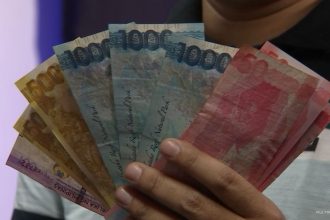
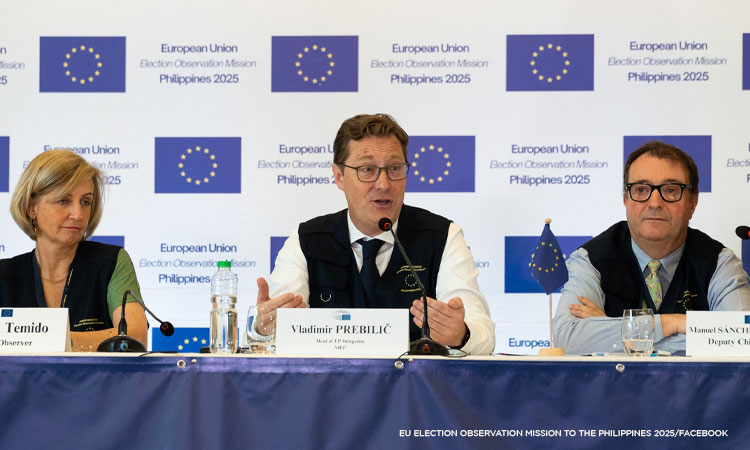
“EU observers witnessed several credible indications and received reports of vote buying through cash and goods, as well as distribution of ayuda,” said Marta Temido, the EU Election Observation Mission chief observer.
“Vote buying remains entrenched and endemic and requires a major engagement to be adequately addressed,” Temido said in the press conference.
The mission said observers saw vote-buying indications at five of the 98 observed campaign events. In a footnote in its 13-page document, the mission also said the instances of “vote buying or ayuda” were in Bohol, Davao Oriental, La Union, Palawan, Quezon, Siquijor, Zamboanga City, and Zamboanga del Sur.
Vladimir Prebilič, the delegation head of the European Parliament, also flagged that the right to secrecy of the ballot was not upheld in voting precincts.
“We believe that steps should be taken to guarantee this important aspect of the electoral procedures in accordance with international standards,” Prebilič said.
Non-access to polling precincts ‘shocking’
The EU mission reiterated its disappointment for failure to access polling precincts on Election Day. It said observation during the voting phase was “essential” to its assessment.
“If Comelec had told the European Union that access to polling precincts was not granted to international observers, EU can be sure that we would not be here today. We would not have deployed the mission at all,” Temido said.
She added the Comelec’s proposal for them to stay outside the precincts and witness through a window instead was “not compatible with our methodology.”
The mission said the mutual commitment between the EU and the Philippines granted them “freedom of access” to all polling precincts and canvassing centers.
But the Commission on Elections (Comelec) denied the group’s request in line with the election law, forcing the international organization not to send the whole team of observers to voting precincts. They were deployed to the counting process instead after the closing polls.
Prebilič said they expressed hope that international election operation missions may be given full access to polling precincts next time.
“Enabling observers’ full access to all phases of the electoral process shows a country’s commitment to transparency,” he said. “Election observation, in short, enhances trust, democracy, and global relations.”
Other findings
The mission praised the Comelec’s voter education efforts for the May midterm elections, particularly roadshows for the new automated counting machines.
It said the distribution of voter information sheets was a “positive endeavor” since the documents also showed the appearance of ballots.
“The initiative sought to effectively replace candidate-distributed sample ballots with institutional, impartial information,” it said in its preliminary findings.
But the EU observers also noted there was no harmonized version of the country’s election code, and even a mechanism to document which provisions are no longer in force. It flagged Comelec resolutions that might amount to “de facto lawmaking.”
“To fully align with international standards, some provisions require revision, namely those on eligibility, candidate registration and status, campaign finance, complaints and appeals, and sanctions,” the mission said.
“Other key issues remain unaddressed, including a comprehensive regulation of political parties and provisions to limit the dominance of political dynasties, as mandated by the Constitution,” it added.