
Metro Manila (CNN Philippines, May 21) — Eight business groups have opposed the proposed ₱150 wage hike, which they said would hurt small businesses and workers in the informal sector more.
They expressed their opposition in a statement posted on the Facebook page of the Employers Confederation of the Philippines (ECOP) on Friday.
The statement was signed by heads of ECOP, Philippine Chamber of Commerce and Industry, Philippine Exporters Confederation, Inc., Federation of Filipino-Chinese Chambers of Commerce and Industry, IT & Business Process Association of the Philippines, Philippine Hotel Owners Association, Foreign Buyers Association of the Philippines, and United Portusers Confederation of the Philippines, Inc.
The groups said they understand the concern of the Senate Committee on Labor, Employment, and Human Resource Development on how the effects of inflation “continued to dampen the purchasing capacity of Filipinos.”
But the business group said the across-the-board wage increase sought by lawmakers, especially Senate President Juan Miguel Zubiri through his Senate Bill No. 2002, would be beneficial only to a “happy” few.
“Raising wages may appear to be the easier and logical solution,” the ECOP added. “However, only a small percentage of the total workforce, 26% or about 8 million in the formal sector out of the 50 million in the total number of Filipino workers, will be able to benefit from this proposal.”
The business group also noted that the rising inflation rate negatively impacted micro, small and medium enterprises (MSMEs) that suffered the brunt of the COVID-19 pandemic, many of which may still be closed. MSMEs comprise 98% of businesses in the country.
Zubiri on May 3 said the Senate was aiming to approve the bill before the session break in June.
WATCH: Senate approves in principle’ proposed ₱150 wage hike
Inflation in the country cooled to 7.6% in March, which was the lowest yet since September 2022.
The ECOP warned that employers from MSMEs may have to “further increase the prices of their products, reduce the number of their workers, or simply close down,” once the proposed wage hike is signed into law.
“That prices of goods in the Philippines are higher compared with these counterpart economies may in fact already be a direct effect of the higher minimum wages in our country,” their statement read. “This proposal then becomes a sure threat against efforts to invite more investors when the CREATE (Corporate Recovery and Tax Incentives for Enterprises Act) and other investment-related law were passed.”
The group also said the wage hike, if legislated, would result in an “even grimmer scenario” for informal workers since they don’t have employers and thus “are not expected to feel any gain.”
Employees in the informal sector represent 84% of the total workforce, which translates to around 42 million workers, including farmers, market vendors, jeepney drivers, tricycle drivers, and home-based small entrepreneurs.
“These are the people who will then start trooping to government offices to ask for ayuda (financial aid) when this burden becomes unbearable already,” the EOP said.
They recommend the creation of a technical working group that will invite representatives from the informal sector to participate, as well as the Department of Trade and Industry, Department of Labor and Employment (DOLE), and the National Economic and Development Authority “who can handle the pencil pushing.”
They also noted that instead of a Senate hearing, the business community “feels more comfortable” with the regional tripartite wage board whose mandate on wage hike “becomes even stronger and credible” because of the “regularity, mechanism, and coverage of terms in consultations.”
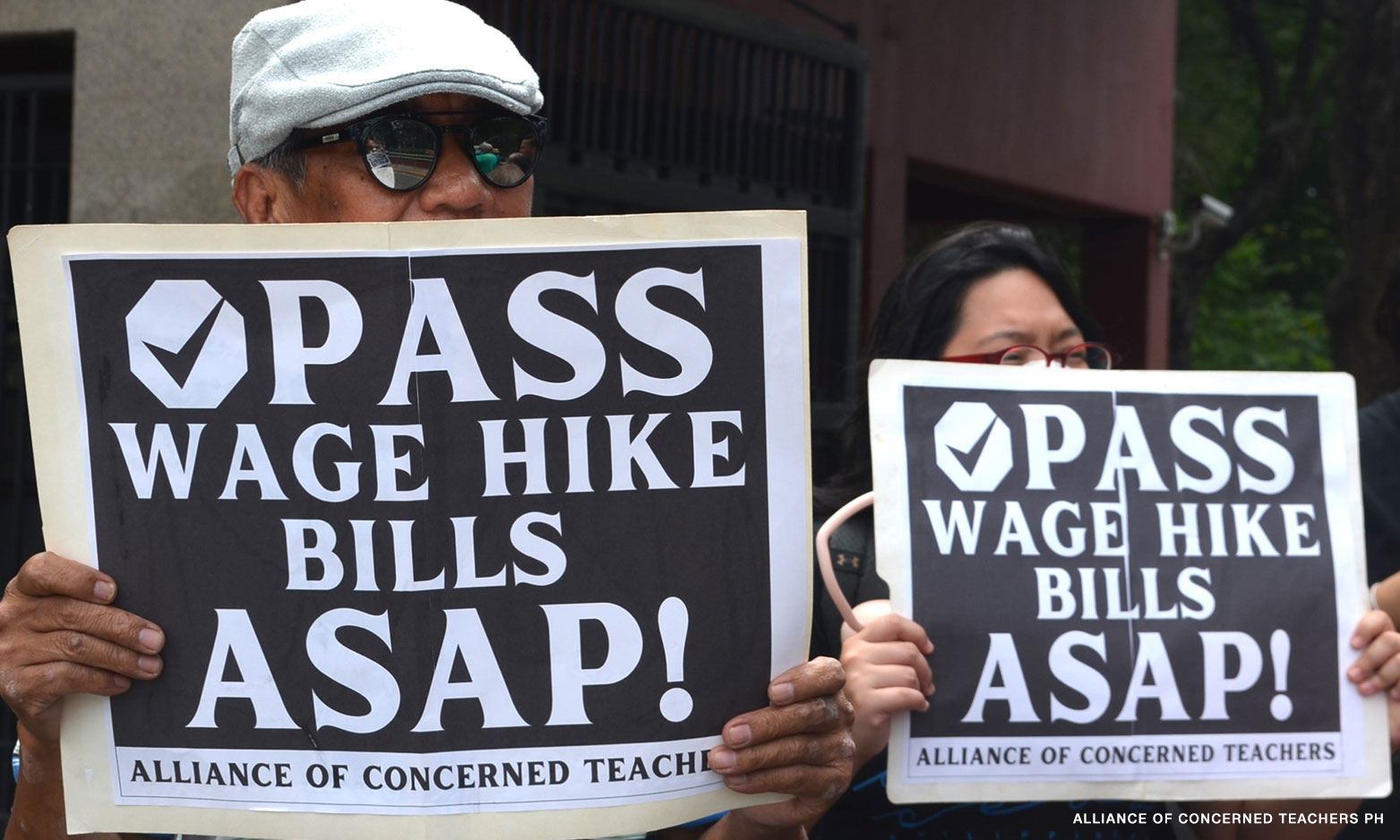
Groups have been renewing their calls for a wage hike, especially during Labor Day on May 1.
RELATED: No mention of wage hike in Marcos’ first Labor Day speech
In March, over 20 labor groups and unions filed before the Regional Wage Board a petition for a ₱530 increase in the minimum wage in Metro Manila to keep up with the ₱1,161 daily family living wage in the region. The DOLE said there were eight wage hike petitions filed.
“Needless to say, such an issue truly needs more time and accurate information to help ensure that efforts are truly responsive to the common good,” the ECOP said.