
(CNN) — Syrian victims of the devastating earthquake that hit their country and Turkey on Monday may become hostages of the politics that have divided Syria for over a decade, analysts have warned.
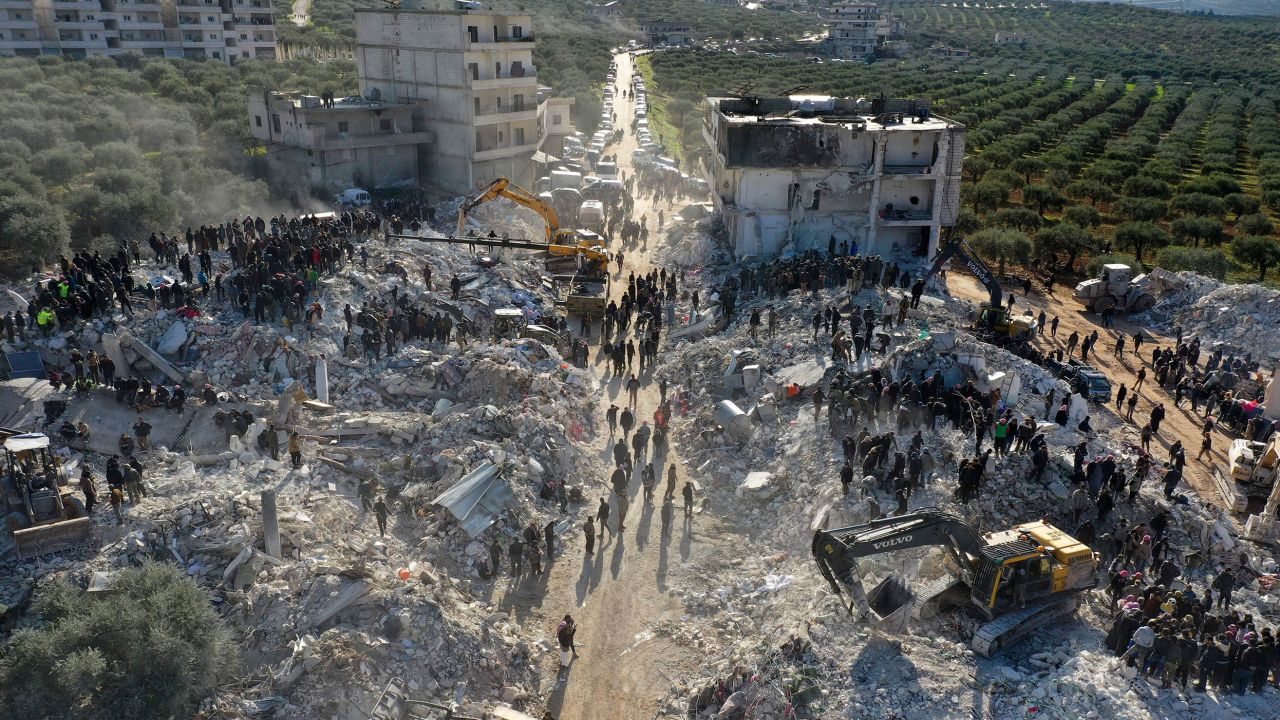
The 7.8 magnitude earthquake, which struck southern Turkey in the early hours of Monday, was followed by more than 100 aftershocks and a second 7.5 magnitude earthquake. More than 11,000 have been killed across Syria and Turkey, and hundreds more are feared trapped under the rubble.
While Turkey has received an outpouring of support and aid from dozens of countries, outreach to Syria has been less enthusiastic, raising concerns that victims on one side of the Turkish-Syrian border may be neglected while others are provided for.
“Syrians must not be forgotten,” Aya Majzoub, Amnesty International’s deputy regional director for the Middle East and North Africa, told CNN. “Often, those who suffer the worst during such disasters are those who were already vulnerable.”
Observers say politics is to blame.
Turkey is a NATO member whose international stature has only grown in recent years. Syria, on the other hand, is ruled by a myriad of disparate groups. Its regime, internationally sidelined and heavily sanctioned due to its brutal suppression of an uprising there that started in 2011, counts Iran and Russia as its closest allies – both global pariahs.
The Syrian regime is shunned by most Western countries. But leader Bashar al-Assad has begun forging ties with former enemies as regional states welcome him back into the fold. Last year, the United Arab Emirates welcomed Assad in Abu Dhabi, and last month Turkish President Recep Tayyip Erdogan said that the pair may soon meet for peace talks.
Some of the areas of Syria most impacted by the earthquake are controlled by the regime, others by Turkish-backed and US-backed opposition forces, Kurdish rebels and Sunni Islamist fighters. Idlib, one of Syria’s last opposition strongholds, is controlled by Hayat Tahrir al-Sham (HTS) organization, an armed Sunni Islamist group.
“It’s still an active conflict zone, the Syrian crisis is far from over,” said Charles Lister, senior fellow and director of the Syria and Countering Terrorism & Extremism program at the Middle East Institute in Washington, DC. “The UN aid mission is a complicated set up.”
Seventy countries and 14 international organizations have offered Turkey relief following the quake, Erdogan said on Tuesday, including the United States, the United Kingdom, the UAE, Israel and Russia.
Aid must go through Damascus
The international aid situation in Syria is less clear. So far, the UAE, Iraq, Iran, Libya, Egypt, Algeria and India have already sent relief directly to regime-controlled airports. Others such as Taliban-ruled Afghanistan, Saudi Arabia, Qatar, Oman, China, Canada and the Vatican have pledged aid; however it is unclear if that relief will be sent directly to the regime.
The regime insists that all aid to the country, including aid that is meant for areas outside its control, be directed to the capital Damascus.
“We are ready to work with all who want to provide Syria, from inside Syria, so access from inside Syria is there,” Syria’s representative to the UN, Bassam al-Sabbagh, told a news conference in New York on Monday. “So, anyone who’d like to help Syria they can coordinate with the government and we will be ready to do so.”
That hasn’t been received well by activists and observers who fear that the regime could hamper timely aid to thousands of quake victims in rebel-held areas, most of whom are women and children, according to the UN.
“The Assad regime has systematically siphoned off aid and/or blocked it from reaching non-regime areas (in the past),” tweeted Mai El-Sadany, a Washington-based human rights lawyer and managing editor at the Tahrir Institute for Middle East Policy. “The international community must urgently find ways to ensure that emergency assistance and support reaches the people of northwest Syria.”
Syria’s ministry of foreign affairs did not respond to CNN’s request for comment.
In northwest Syria, where the UN says more than 4.1 million people already depend on humanitarian aid, a political and military standoff between Assad and opposition forces is only expected to stifle international assistance.
“There is likely to be less international assistance provided to opposition areas because that is additionally complicated,” Lister told CNN. “It’s not an area controlled by a sovereign government and makes it difficult for aid operators.”
Already, UN aid to the region has been disrupted due to damage inflicted on roads by the earthquake, the UN has said. The damaged Bab al-Hawa crossing is the only humanitarian aid corridor between Turkey and Syria.
“We are exploring all avenues to reach people in need and conducting assessments on feasibility,” Madevi Sun-Suon, a spokesperson for the UN Office for the Coordination of Humanitarian Assistance (OCHA), told CNN on Tuesday. “We do have aid but this road issue is a big challenge as of now.”
Majzoub said residents of the northwest “live in appalling conditions, with little access to adequate shelter, water, sanitation, and healthcare, due to the Syrian government’s denial and obstruction of access to essential services.”
The rebel-held region is also grappling with a harsh winter and deadly cholera outbreak.
“They depend entirely on humanitarian aid facilitated by the UN cross-border mechanism from Turkey, which allows the UN and its partners to provide aid without the authorization of the Syrian government,” she said.
Exploiting the earthquake
The Syrian regime has also used the opportunity to call for sanctions against it to be lifted. Its UN envoy Sabbagh said on Tuesday that planes refused to land at Syrian airports because of American and European sanctions. “So even those countries who want to send humanitarian assistance, they cannot use the airplane cargo because of the sanctions,” he said in New York.
The Damascus-based Syrian Arab Red Crescent made a similar appeal on Tuesday, adding that it was ready to deliver aid into rebel-held areas.
In November, a UN-appointed human rights expert called for the immediate lifting of unilateral sanctions against Syria, saying they are exacerbating the destruction and trauma suffered by ordinary citizens there.
The US has, however, ruled out changing its position on the regime.
“It would be quite ironic, if not even counterproductive, for us to reach out to a government that has brutalized its people over the course of a dozen years now – gassing them, slaughtering them, being responsible for much of the suffering that they have endured,” US State Department spokesperson Ned Price told a media briefing on Monday.
Some analysts agree that the regime could exploit the tragedy for its own benefit.
“It’s a very convenient time for the regime to be making that argument because if sanctions were dropped, the ramifications of the much broader geopolitical situation would be game changing,” said Lister.
This story was first published on CNN.com, “As aid is rushed into Turkey, Syria could be left behind”