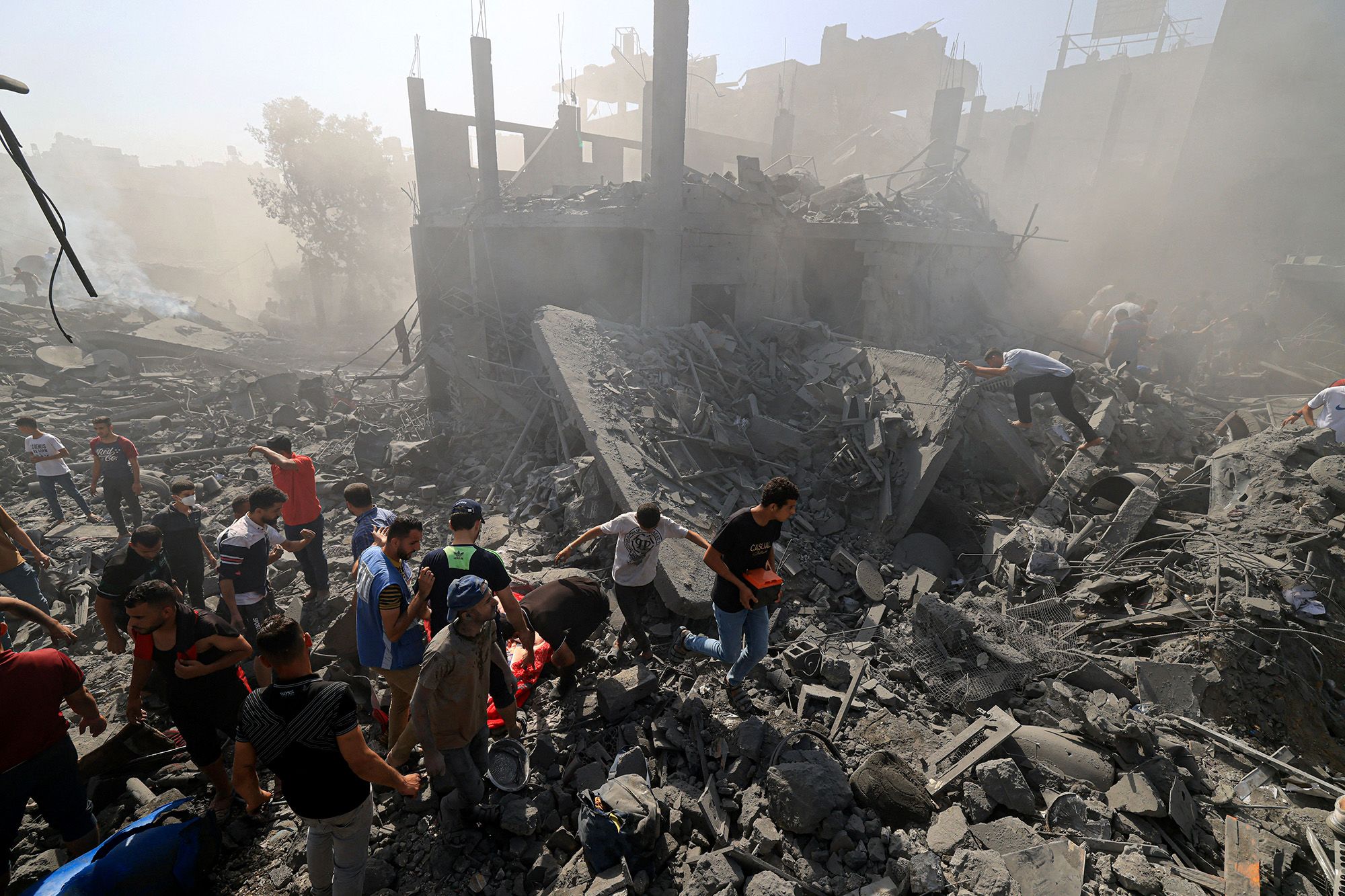

(CNN) — United Nations diplomats prepared to vote on a resolution calling for a ceasefire in Gaza on Friday, as Israel’s military announced it is “expanding ground operations” in the besieged enclave.
Multiple residents in Gaza told CNN that the evening’s airstrikes were the most intense they had experienced in weeks, with one eyewitness at the Al Aqsa Martyrs hospital in Deir al Balah saying that Gaza has been “left in the dark with no connection to the outside world. The hospital is bracing for rising casualties, with the eyewitness saying 11 bodies have already arrived.
“Intense bombardment” has cut off the telecommunications network of Jawwal, the Palestinian telecom company that provides mobile service to the Gaza Strip, it said on Friday. Aid group the Red Crescent Society said it has “completely lost contact with the operations room in Gaza and all our teams operating there.”
Israel has vowed to continue ground raids over the coming days after ordering the “complete siege” of Gaza in the wake of Hamas’ October 7 terror attack that killed more than 1,400 people and saw some 200 people taken to Gaza as hostages. Ongoing air strikes and a blockade of life-saving fuel have sparked increasingly dire warnings for the 2 million people trapped in the battered enclave.
UN Secretary General Antonio Guterres has warned that a ground operation in Gaza could have a “devastating impact” and urged parties to respect international humanitarian law, his spokesperson Stephane Dujarric said earlier on Friday.
In New York, UN member nations are preparing to vote on a resolution calling for an immediate cessation of hostilities in the war between Israel and Hamas so that humanitarian aid can reach civilians in Gaza.
Emotional speech-making continued Friday with key Arab states, including Egypt, endorsing the resolution. The US, siding with Israel, sharply criticized the effort, calling the resolution “deeply flawed.”
Jordan brought the resolution to the General Assembly after successive attempts to call for ceasefires and humanitarian pauses failed in the more powerful Security Council.
A majority of at least two-thirds of member countries present in the General Assembly Hall would need to vote yes for the resolution to pass. A general assembly vote is politically significant but not binding.
The draft resolution calls for an “immediate, durable and sustained humanitarian truce leading to a cessation of hostilities,” as well as “immediate, full, sustained, safe and unhindered humanitarian access,” and asks Israel to rescind its order to evacuate northern Gaza.
It also calls for “the immediate and unconditional release of all civilians who are being illegally held captive” but does not name Hamas as the captor.
In debate Thursday, Israeli ambassador to the UN Gilad Erdan called the resolution “completely devoid of any content related to the situation,” saying calls for a ceasefire were “not an attempt for peace,” but “an attempt to tie Israel’s hands, preventing us from eliminating a huge threat to our citizens.”
Ambassador Riyad Mansour, head of the Palestinian Permanent Observer Mission to the United Nations, highlighted the climbing death toll among Palestinian civilians, asking the assembly, “Is this the war some of you are defending?”
The US has avoided the word “ceasefire.” A US-backed Security Council resolution calling for “humanitarian pauses” in the fighting failed earlier this week.
There is no explicit criticism of Hamas in the General Assembly resolution currently under debate.
“These are omissions of evil and they give cover to and they empower Hamas’s brutality,” Linda Thomas-Greenfield, the US ambassador to the UN, said Friday. “No member state should allow that to happen.”
Canada has offered a last-minute amendment which sharply denounces the militant group.
Civilian toll
Sewage is overflowing in the streets of Gaza and its population is facing the increasing threat of disease and hunger, the United Nations has warned, adding that the aid coming in amounts to “nothing more than crumbs.”
“Food and water are running out. The streets of Gaza have started overflowing with sewage. Gaza is on the brink of a massive health hazard as the risks of diseases are looming,” said Phillipe Lazzarini, the head of the UN Relief and Works Agency for Palestine Refugees (UNRWA).
“The last remaining public services are collapsing, our aid operation is crumbling and for the first time ever, [our staff] report that people are now hungry.”
Some aid trucks have been able to enter Gaza through Egypt since the crisis began but Lazzarini said the deliveries were doing little to address the Gazans’ needs.
While the initial aid deliveries have provided food, water and medicine, they have not included fuel, which the UN has said is “paralyzing” its aid operations. UNRWA officials said this week that without fuel, they would be unable to collect and distribute aid that reaches Gaza, warning they would be forced to “wind down” their relief efforts.
“We should avoid conveying the message that few trucks a day means the siege is lifted for humanitarian aid. This is not true,” Lazzarini added. “The current system in place is geared to fail. What is needed is meaningful and non-interrupted aid flow.”
A total of 74 trucks have entered the strip since humanitarian aid transfers resumed several days ago, the Palestine Red Crescent Society (PRCS) said Thursday. Eight more trucks were expected Friday, the UN said, adding that previously 450 trucks were going in each day.
Israel says Hamas is stockpiling fuel for its own use and has called on the militant Palestinian group that governs Gaza to share it. IDF spokesperson Lt. Col. Jonathan Conricus told CNN on Thursday that Hamas controls “between 800,000 and perhaps more than 1 million liters of fuel of different types stored inside Gaza,” according to Israeli military intelligence estimates.
CNN cannot independently verify the amount of fuel in Gaza.
Lazzarini criticized Israel’s questioning that aid would be used solely for civilians, stressing that UNRWA has strict vetting mechanisms in place. “It pains me that humanitarian aid, a very basic right for people, is constantly questioned while at the same time despair is live streamed under our watch,” he said.
“All our vendors and partners are vetted against the sanctions list. We give aid to those who need it most. Our convoys and their routes are notified and deconflicted,” he said. “UNRWA does not and will not divert any humanitarian aid into the wrong hands.”
UN Secretary General Antonio Guterres issued a fresh plea for a “humanitarian ceasefire” to allow for “delivery of life-saving supplies at the scale needed.”
“The verification system for the movement of goods through the Rafah crossing must be adjusted to allow many more trucks to enter Gaza without delay,” Guterres said in a statement Friday.
A 10-person team of medical staff and experts from the International Committee of the Red Cross (ICRC) also crossed into Gaza Friday, the organization said in a statement, warning that “the humanitarian catastrophe is deepening by the hour.”
The ICRC said it had enough equipment to treat several thousand wounded people and enough water purification supplies to treat 50,000 liters of water.
Finding the right words
The deepening humanitarian crisis in Gaza has sparked huge international concern but, nearly three weeks since the outbreak of violence, the world has so far failed to unite around a common position on the crisis.
European leaders have stopped short of calling for a ceasefire in Gaza, instead appealing for humanitarian “pauses.” Airstrikes have killed more than 7,000 people in Gaza since October 7, according to figures released Thursday by the Hamas-controlled Palestinian Ministry of Health in Gaza.
The health ministry on Thursday published a 212-page report with more than 6,000 names describes as “documented deaths since October 7” in Gaza.
The ministry blamed the deaths on Israel’s “military aggression,” after Israel, along with the United States, expressed doubts about the casualty numbers being reported out of Gaza, without providing evidence that they are exaggerated. The list of 6,747 names gives the sex, age and identity card number of each of the victims.
“The maneuvering will begin when the conditions are right. These conditions are complex because so is the campaign. The troops are ready,” Gallant said in a briefing in Tel Aviv.
Meanwhile, six people were injured when a rocket struck the Red Sea resort city of Taba, in Egypt, early on Friday, according to official sources cited by Egypt-affiliated Al-Qahera News.
The rocket hit an ambulance building and a residential area of the hospital’s administration in the city, which shares its border with Israel. It is unclear yet who fired the rocket
Hagari said at a press briefing Friday that Israel will cooperate with Egypt and the US to “tighten the defense in the region against threats from the Red Sea area.” Hagari said an aerial “threat” had been detected in the Red Sea area, which he said he believed was the cause of the strike in Egypt.