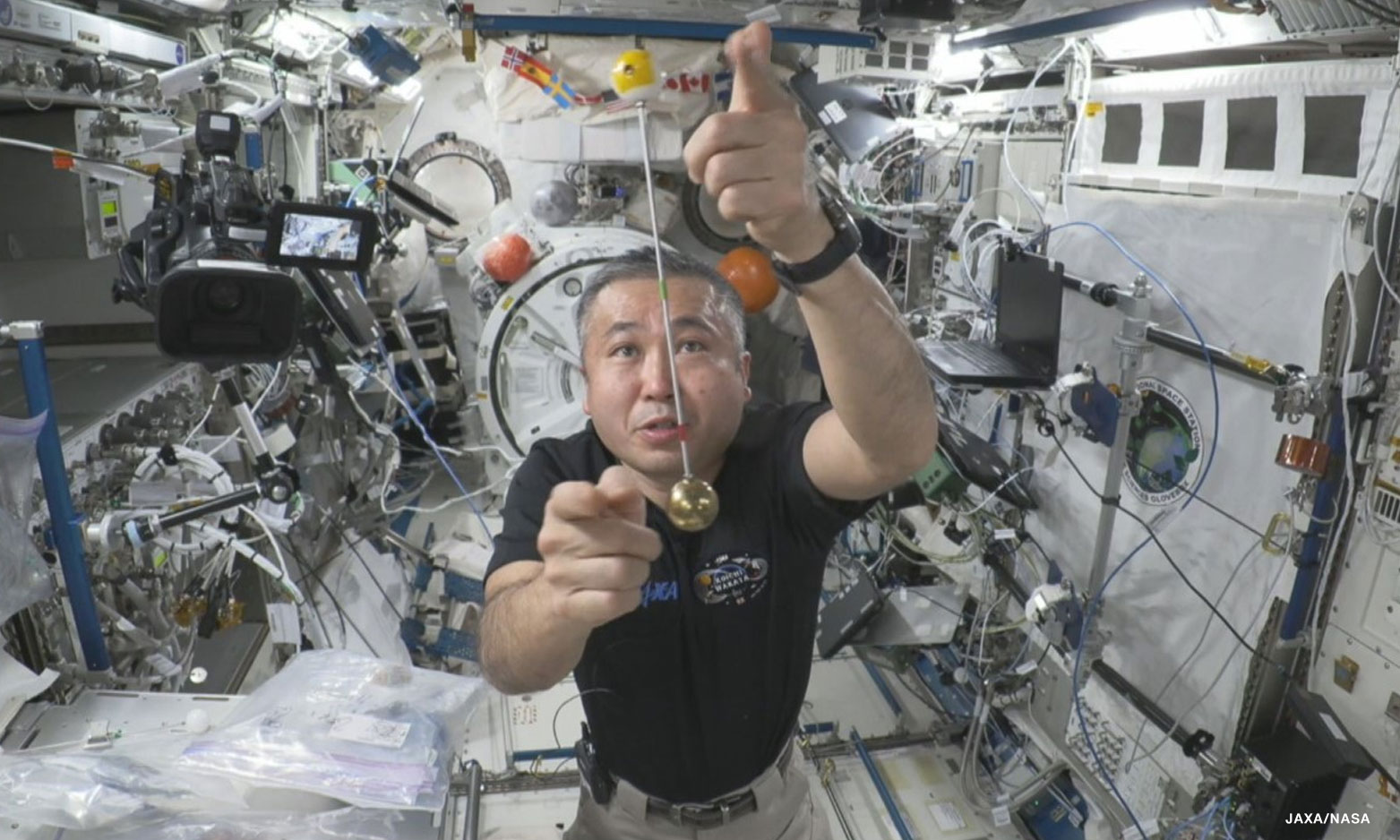

Metro Manila (CNN Philippines, January 20) — A Filipino student’s zero-gravity experiment proposal has been performed in the International Space Station (ISS), demonstrating the expected object movement which could boost spacecraft designs.
According to Philippine Space Agency (PhilSA) on Friday, William Kevin Abran’s “Rotation of Dumbbell-shaped Objects in Space” proposal was performed by Japan Aerospace Exploration Agency (JAXA) astronaut Wakata Koichi on “Kibo,” the Japanese Experimental Module on the ISS.
During the experiment, the dumbbell-shaped object moved as expected but the Dzhanibekov effect, or the dancing screw motion, was not that evident.
However, PhilSA said it cannot be ruled out at the moment.
“The result of Mr. Abran’s experiment will help in the designs of spacecraft and offer a real-life example affirming the validity of Newton’s Laws of Motion and Ehrenfest Theorem in microgravity,” the agency said.
Abran, who only got to present and interact with JAXA via livestream, said he was honored that Wakata conducted his experiment aboard the ISS on Jan. 17.
“The result was satisfying knowing that the dumbbell shapes behaved as predicted,” said the student from University of the Philippines Los Baños, as quoted by the PhilSA.
“Also, watching the experiments proposed by students from other countries gave me a new perspective about the microgravity environment,” he added. “Hopefully, this initiative inspires more students to continue doing research and be curious about the world around us.”
Wakata also conducted five more experiments in the ISS that day. They were chosen from the over 200 proposals submitted in the Asian Try Zero-G competition organized by JAXA.
Abran will still write a scientific paper discussing the results of his experiment.
GOOD AS PREDICTED!🚀 Finally, the experiments for ASIAN TRY ZERO-G 2022 have been conducted. Astronaut Koichi Wakata did a great job doing six experiments from 5 countries, live from ISS last night. pic.twitter.com/hSmxqTxlxI
— William Abran 🛰️🇵🇭 (@will_spacenaut) January 18, 2023
The other physics experiments also had amazing and some unexpected results. Although we're the only country with no representative on site, it was still a great experience. I was able to present and interact live with JAXA mission control room, thanks to UPLB OVCSA and PhilSA. pic.twitter.com/sRduy1vjqt
— William Abran 🛰️🇵🇭 (@will_spacenaut) January 18, 2023