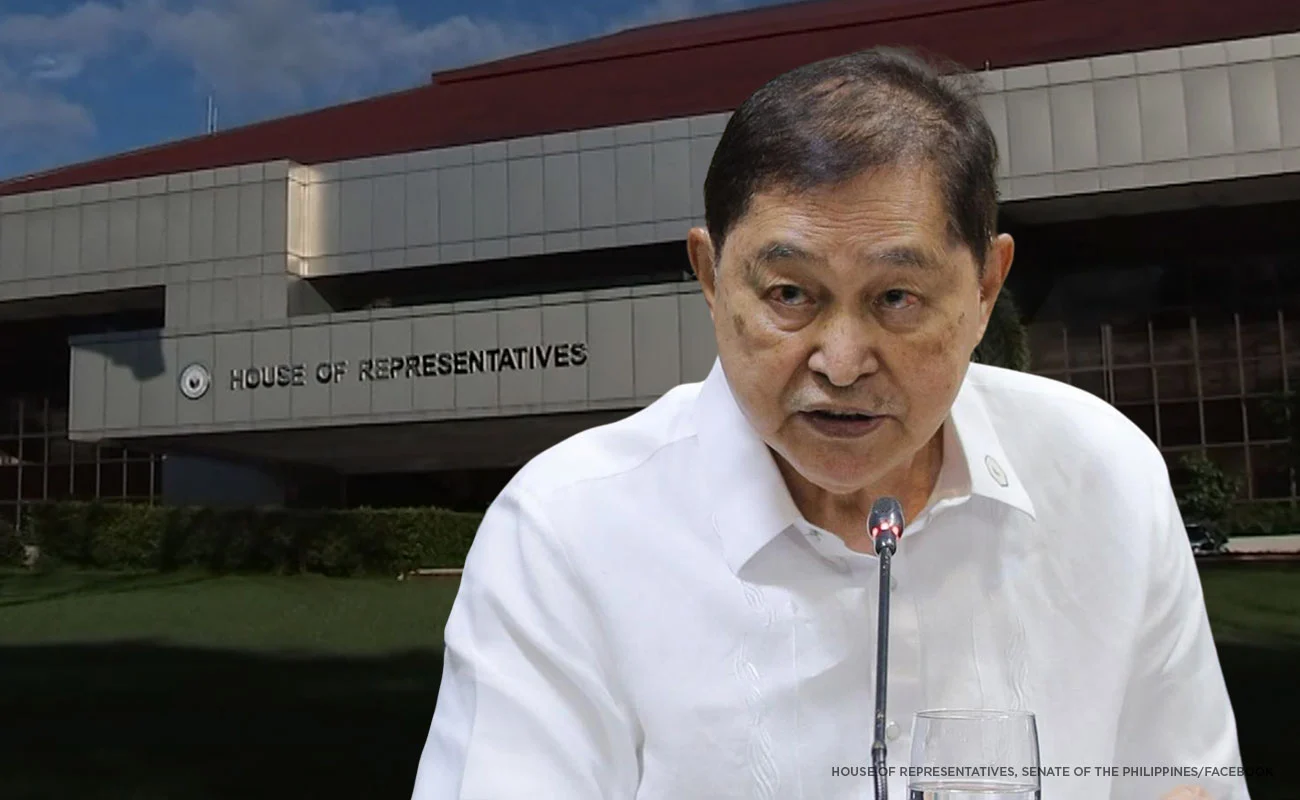

Metro Manila, Philippines – The committee-approved version of the anti-political dynasty – dubbed by critics as a “watered-down” proposal – does not fulfill the charter’s mandate to prohibit dynasties, a constitutional framer said.
In an interview with NewsWatch Plus, Adolfo Azcuna, a member of the Constitutional Commission, hit the substitute bill for avoiding prohibitions on the overlapping of positions at geographical areas.
The House bill, mainly based on the version of House Speaker Bojie Dy and Majority Leader Sandro Marcos – both from political clans and dynasties, prohibits holding an elective position at each level, for relatives to second degree of consanguinity and affinity. This covers parents, children, grandparents, grandchildren, siblings, spouses, parent in-law, and daughter and son in-law.
The proposal effectively allows clan members to hold office in different localities.
For example, at the national level, the president couldn’t have relatives of up to second degree as vice president and senators.
While at the provincial level, a governor couldn’t have family members as vice governor and board members – but they can be elected in a different locality.
Azcuna flagged this provision, which is the current structure of political dynasties.
“It should be geographical. So it should not be merely prohibiting the same offices within the provincial government but it should be prohibiting offices within the province…It should be prohibiting running for Congress as well as governor for instance,” he said.
Azcuna said he is in favor of the second degree ban.
“Subukan natin ang two degrees pero kailangan tunay naman. Huwag ‘yung two degrees tapos hindi sila natatamaan dahil ang pinapatamaan lamang ay the same political unit, it should the same geographical unit,” he said.
[Translation: Let’s try the two degrees, but it has to be genuine. Not the kind of two degrees where they aren’t actually affected because what’s being affected is only the same political unit—it should be the same geographical unit.]
Azcuna said there should also be a prohibition on succession.
Beyond ‘stepping forward’
In an interview on Friday, March 6, House committee on electoral reforms chairperson Zia Adiong described the bill as a “step forward” and a “trailblazer policy” despite critics calling it a weak version.
A number of lawmakers, including Caloocan Rep. Edgar Erice, withdrew as authors in the consolidated version. Over 20 bills against political dynasties were filed.
“This is the first time in 40 years. So it’s a positive step. But again, may mga kasamahan tayo sa committee ng mga members na willing sila to reach a more agreeable version. Many of them in fact. Some of my colleagues here in the House of Representatives are not in favor of the anti-political dynasty but they are willing to listen,” Adiong said, noting that he anticipated both criticisms and support for the bill.
[Translation: This is the first time in 40 years, so it’s a positive step. But again, we have colleagues in the committee– members who are willing to reach a more agreeable version. Many of them, in fact. Some of my colleagues here in the House of Representatives are not in favor of the anti-political dynasty measure, but they are willing to listen.]
Azcuna said the Constitution’s mandate goes beyond making a step forward.
“The Constitution does not only command them to step forward but to prohibit…You need to dismantle the whole of the dynasty and you cannot do that if you avoid geographical overlapping and the succession,” he said.
Article 2 Section 26 of the 1987 Constitution says the “state shall guarantee equal access to opportunities for public service, and prohibit political dynasties as may be defined by law.”
Azcuna said lawmakers must read this provision completely.
“Does this bill provide equal access? I don’t think so. So it does not fulfill the constitution mandate,” he said.
Lack of political will
Meanwhile, Jean Franco, a professor at the University of the Philippines political science department, said House members fell short in approving a genuine anti-dynasty bill.
“They lack political will precisely because the lack of regulation on political dynasties has worked in their favor for a very long time,” Franco told NewsWatch Plus.
“They’re trying to really exert as much effort as they can to actually stall or prevent an honest-to-goodness anti-political dynasty bill from being approved by Congress,” she added.
Franco acknowledged that crafting legislation means dealing with compromises, but added that the House version was unacceptable.
“We know that it’s an uphill climb, but there are still a lot of provisions that can be incorporated in the House version. Hopefully, during the bicam [bicameral conference committee] meetings, they can be consolidated in a way that will be beneficial to the country,” she said.
The House plenary debates on the measure will begin next week.