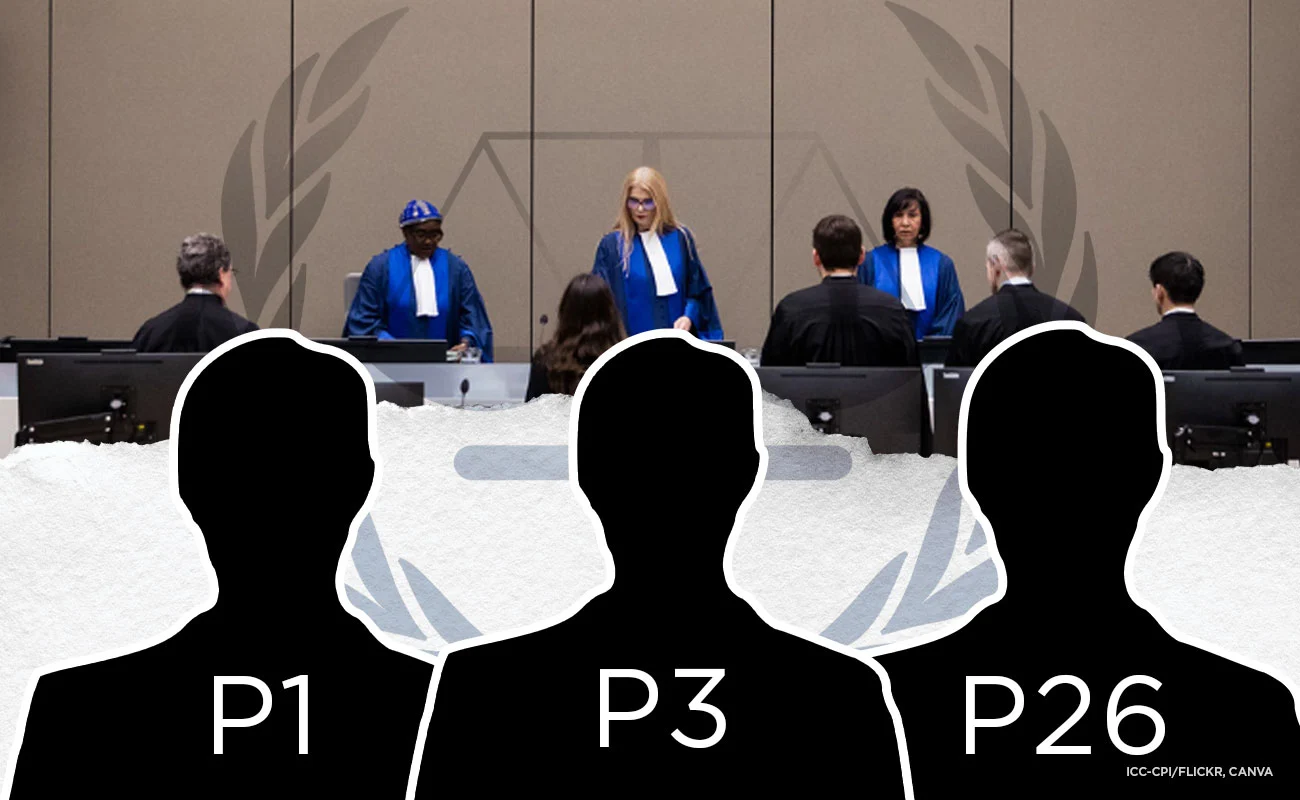

The Hague, Netherlands – In the proceedings against former president Rodrigo Duterte at the International Criminal Court, prosecutors are relying on a series of protected insider witnesses identified only by letter and number.
In last week’s confirmation charges hearing for the former president, at least ten prosecution witnesses were identified by designation: P1, P2, P3, P26, P170, P1050, P1158, P1174, P1207 and P1214.
Each plays a different role in the prosecution’s theory. The defense is challenging each witness.
The Davao-insiders
P1
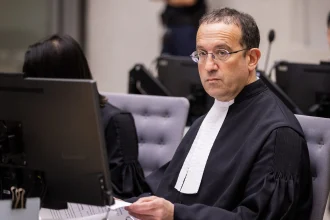
P1 is positioned as a central Davao-era insider. In court, defense counsel Nicholas Kaufman quoted P1 as saying: “Every time somebody was at fault against the government of Rodrigo Duterte, we didn’t bother to send them to prison, we would just kill them.”
The defense characterizes P1 as a “self-confessed murderer,” arguing that his own admission undermines his credibility. Prosecutors, however, rely on P1 to establish that killings were systematic and targeted, not spontaneous vigilante acts. His statement, in their view, reflects an operational culture rather than isolated criminal behavior.
P2
P2 is tied to a specific Davao incident under Count One. According to the transcript, defense lawyers argued that P2’s account relied on information he “heard from” another individual rather than direct participation. They framed his testimony as hearsay.
Prosecutors maintain that even second-hand insider testimony can help demonstrate how operations were structured when corroborated by other evidence.
P26
P26 is another Davao-period witness whose testimony focuses on authorization. In the transcript, P26 stated: “There was clearance. We would not proceed without approval.” When pressed on where that approval came from, he answered: “From above. That was our understanding.”
The defense counsel asked whether he ever directly heard Duterte order a killing. “No,” P26 said. “Not directly.” Prosecutors argue that this exchange is significant because it suggests an organized chain of approval, even if direct orders were not personally heard by the witness.
The Duterte-presidential period insiders
P3
P3 testified about the presidential period after the 2016 launch of the nationwide anti-drug campaign. His testimony addresses operational expectations and language. “We were told to produce results,” P3 said. “Neutralizations were counted.” Asked what “neutralize” meant in practice, he responded: “It meant the suspect would not return alive.”
Defense counsel challenged whether that meaning was formally defined. P3 replied: “That was the understanding in the unit.” Prosecutors cite this exchange to argue that internal interpretation of language can reflect operational intent.
P1158 and P170
P1158 and P170 were cited by the defense in connection with the meaning of “neutralize.” According to defense arguments in court, those witnesses indicated that the term meant arrest or incapacitation rather than killing. The defense uses their testimony to argue that prosecutorial interpretation of terminology is selective and contested.
P1050 and P1174
P1050 and P1174 were referenced regarding the use of force in police operations. Defense counsel stated that those witnesses indicated lethal force was used only when officers’ lives were in danger. Their testimony, the defense argues, supports the claim that operations were conducted under rules of engagement consistent with self-defense.
P1207
P1207 was mentioned in arguments concerning operational terminology such as “double barrel” and “Tokhang,” programs central to the anti-drug campaign. The defense described those terms as metaphors and enforcement strategies rather than proof of unlawful directives.
P1214
P1214 appears in the transcript among the list of prosecution witnesses connected to specific incidents, though detailed portions of the testimony remain redacted in the public version. Prosecutors rely on cumulative testimony from multiple P-witnesses to demonstrate patterns across incidents.
Prosecutors contend that such testimony supports their argument that killings were part of a broader policy rather than isolated acts. Duterte has repeatedly denied ordering unlawful killings and has said he instructed police to use lethal force only when necessary in self-defense.
His legal team has argued in court filings that the prosecution’s case relies heavily on individuals who admitted involvement in criminal activity and may have incentives to cooperate.
“These are self-confessed perpetrators,” defense lawyers have said, urging judges to treat their accounts with caution.
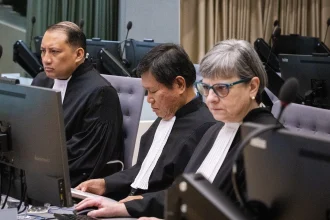
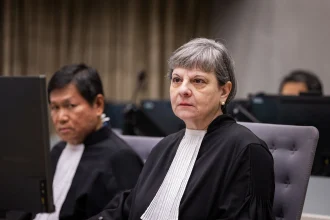
The ICC judges are assessing whether there are substantial grounds to believe crimes against humanity were committed and that Duterte bears responsibility. The standard at this stage is lower than proof beyond reasonable doubt.