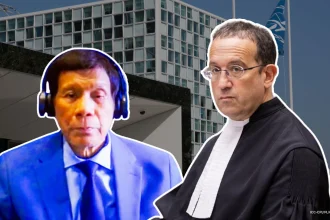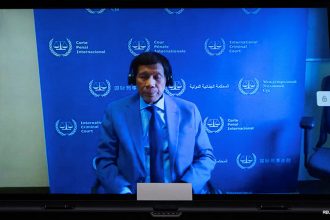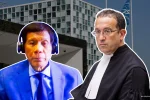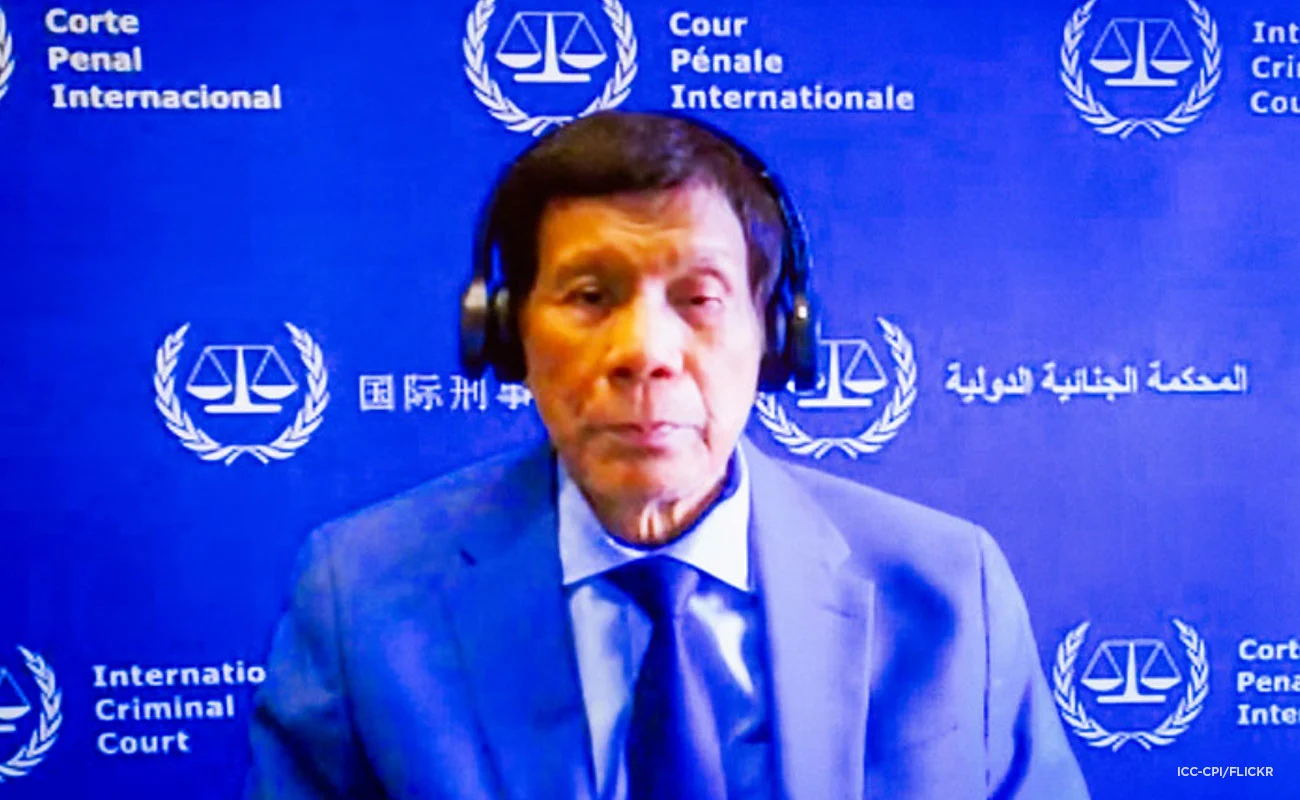

Metro Manila, Philippines – The International Criminal Court (ICC) ended on Friday, Feb. 27, the confirmation of charges hearing for the crimes against humanity case of former President Rodrigo Duterte.
After four days of session, the prosecution, defense, and victims’ counsel aired their arguments on whether there is sufficient evidence for the case to go to trial.
The ICC Pre-Trial Chamber I will have 60 days to come up with its decision.
Duterte faces three counts of murder and attempted murder over drug-related killings when he was mayor of Davao City and then president of the Philippines.
Here are some of the main points raised by the parties in delivering their closing statements.
Duterte ‘most responsible’
ICC senior trial lawyer Julian Nicholls said Duterte was at fault over the crimes against humanity of murder connected to the bloody war on drugs.
“And the most responsible is…former President Duterte, not the people on the ground who committed the killings. They are responsible, but they are not the most responsible,” Nicholls said.
Duterte has eight alleged co-perpetrators that included Senators Ronald “Bato” dela Rosa and Christopher Lawrence “Bong” Go.
Nicholls refuted the argument of the defense that there was no link of the alleged incidents to Duterte.
In Incident 1, the evidence shows that “we have a witness who heard Mr. Duterte on the phone, who heard that the order came from Superman, his client’s code name and nickname,” he said.
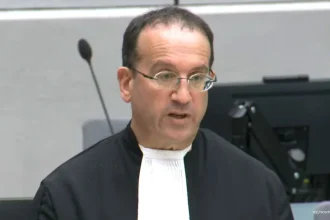
The prosecution lawyer also criticized the lead defense counsel, Nicholas Kaufman, for his arguments on how to treat Duterte’s speeches.
Nicholls said that during the hearing, Kaufman said Duterte’s “word was his word, and the people knew it,” but at the same, “one cannot rely on anything coming out of Mr. Duterte’s mouth.”
“As I went through on Monday, three times under oath, Mr. Duterte said in committee hearings, ‘I have a death squad.’ Is Mr. Kaufman saying that his client is a liar and a perjurer who has no problem lying under oath?” he said.
Narrative control
On the other hand, Kaufman admitted that the defense struggled as its remarks have been redacted multiple times, reducing their ability to make “comprehensive submissions” in open session.
“They have been so sweeping that virtually nothing intelligible remains of the 49 incidents that we have been talking about for the public to read and to understand,” he said.
“The prosecution controls the narrative by arbitrarily lifting reductions so that it can make its narrative of a grand scheme of co-perpetration known to the public in open court, while the defense can only meaningfully attack the real meat and the substance of the charges, either obliquely or in closed session,” he said.
Still, the defense said it was confident with their assertions of weaknesses in the prosecution’s evidentiary matrix.
Ahead of the closing statement, Kaufman hit the list of “high-value targets” in drug operations.
“HVT is not a code for an instruction to kill or a witch hunt,” he said. “It was a prioritization tool within anti-drug operations, applied across regions and units on the basis of intelligence assessments, alleged position within drug networks or inclusion on watch lists.”
He also cast doubt on the evidence of Incidents 10 to 14 listed in the document containing the charges against Duterte, which included the killing of Albuera, Leyte Mayor Rolando Espinosa and Ozamiz City Mayor Reynaldo Parojinog.
“We see absolutely no evidence whatsoever of any attribution to Mr. Duterte on the granular level, nor do we see any evidence of a mutually agreed course of conduct on the upper hierarchical level of government involving Mr. Duterte and his alleged so-called co perpetrators,” he said.
Kaufman also said apart from Kian de los Santos, the prosecution has not provided evidence that minors were among the victims of the drug war.
“No birth certificates, no corroborative evidence, nothing,” the defense argued.
No probe of 4,000 drug-related killings
The common legal representative for the victims said the attack against the specific group within the civilian population, which it said were individuals perceived as linked to drug crimes, was “widespread and systematic.” This is one of the elements of a crime against humanity.
Filipino lawyer Gilbert Andres also cited that the Supreme Court resolution that said the 3,967 drug personalities killed in anti-drug operations from July 2016 to November 2017, as reported in Duterte’s 2017 year-end report, was “indicative of the state policy of extra judicial killings under the Duterte administration.”
“However, your honors, despite that, at least 3,967 deaths under anti-drug operations, there were no motu proprio investigations for all of these deaths,” Andres said.
“Mr. Duterte’s administration has not criminally prosecuted the police officers responsible for the government-recognized deaths,” he said.
Andres said the prosecution presented sufficient evidence to establish substantial grounds that Duterte committed the crimes as charged.
“The victims want these charges to be confirmed because they want to be reintegrated to their communities, because they are still in the shadows of fake news, of fear, and of threats from Mr. Duterte’s supporters,” he said.
“Hence, it’s important, your honor, that all of these charges be confirmed against Mr. Duterte, so that the victims of these crimes will be taken out of the shadow of darkness into the light of truth and justice,” he said.