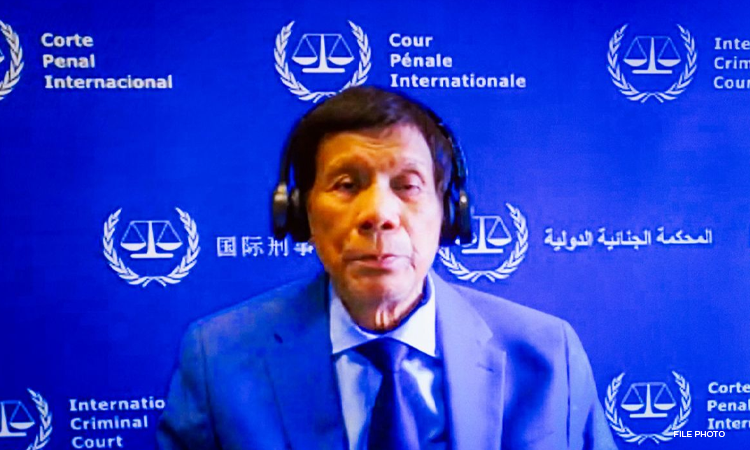

Metro Manila, Philippines – Prosecutors at the International Criminal Court (ICC) have asked judges to reject former President Rodrigo Duterte’s request to skip his upcoming confirmation of charges hearing, saying he is “available, fit, and should attend the hearing in person.”
In a six-page response signed by Deputy Prosecutor Mame Mandiaye Niang dated Feb. 19, the Office of the Prosecutor said Duterte is “not entitled to unilaterally excuse himself from attending the proceedings in-person” and argued that it is ultimately for the judges to decide “whether there is cause” to hold the hearing in his absence.
Requests to be excused from proceedings have been granted “sparingly,” prosecutors said, and recognized as “exceptional” in nature.
Duterte, 80, had asked the ICC’s Pre-Trial Chamber I to waive his right to attend the four-day confirmation hearing scheduled to begin Feb. 23, citing his age, frailty and refusal to recognize the court’s jurisdiction.
“I do not recognize the jurisdiction of the International Criminal Court over my person,” Duterte wrote in a letter attached to his request.
He alleged he was “a Filipino citizen forcibly pushed into a jet and renditioned to The Hague in the Netherlands in flagrant contravention of my country’s Constitution and of national sovereignty,” and claimed his “kidnapping” was “facilitated by the Office of the incumbent President of the Philippines.”
Duterte said he did “not wish to follow these proceedings from outside the courtroom through the use of communication technology.”
“I do not wish to attend legal proceedings that I will forget within minutes. I am old, tired and frail. I wish for this Court to respect my peace inside the cell it has placed me,” he said.
He added he had “accepted the fact that I could die in prison,” but maintained that the accusations against him were politically motivated.
“The claim that I oversaw a policy of extra-judicial killings is an outrageous lie,” he wrote, adding that the allegations were “peddled by my political opponents for many years.”
The prosecutors pushed back strongly on Duterte’s claims adding that his refusal to acknowledge the legitimacy of the proceedings does not constitute cause to hold the confirmation hearing in his absence.
The prosecution added that Duterte is “fit, competent, and physically and mentally able to attend the hearing in person,” noting that his health has been “comprehensively examined and litigated” before the Chamber.
The judges previously concluded that he is physically and mentally fit to participate and have “put measures in place to ensure his comfort throughout the hearing,” prosecutors said, citing independent medical evidence and expert opinion.
They added that his complaints that he is “old, tired, and frail” are “irrelevant.”
The prosecution also said Duterte’s stated refusal to participate even via video link demonstrates that his reasons to avoid appearing in public “are not health related but rather due to his lack of respect for the Court.”
Prosecutors argued there are “compelling reasons” for Duterte to appear, describing the confirmation hearing as “a significant milestone for the victims in this case” and stressing the importance of open proceedings in which he is “visible while he defends the criminal charges made against him.”
Under Article 61 of the Rome Statute, suspects are generally required to attend confirmation of charges hearings but may waive that right. Judges may allow proceedings to continue without the accused if they determine it is in the interests of justice, with legal counsel representing the defense.
The pre-trial chamber has yet to rule on Duterte’s request ahead of the confirmation of charges hearing on Feb. 23.
During the hearing, prosecutors, defense lawyers and legal representatives of victims are expected to present arguments on whether there is sufficient evidence to send the case to trial.
Judges typically issue a written decision within 60 days, deciding whether to confirm the charges, request additional evidence or decline to move the case forward.