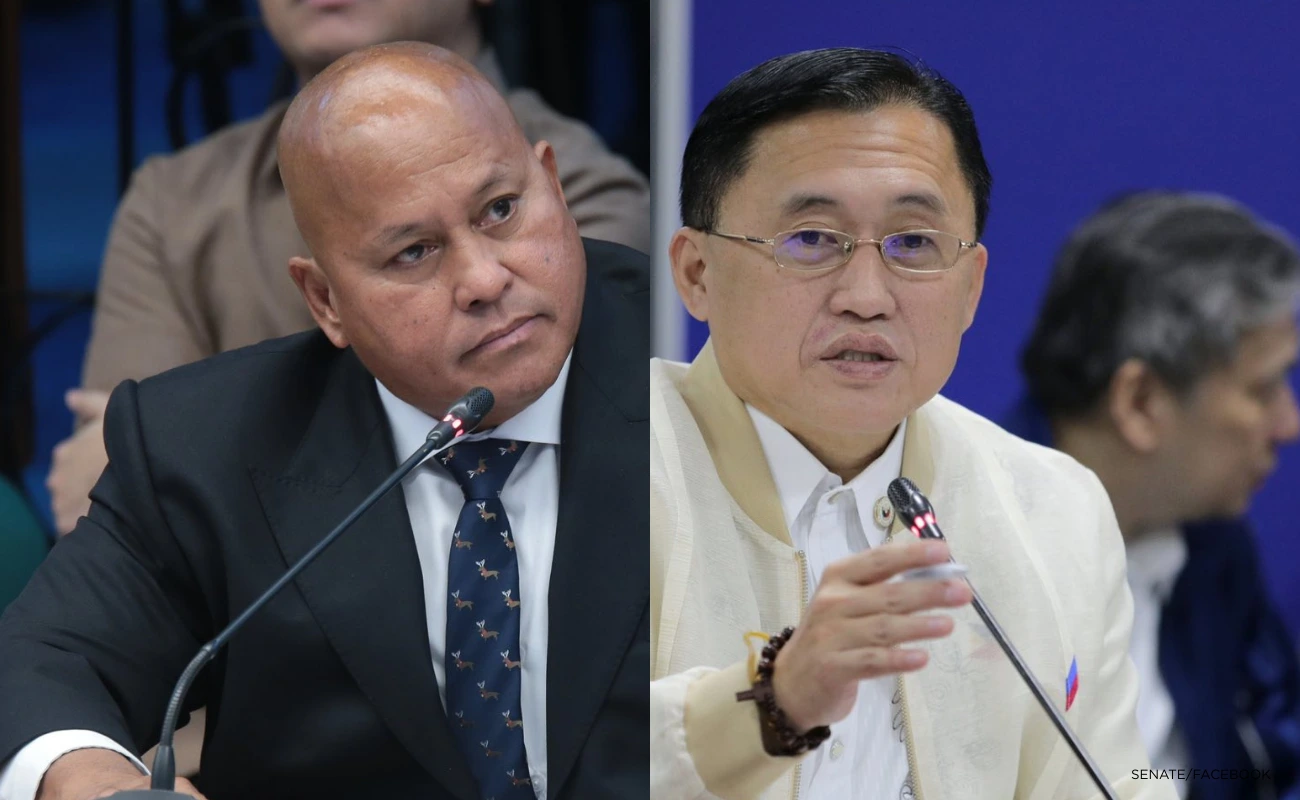

Metro Manila, Philippines – The International Criminal Court (ICC) has disclosed that Senators Ronald “Bato” dela Rosa and Christopher Lawrence “Bong” Go as among the co-perpetrators in former President Rodrigo Duterte’s crimes against humanity case in relation to the bloody war on drugs.
Dela Rosa, considered the chief implementer of the drug war, has been absent in the Senate since November after Ombudsman Jesus Crispin “Boying” Remulla said an ICC warrant of arrest was issued against the lawmaker.
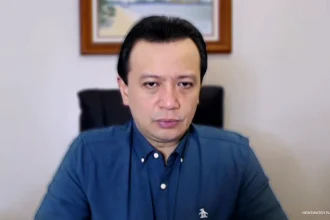
For his part, Go denied “any involvement in, knowledge of, or authority over these allegations” in a statement on Saturday, Feb. 14.
The ICC Office of the Prosecutor published a less redacted version of the document containing the charges against Duterte on Friday, Feb. 13, more than a week before the confirmation of charges hearing on Feb. 23.
In a 16-page document signed by Deputy Prosecutor Mame Mandiaye Niang, ICC prosecutors said the following were the members of the “common plan” or agreement to “neutralize” alleged drug criminals in the Philippines through violent crimes, including murder:
- Ronald “Bato” dela Rosa, former Philippine National Police (PNP) chief
- Vicente Danao, former PNP officer-in-charge
- Camilo Cascolan, former PNP chief, who died in 2023
- Oscar Albayalde, former PNP chief
- Christopher Lawrence “Bong” Go, Duterte’s long-time aide who became special assistant to the president
- Dante Gierran, former National Bureau of Investigation chief
- Isidro Lapeña, former Philippine Drug Enforcement Agency chief
- Vitaliano Aguirre II, former justice secretary; and
- other members of the PNP and high-ranking government officials.
The “common plan” was from Nov. 1, 2011 to March 16, 2019, covering Duterte’s mayoralty in Davao City and presidential term. It was also the period when the Philippines was a member of the Rome Statute, which formed the ICC.
ICC prosecutors alleged Duterte and his close associates in Davao City crafted the policy, implemented it at the local level, then expanded it to the national level when he became president in 2016. It was deemed a “widespread and systematic attack against the civilian population.”
The government said the drug war killed around 6,000 people, but human rights groups claimed higher figures.
“This shows that the plan was crafted not only to ensure implementation, but to ensure impunity,” ICC Assistant to Counsel Kristina Conti said on Facebook. “The involvement of those in the investigating units, which should have acted as the killings happen, is material to the plan.”
Smaller world for co-perpetrators
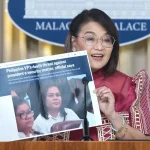
ML party-list Rep. Leila de Lima believed the ICC prosecutor has “made the world smaller” for the co-perpetrators in the Duterte case, adding they will now go into hiding, just like Dela Rosa.
De Lima is among the most vocal critics of Duterte and his drug war. She investigated the extrajudicial killings as a sitting senator in 2016, before being arrested for three drug-related cases in 2017. She was cleared in all of them in 2024.
For Senate President Pro Tempore Panfilo “Ping” Lacson Sr., his colleagues must be given the chance to avail of all legal options if arrest warrants will be issued.
“Kasi dapat igalang natin ang local courts,” Lacson said in a DWIZ interview. “Pag may arrest warrant from ibang bansa, ICC o foreign court, dapat ito dinadaan natin sa local court at may corresponding order galing sa ating local court ilalabas para ma-implement ang arrest warrant galing sa foreign entity.”
[Translation: The local courts must be respected. If there is an arrest warrant from a different country, ICC or foreign court, it must go through the local court, which will issue a corresponding order to implement the arrest warrant from the foreign entity.]
Lacson said the Senate will discuss what course of action it will take, including the possible assistance to extend to Dela Rosa and Go. He said Senate President Vicente “Tito” Sotto III may call a caucus and consult the senators.
The charged crimes
ICC prosecutors listed 49 incidents in the document to charge Duterte for three counts of murder in relation to the anti-drug campaign. The incidents comprised 76 murders and two attempted murders.
The drug war, according to the prosecution, comprised multiple acts contrary to Article 7(1) of the Rome Statute, or “crime against humanity,” which means committed acts “as part of a widespread or systematic attack directed against any civilian population, with knowledge of the attack.”
The charges against Duterte involved murders in or around Davao City during the mayoral period by the Davao Death Squad (DDS), murders of high-value targets during the presidential period, and murders and attempted murders in barangay clearance operations during the presidential period.
According to the ICC prosecution, Duterte’s individual criminal responsibility were indirect co-perpetration, ordering and/or inducing the DDS and the national network of law enforcement officers, non-police assets, and hitmen to commit the murders and attempted murders, and aiding and abetting them to commit the crimes.
Among his “essential contribution” to the crimes were:
- “creating and maintaining a system in which perpetrators knew they would be protected, including through promises of immunity and shielding perpetrators from investigation and prosecution”
- “making public statements authorizing, condoning and encouraging killings of alleged criminals, both as Mayor of Davao City and President of the Philippines”
- “publicly naming individuals and holding up charts from lists of alleged criminals, including so-called ‘high-value targets’, some of whom were subsequently killed.”
They alleged the DDS, where Duterte was at the top, “had structures or mechanisms that were sufficiently efficient to carry out the attack.”
What’s next
Duterte’s case will move forward to the confirmation of charges hearing on Feb. 23, to determine whether there is sufficient evidence in the charges to go into a trial.
On Friday, the ICC Pre-Trial Chamber I, led by Presiding Judge Iulia Antoanella Motoc, denied Duterte’s appeal seeking to overturn an earlier ruling that found him fit to participate in pre-trial proceedings.
The pre-trial chamber ruled the Duterte’s defense team failed to raise appealable issues and upheld its January decision that rejected an indefinite adjournment.
In a separate document, the pre-trial chamber also authorized 500 more applicants to participate as victims in the Duterte case. These were on top of the admitted 29 Group A applicants, or “applicants who clearly qualify as victims.”
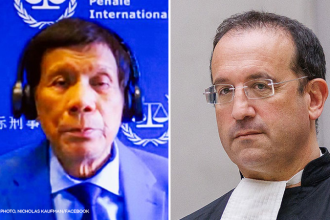
The Duterte defense, led by lawyer Nicholas Kaufman, on Feb. 11 requested the disqualification of Joel Butuyan, Gilbert Andres, and Nicolene Arcaina as external legal representatives for the victims due to “impediment to representation and, in the alternative, on the basis of a conflict of interest.”
On the prosecution side, it submitted a second updated list of evidence, highlighting two new items, which were not disclosed to the public.
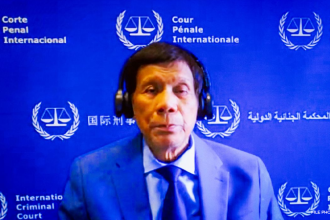
In March 2025, Duterte was arrested via an ICC warrant coursed through the Interpol at the Ninoy Aquino International Airport. He was detained at the ICC detention center in Scheveningen in The Hague, The Netherlands.