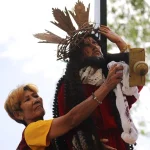

Metro Manila, Philippines – The annual procession of the venerated image of the Black Nazarene or “Traslacion” ended after 30 hours on Saturday, Jan. 10, the longest yet in recent memory.
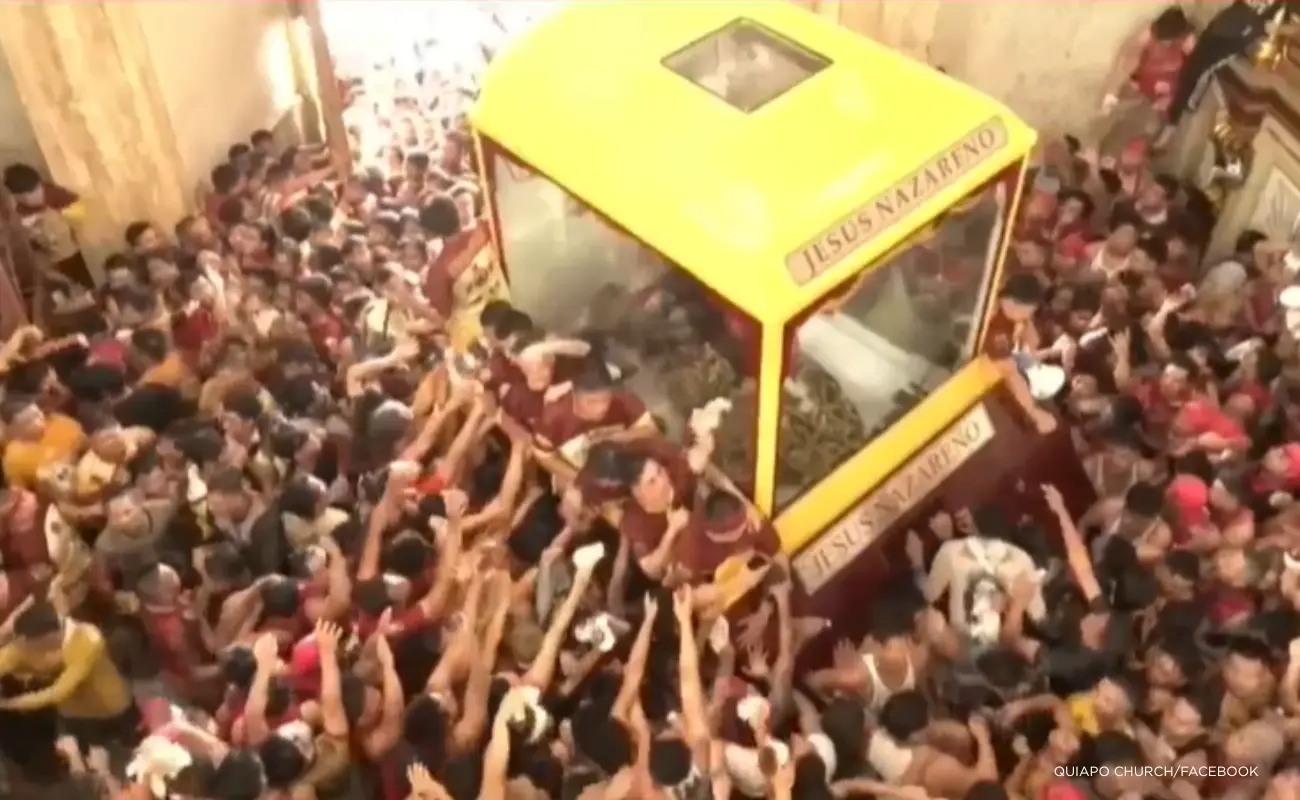
The “andas” or carriage of the 16th century image of Jesus Christ entered the Quiapo Church, or the Minor Basilica and National Shrine of Jesus Nazareno in Manila, at around 10:50 a.m. on Saturday.
It topped 2024’s time of around 20 hours, and the previous longest record of 22 hours in 2012.
Sadly, this year’s procession also saw the deaths of two devotees, as well as a veteran photographer covering the Traslacion from heart attack, said organizers. Officials recorded around 1,700 medical cases.
Meanwhile, Dr. Cynthia Versoza of Jose R. Reyes Memorial Medical Center (JRRMMC) said three devotees in hospital have died.
In a radio show by the Department of Health, Versoza said one person died after a heart attack, while two others were found unconscious during the procession and declared dead on arrival.
Organizers will hold a news briefing on Saturday to provide final details in the aftermath of the Traslacion, especially on the deaths.
President Ferdinand Marcos Jr. declared a special non-working day in Manila for the religious event, while the local government suspended classes at all levels.
More than a day’s procession
The procession began at around 4 a.m. on Jan. 9, a Friday, from the Quirino Grandstand and covered 5.8 kilometers in the streets of Manila.
The traditional “Dungaw” rite happened past 4 a.m., already a day after the procession began.
The “Dungaw” is a brief moment when the image of the Black Nazarene stops to meet the image of Our Lady of Mt. Carmel de San Sebastian at the San Sebastian Church at Plaza del Carmen.
Father Ramon Jade Licuanan, Quiapo Church rector and parish priest, announced after the “Dungaw” that the image of the Black Nazarene will stay at the San Sebastian Church, admitting that first responders and health personnel were already overwhelmed with medical cases.
Still, devotees continued with the rites until they reached Plaza Miranda six hours later.
The procession moved slow as over seven million Catholics joined the parade, said the Manila government. Many were on barefoot and eager to touch or wipe their towels on any part of the “andas,” including the attached ropes pulled by volunteers.
Another factor, organizers said, was the sheer number of devotees who climbed onto the carriage, which was repeatedly discouraged.
The “andas” was modified to run on four wheels with steering and brakes to make it safer for devotees. It also featured a stainless steel frame with a glass enclosure.
Some, meanwhile, were content to witness the “solemn transfer” of the Black Nazarene and offer their prayers from safe, nearby areas.
Corruption at center stage
Balanga, Bataan Bishop Rufino Sescon Jr., who presided over the Misa Mayor at the Quirino Grandstand before the procession, preached about Jesus Nazareno’s example of love, tweaked to rebuke the corruption scandal.
RELATED: Traslacion prayers: personal miracles to a corruption-free Philippines
“Sa ating bayan ngayon, may mga ayaw bumaba kahit mali na at bistado na,” the priest said, while slamming politicians who exploit the poor and the nation.
[Translation: In our country now, there are those who do not want to resign even if they were already caught in their wrongdoings.]
“Tumigil na, tama na, maawa na kayo sa taumbayan. Mahiya naman kayo, bumaba na nang kusa alang-alang sa awa at pag-ibig,” he said.
[Translation: Stop, enough is enough, have mercy on the people. Be ashamed, and come down voluntarily for the sake of mercy and love.]
Church leaders and religious groups have joined massive protests denouncing the anomalies in flood control projects and the alleged kickback scheme of politicians.