
Metro Manila, Philippines – The Education Department on Friday launched a nationwide artificial intelligence initiative aimed at preparing teachers, students and schools for the growing role of AI in education, with officials saying the program is designed to strengthen learning outcomes, improve school governance and promote responsible use of emerging technologies.
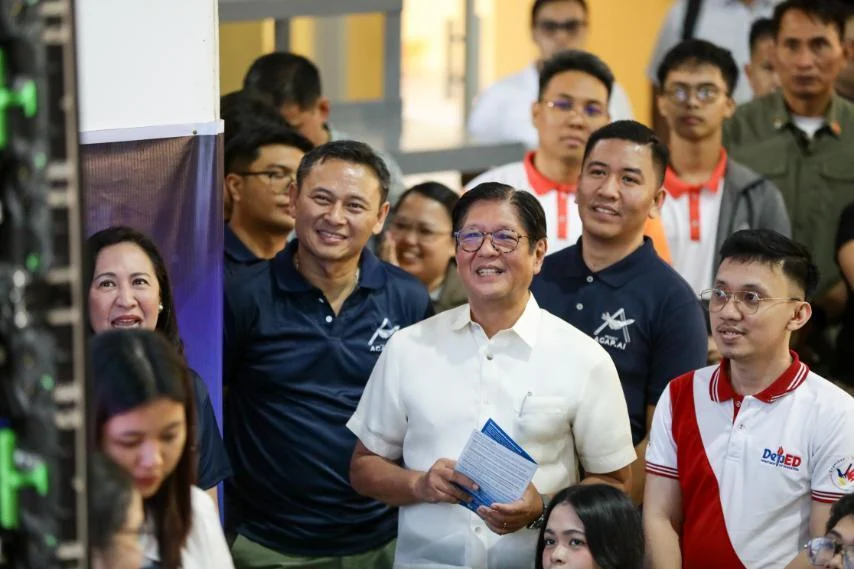
President Ferdinand R. Marcos Jr. and Education Secretary Sonny Angara led the launch of Accelerating Governance and Adaptive Pedagogy through Artificial Intelligence, or Project AGAP.AI, at Quezon City Science High School.
The DepEd said Project AGAP.AI places learners, teachers, parents and school leaders at the center of the country’s transition to AI by providing clear frameworks, training and safeguards to ensure technology enhances — rather than disrupts — teaching and learning. The program will be rolled out in phases starting in 2026.
“In our language, agapay means to support or to bridge,” Marcos said, describing the initiative as an effort to close the gap between technology and education.
He said the government is positioning AI as a tool to support development while maintaining ethical and human-centered use.
Angara said the initiative is anchored on a national framework aligned with the administration’s Bagong Pilipinas agenda and the Quality Basic Education Development Plan. He said it aims to strengthen classroom instruction, improve education governance and deliver better outcomes across the system.
A key component of Project AGAP.AI is large-scale capacity-building. DepEd said it will launch a nationwide training program in 2026 under the banner “AI Ready ASEAN Philippines,” targeting up to 1.5 million participants, including about 1.05 million learners, 300,000 teachers and 150,000 parents.
The training program, funded by Google.org and supported by the ASEAN Foundation, will cover AI fundamentals, practical classroom applications, ethics and data privacy, and ways to address risks such as misinformation. Local partner organizations will help implement the program nationwide.
To establish guardrails, the department said it will issue Foundational Guidelines on the Integration of Artificial Intelligence in Basic Education, outlining standards on ethical use, learner protection, inclusivity and data privacy. Curriculum updates are also planned to integrate AI concepts into basic education and strengthen learners’ computational thinking.
AI-focused in-service training modules for teachers are scheduled to be rolled out by the second quarter of 2026. DepEd said it will also pilot AI-powered tools to support teaching, assessment and school management, developed by the Education Center for AI Research, while expanding existing platforms subject to national standards.
Marcos said AI can help address complex challenges but cannot replace discipline, effort or creativity.