
Metro Manila, Philippines – The alert for Mayon Volcano in Albay is at Level 3 on Tuesday, Jan. 6, as officials recommended the evacuation of people within the six-kilometer radius permanent danger zone.
The Philippine Institute of Volcanology and Seismology (Phivolcs) said Mayon, the country’s most active volcano, has higher chances of transitioning into a hazardous eruption.
“The overall monitoring parameters indicate that very slow extrusion of shallow degassed magma is ongoing and is incrementally increasing in rate; i.e., effusive magmatic eruption is taking place,” it said in a bulletin.
The agency also warned that there are more chances of lava flow and hazardous pyroclastic density currents (PDCs), as well as potential explosive activity within days or weeks.
Ash fall events may also occur, it added.
Phivolcs said 30 villages or barangay are within the permanent danger zone radius. These are in Tabaco City, Malilipot, Ligao City, Santo Domingo, Camalig, Daraga, Guinobatan, Legaspi City, and Bacacay.
The Albay Public Safety and Emergency Management Office said at least 729 families are within the danger zone.
The local governments of Camalig and Tabaco have announced ongoing evacuation as of Tuesday afternoon.
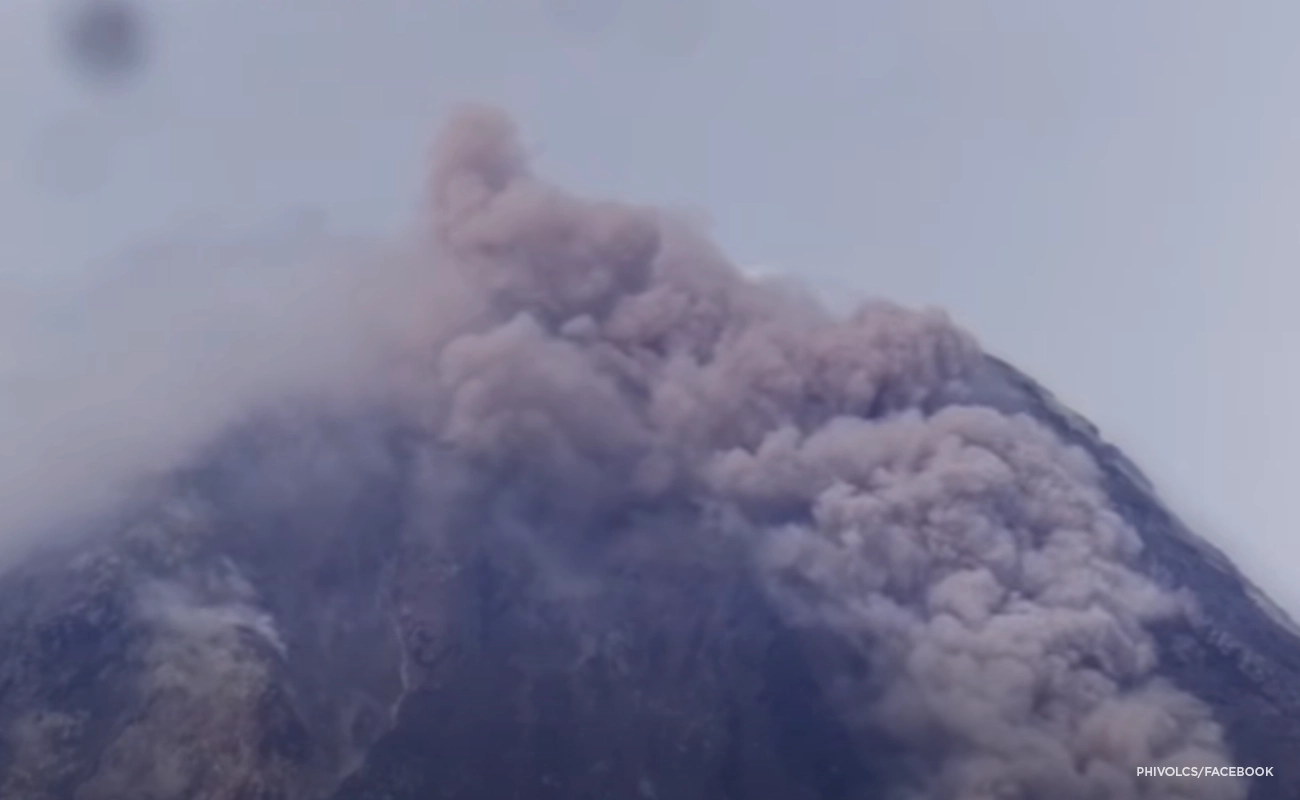
Mayon’s summit was covered with thick gray smoke past 12 p.m. on Tuesday after a dome collapse triggered a PDC, as seen in a video posted by Phivolcs.
PDCs, locally called “uson,” are deadly, fast-moving mixtures of volcanic particles and gas.
The agency said PDCs generated on the Bonga (southeast) Gully lasted at least three minutes and were emplaced within two kilometers at Mayon’s summit crater.
Likely scenario
The rise in alert level came five days after Phivolcs put Mayon Volcano under Alert Level 2 or “moderate level of volcanic unrest.”
Ma. Antonia Bornas, Phivolcs Volcano Monitoring and Eruption Prediction Division chief, said the “most likely scenario” would be the same with the June 2023 blast.
In a press conference, Bornas said the June 2023 eruption generated tall lava domes, increased rockfall events, PDCs, and a lava flow. The alert was lowered to Level 2 by December of that year.
“Kung ihahambing natin sa 2023 eruption, baka mas marami ang lava na ilabas dahil nong 2023 wala masyadong ground deformation,” she said.
[Translation: If we compare it to the 2023 eruption, Mayon may spew more lava now because in 2023, there was no ground deformation.]
Bornas said since it’s possible that Mayon will spew more lava, the current effusive magmatic eruption may take longer than the 2023 situation.
“Meron ding tiyansa na aside from lava flow, meron tayong minor explosive eruption…maaaring magkaroon ng lava fountaining,” she said, noting this scenario would trigger the further elevation to Alert Level 4.
[Translation: Aside from lava flow, there is also a chance of a minor explosive eruption and lava fountaining.]
Bornas said an Alert Level 5 scenario, where highly explosive eruptions are possible, only has a “slim chance” of happening based on current parameters.
Aside from Tuesday’s dome collapse and PDCs, state volcanologists also observed that the volume of discrete rockfall, seen with incandescence or glowing due to intense heat at nighttime, increased on Monday evening.
Since Jan. 1, they recorded 346 rockfall events and four volcanic earthquakes over Mayon. They also noted the sulfur dioxide emission remained at baseline or background levels.
Mayon, standing at over 2,400 meters and known for its perfect cone, last violently erupted in 2018, reaching Alert Level 4.