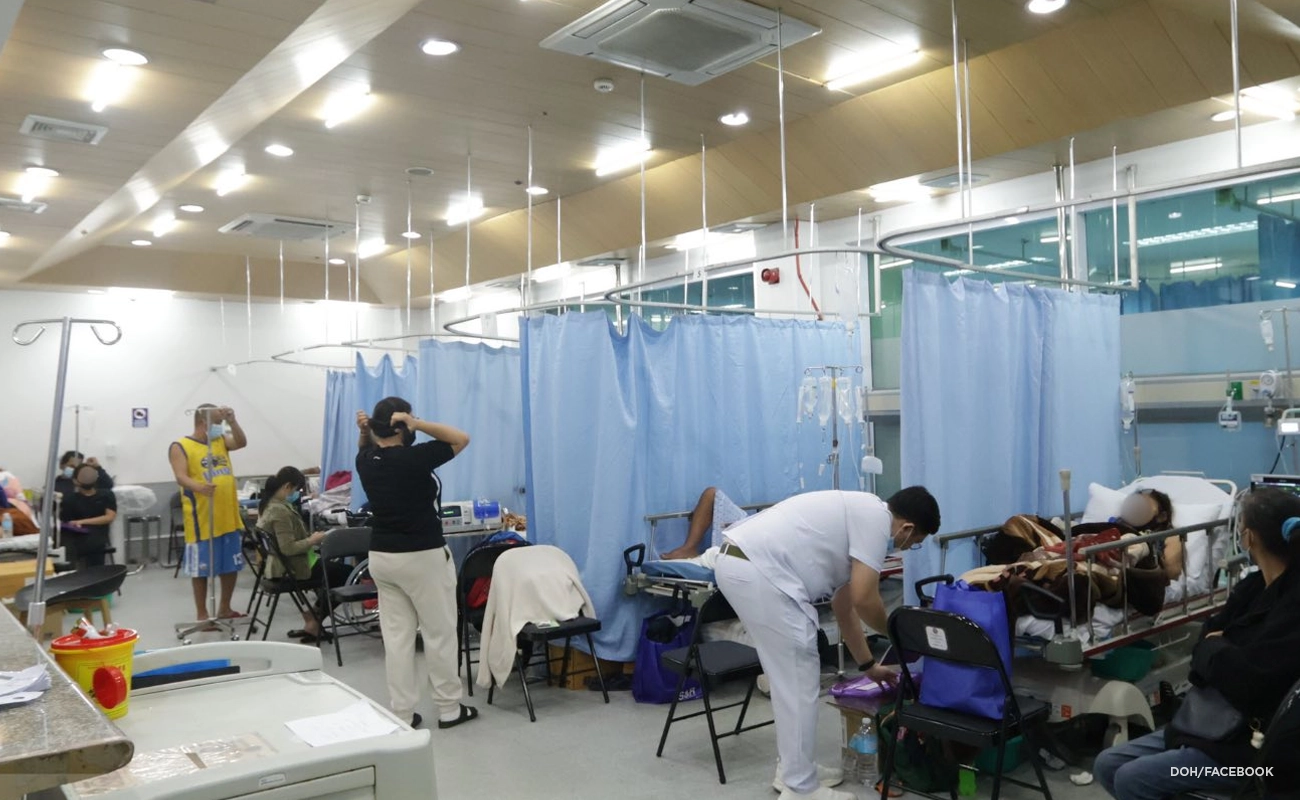

Metro Manila, Philippines – The Department of Health (DOH) will initially focus on tertiary public hospitals in the planned expansion of a policy that covers out-of-pocket expenses for qualified beneficiaries in basic accommodation, under the new national budget, a Cabinet official said on Monday, Jan. 5.
The DOH has P1 billion to expand the zero-balance billing to local government unit (LGU) hospitals, which Health Secretary Ted Herbosa said will be spent efficiently given limited resources.
Under the program, the government will shoulder the cost of ward accommodation, doctor’s fees, diagnostics, and medicines. It now covers 87 medical facilities.
“We will create correct guidelines para hindi naman maubos agad at matipid natin the whole year at mag-benefit mas maraming Pilipino sa zero-balance sa ating LGU hospital,” Herbosa said in a news briefing.
[Translation: We will create the correct guidelines so we will not immediately exhaust the fund and it could run the whole year, with more Filipinos to benefit from the zero-balance in LGU hospitals.]
Herbosa said 17 LGU hospitals were classified as Level 3, which means their services are “very similar” to DOH-run facilities.
“We will do it progressively, it’s not a fixed number immediately,” he said.
RELATED: DOH studies expansion of zero-balance billing to private accommodation
Once accomplished, the DOH chief said they may support Level 2 hospitals next. It would be followed by other LGU hospitals that will enter into an agreement with nearby DOH-run hospitals to take in patients for the zero-balance billing coverage.
Citing Sen. Win Gatchalian, Herbosa said that the DOH can also tap other funds, including the Medical Assistance for Indigent and Financially Incapacitated Patients (MAIFIP) budget, for the zero-balance billing.
Herbosa: No need of guarantee letters for MAIFIP patients
Herbosa said MAIFIP beneficiaries will not need guarantee letters.
Gatchalian, the Senate finance committee chairperson, earlier told reporters that it is up to the DOH to scrap the guarantee letters in its process.
Guarantee letters are essentially endorsements from politicians to help indigent patients in their hospital bills through DOH funding.
“You can access MAIFIP from the DOH and regional offices. Du’n sila pupunta [They should go there],” Herbosa said.
The MAIFIP had a significant funding boost in the new budget law, which has a special provision barring politicians from the distribution of any financial aid to avoid political patronage.