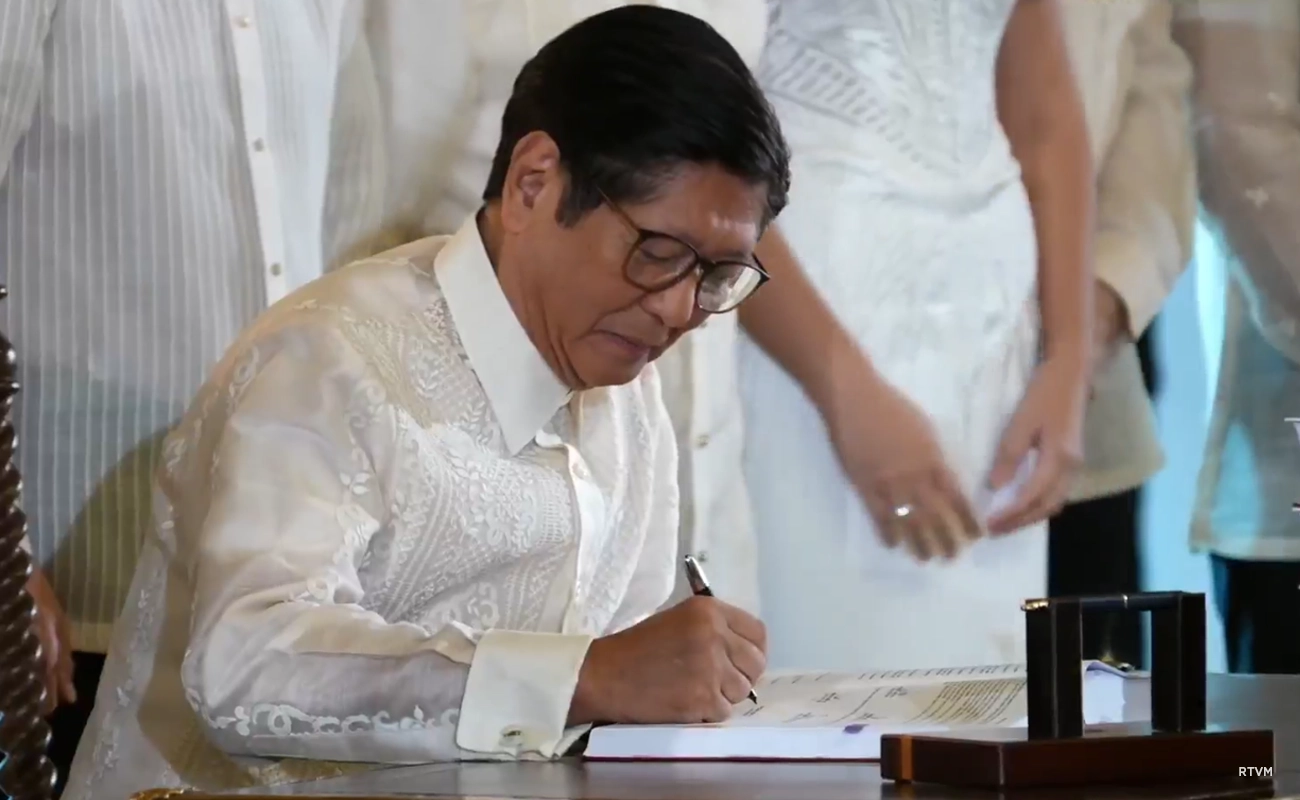

Metro Manila, Philippines – President Ferdinand Marcos Jr. signed into law the 6.79 trillion-peso national budget for 2026, approving a spending plan that places education, health care, and social protection at the center of economic growth, while sharply tightening controls on discretionary spending.
The General Appropriations Act (GAA) for fiscal year 2026 was signed on Monday, Jan. 5, and was witnessed by Senate President Tito Sotto, House Speaker Bodjie Dy, and members of the Cabinet.
Education received the largest allocation at 1.345 trillion pesos, equivalent to 4.36% of gross domestic product and compliant with the UNESCO benchmark for education spending. The allocation covers the hiring of nearly 33,000 teachers and more than 32,000 non-teaching personnel, as well as the construction of close to 25,000 classrooms nationwide.
Health spending reached a record 448.1 billion pesos to support universal health care, zero-balance billing, disease surveillance, and the hiring of additional doctors and nurses, while strengthening the Philippine Health Insurance Corporation.
Agriculture was allotted 297.1 billion pesos to boost food security, modernize supply systems and expand farm-to-market roads, while social services received 270.2 billion pesos to reduce vulnerabilities and protect marginalized sectors, including senior citizens and persons with disabilities.
Local governments will receive higher support through an expanded Local Government Support Fund, complemented by 15.33 billion pesos for disaster rehabilitation and reconstruction. The budget also continues pay increases and higher subsistence allowances for military and uniformed personnel following an executive order issued in 2025.
Sharp limits on unprogrammed funds
After outlining the spending priorities, Marcos turned to unprogrammed appropriations — funds that can only be released once specific revenue conditions are met — vowing to impose unprecedented limits and safeguards.
“We acknowledge the support of Congress in limiting the unprogrammed appropriations to essential needs. However, I push further and reduce it to the absolute bare minimum,” Marcos said, adding that the remaining level is the lowest since 2019.
“Let me be clear: the unprogrammed appropriations are not blank checks,” he said. “We will not allow them to be misused or treated as a backdoor for discretionary spending.”
Marcos said he vetoed several unprogrammed items totaling almost 92.5 billion pesos to ensure public funds are spent strictly in line with national development goals. Releases, he said, would only occur after strict validation and once clearly defined triggers are met, with full public disclosure of funding sources and purposes.
Unprogrammed appropriations are standby funds that can only be released if the government collects excess revenues, secures additional financing, or meets specific fiscal conditions—but some lawmakers argue the mechanism is unconstitutional.
Measures aimed at curbing political misuse
Addressing public concern over past budget controversies, Marcos said the government had heard the people’s anxieties and committed to a more disciplined, careful and responsible use of public funds.
The president also warned politicians and government officials against attempting to influence or divert budget releases for personal or political gain, saying safeguards will be enforced “without exception.”
“My administration will enforce these safeguards to serve the public interest,” Marcos said, adding that any release charged to unprogrammed appropriations will be transparent and subject to scrutiny.
He directed all departments and agencies to practice prudent fiscal management to ensure uninterrupted and high-quality public services.
Marcos acknowledged that the 2025 budget had been re-enacted and remained in force until Jan. 4. He said the DBM will account for expenditures incurred during that period when setting fund release guidelines for 2026.