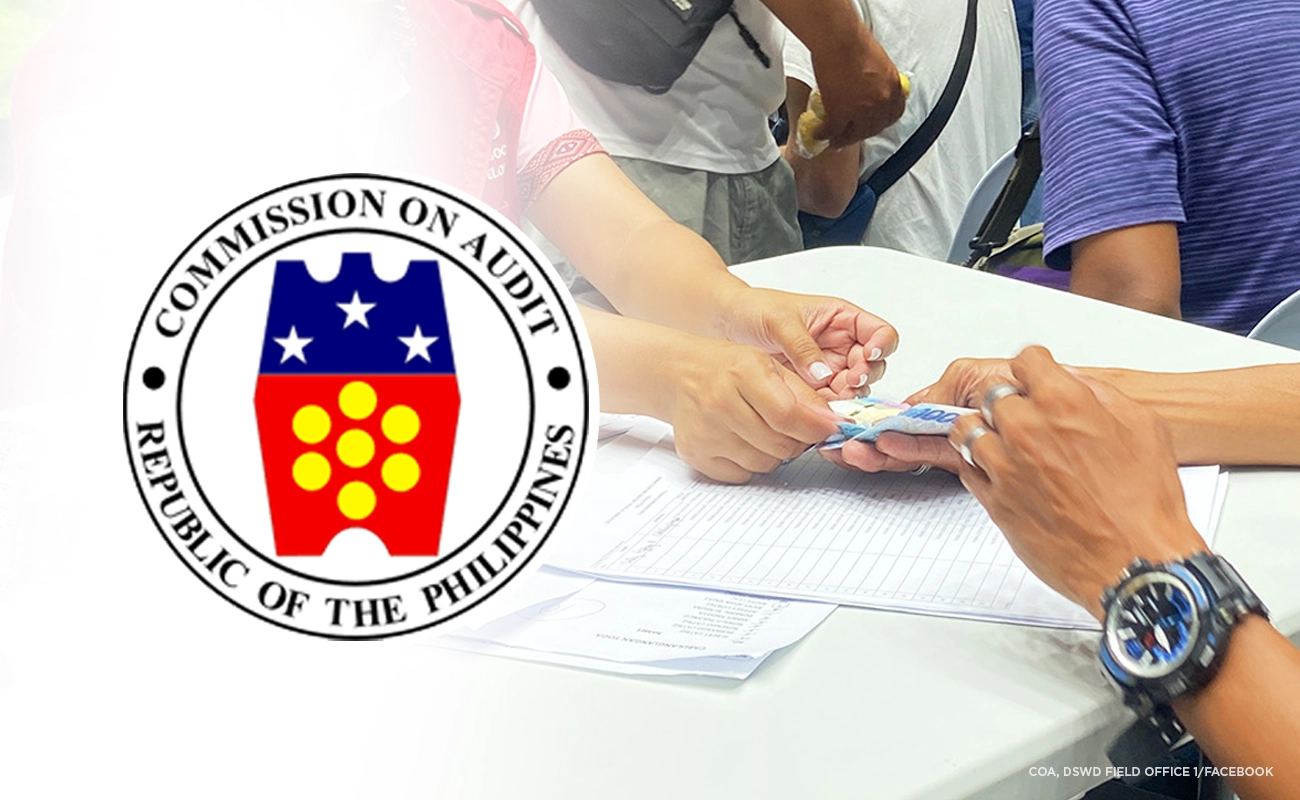

Metro Manila, Philippines – A cash assistance program for low-income workers was repeatedly used to promote politicians at the expense of public aid, according to a 2024 government audit.
In its report, the the Commission on Audit (COA) said political messaging during payouts under the Department of Social Welfare and Development’s Ayuda sa Kapos ang Kita Program, or AKAP, created a “mistaken impression” that the assistance was personally facilitated or sponsored by elected officials, rather than funded and administered by the government.
“It was likewise observed that multiple posts from the official Facebook pages of political personalities, video/photos of speeches during payouts highlighting political accomplishments, display of tarpaulins featuring the AKAP logo alongside the names and images of politicians and delivery of speeches during payouts showcased their direct involvement in the AKAP distribution process,” the report said.
The AKAP provides financial assistance to minimum-wage earners and low-income workers outside other regular assistance programs of the Department of Social Welfare and Development.
Lawmaker referrals
In the Calabarzon region, for example, auditors found that a sample of 249 beneficiaries admitted they were included in the program through referrals from district representatives or party-list groups. The commission said this practice could advance political agenda under the guise of aid.
Auditors said payouts were sometimes scheduled to coincide with politicians’ visits “to ensure a mass gathering,” while some beneficiaries were given white T-shirts labeled with “AKAP” for photo opportunities.
In Central Visayas, the audit found that payouts bypassed local social welfare offices and facilitated instead by lawmakers and their staff, weakening institutional oversight and coordination.
The COA said political involvement during payout imposed more operational and security burdens on DSWD personnel, forcing staff to transport large sums of cash to remote areas without proper security.
The audit report noted that this exposed government funds to “unacceptable levels of risk.”
In the Caraga region, auditors also observed DSWD employees showed “deference toward politicians attending payout events,” which the commission said compromised the agency’s ability to assert full control over the neutrality of implementation.
Systemic weaknesses
The report noted “systemic weaknesses” in validation, coordination and data management that resulted in improper or compromised disbursements of ₱108.3 million.
Auditors cited duplication of aid, erroneous disbursements and misidentification of beneficiaries because of inadequate cross-matching procedures, inconsistent database updates and reliance on manually validated or politically endorsed beneficiary lists.
In Metro Manila, about 19,500 AKAP beneficiaries received multiple assistance worth ₱69.44 million within a three-month period. The audit also found that more than 3,500 beneficiaries received AKAP aid while also receiving assistance from the Assistance to Individuals in Crisis Situations program, in violation of program rules.
The commission further reported that ₱48.7 million was given to college students and ₱11.9 million to recipients earning above the minimum wage, both groups falling outside eligibility standards.
The COA recommended that the DSWD revise and strictly enforce protocols that ban politicians from attending, participating in or influencing any aspect of the payout. It also urged the agency to take control of venue selection and preparation to prevent the installation of politically branded materials at distribution sites.
Auditors further recommended the creation of a centralized beneficiary verification system with automated cross-checking to prevent duplicate or erroneous disbursements.
DSWD: We take COA findings seriously
In a statement, the DSWD said it has already submitted its comprehensive response to the Commission on Audit’s (COA) recent observations on the implementation of AKAP.
“Our submission clarifies DSWD’s policies and procedures, explains the context of the transactions, and outlines the measures we are undertaking to strengthen internal controls and data management systems,” DSWD Assistant Secretary Dumlao said on Monday..