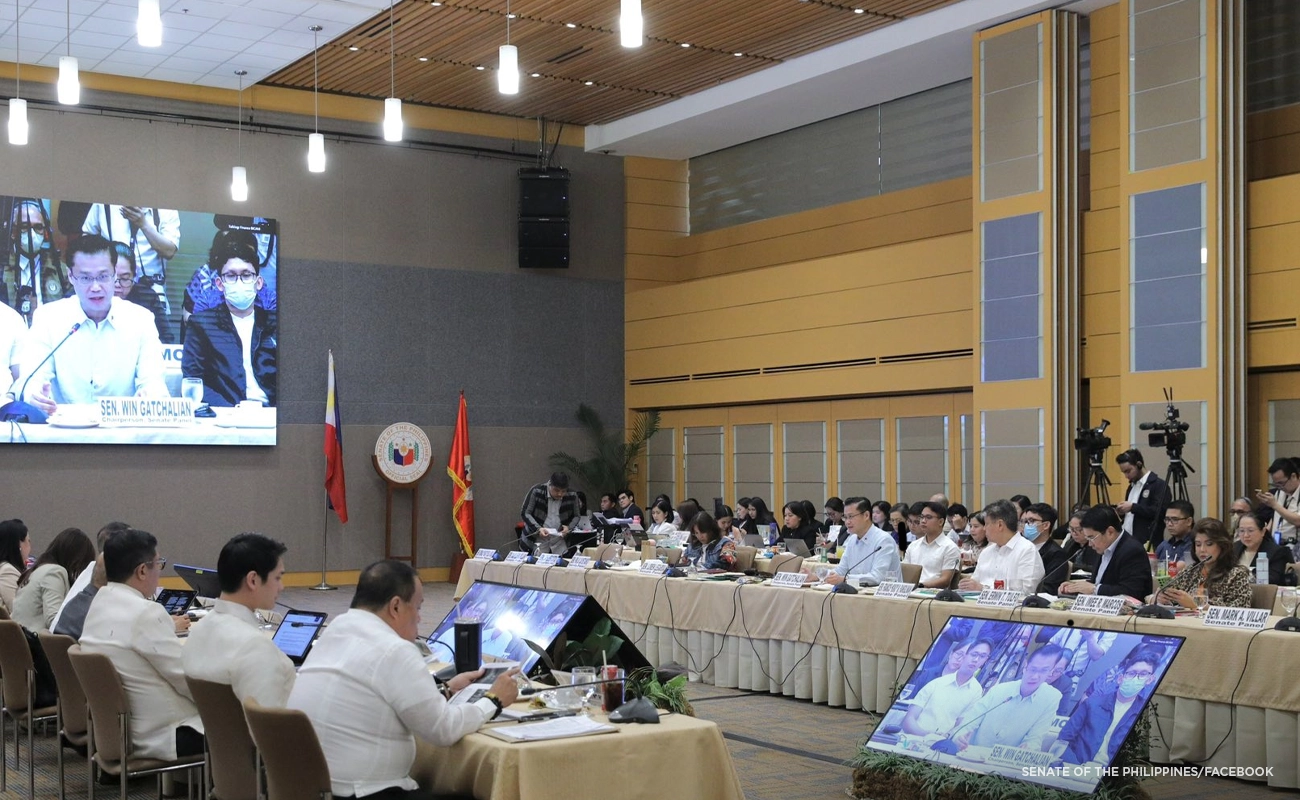

Metro Manila, Philippines – The bicameral conference committee tasked with finalizing the 2026 national budget failed to meet on Monday, Dec. 15, amid what the Senate contingent described as a “deadlock” over the controversial Department of Public Works and Highways (DPWH) budget.
It was supposed to be Day 3 of the meeting scheduled for 4 p.m. However, in a press briefing at the Senate around 3:15 p.m., finance committee chairman Sherwin Gatchalian announced the chamber’s decision to postpone the session.
Gatchalian said the decision was reached following a caucus among senators.
“After the caucus sabi namin ipostpone muna yung bicam today para maresolba itong issue with the House and also with the DPWH,” Gatchalian said.
[Translation: After the caucus, we decided to postpone the bicam today so we can resolve this issue with the House and with the DPWH.]
At issue was DPWH Secretary Vince Dizon’s last-minute appeal to restore the P45-billion cut imposed by the Senate on the agency’s budget. In a rare move, Dizon was allowed to personally make the appeal during the bicam meeting on Sunday.
Senators have repeatedly explained that the cuts covered amounts believed to be overpriced, based on data submitted by the DPWH. Dizon, however, argued that the data was presented per region and that reductions should be made per project rather than across the board.
Senators remained firm that they cannot pass a budget containing overpriced items.
“We can call it deadlock on that aspect pero naghahanap tayo ng solution,” Gatchalian said.
Instead of proceeding with the meeting, Gatchalian said he would first meet with the DPWH to clarify the issues.
The House contingent had earlier pushed for the adoption of its version of the budget, which allocates P624 billion to the DPWH, compared with the Senate’s reduced P570 billion.
House insisted on meeting
Upon receiving the Senate decision to postpone the meeting, House appropriations committee chairperson Mika Suansing said she expressed the House sentiment to push through with the session and follow the timeline.
Speaking to reporters at the Philippine International Convention Center (PICC), Suansing said nine out of 11 members of the House contingent showed up at the venue.
“Upon conferring with the House leadership and the members of the bicam conference committee, all of us are here, we all believe that we should continue the discussions,” she said.
Suansing added that Congress could continue to tackle the DPWH budget on the sidelines of the committee session to stay on schedule.
“I wouldn’t want to characterize it as a gridlock. We just want to figure out the best way forward and we are actually coordinating with DPWH and Secretary Vince to figure out the best way to do this,” she added.
Suansing said Congress is aligned in cutting some overpriced items under the DPWH allocations.
Oversight
In a letter to Gatchalian dated Dec. 15, Dizon apologized for his agency’s oversight on the initial data it submitted to the committee.
The secretary admitted that their initial submissions were not enough “to arrive at an accurate adjustment to the almost 10,000 affected projects.”
“The initial adjustment factors, which were derived using more generic material cost assumptions, are only indicative estimates intended to model potential savings under assumed conditions. As such, they do not reflect actual project-specific impacts and should not be treated as a conclusive basis for budget cuts or funding reductions,” Dizon wrote.
He added that his department is submitting additional, project-category-based data, reflecting the effects of CMPD adjustments.
Dizon reassured the Senate that the reduced materials cost will be applied in the 2026 budget.
“Should any priority project nonetheless become unimplementable, the department will seek appropriate funding augmentation from the Office of the President, including the use of generated savings within the DPWH,” he added.
Still on track
Despite the latest delay, Gatchalian said Congress could still ratify the committee report by Dec. 22, provided the budget is finalized by Wednesday, Dec. 17.
He said this flexibility is among the “buffers” built into the budget timeline, adding he remains confident President Ferdinand Marcos Jr. will sign the proposed P6.793-trillion national budget before year-end to avoid a reenacted budget.
A reenacted budget is widely feared, as it would extend the implementation of the corruption-tainted 2025 General Appropriations Act into next year.
Budget deliberations faced a number of delays, which Gatchalian attributed to transparency efforts. The first-ever livestreamed meetings were initially set for Dec. 11, then moved to Dec. 12, and again to Dec. 13, as technical staff needed more time to prepare budget documents and logistics.
NewsWatch Plus correspondent Lance Mejico contributed to this report.