
Metro Manila, Philippines – San Miguel Corporation (SMC) is back cleaning rivers in Bulacan province, after completing a massive effort from October 2022 to September 2024, that removed over 4.15 million metric tons of flood-causing silt and waste from 74 kilometers of rivers, at no cost to government and with no commercial benefit to the company.
This time, SMC is undertaking maintenance cleanups of major rivers draining out to Manila Bay that surround the country’s future largest and most modern international gateway.
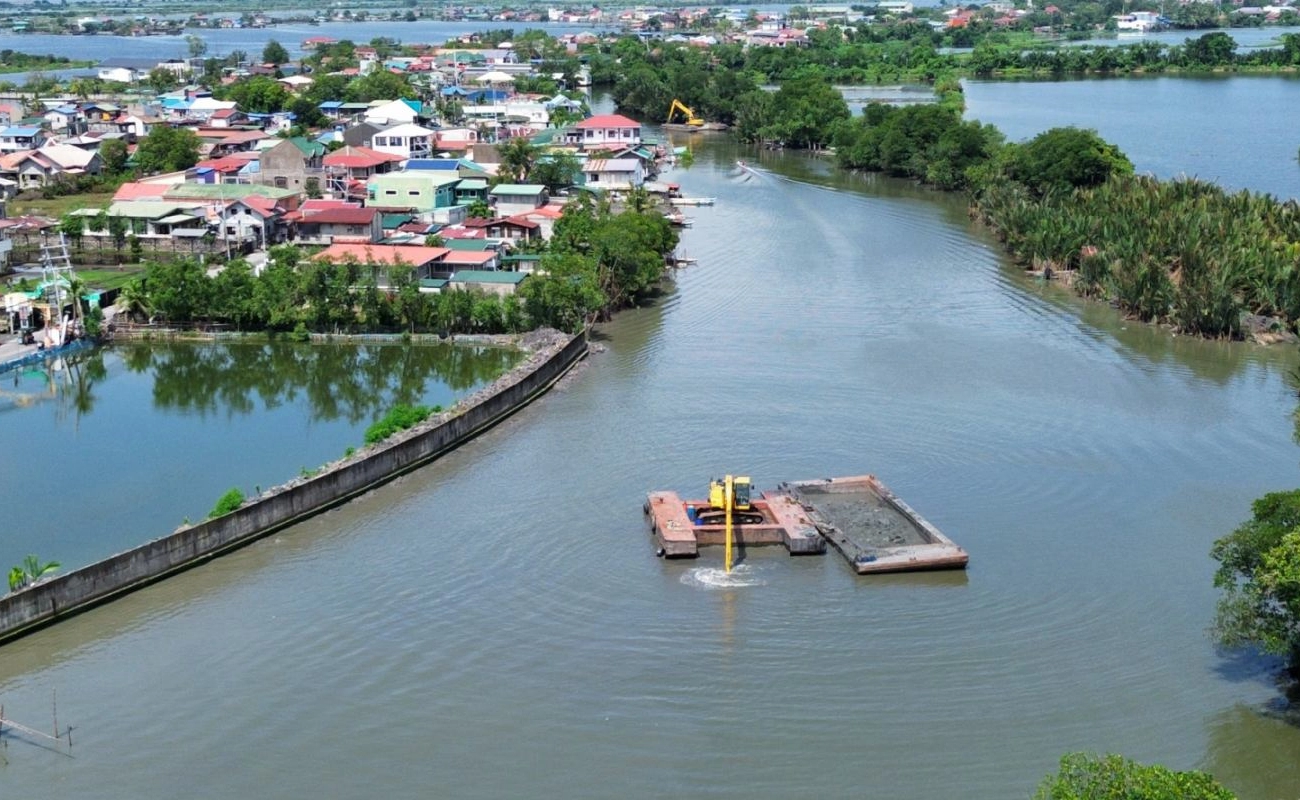
SMC Chairman and CEO Ramon S. Ang said that over the last 10 months, the company’s Better Rivers PH cleanup crews have removed over 500,000 tons of silt and waste from a nine-kilometer stretch of the Maycapiz-Taliptip River and Bambang River.
This has further deepened the river channels, which used to be mostly knee-deep prior to any dredging. Today the rivers are more than three meters deep, equivalent to the height of two persons, one standing on top of the other.
Apart from this, SMC has also extended its river cleanup efforts to the Bagumbayan River within the town of Bulakan, Bulacan where it has so far removed over 91,000 tons of silt and waste from 3.3 kilometers of the river.
Ang said that regular maintenance cleanups of these rivers are needed to ensure that gains made through the company’s years-long flood mitigation efforts — primarily, the increased flood-carrying capacities and improved flow of these rivers — are preserved.
“Rivers that surround the New Manila International Airport project have a vital function — to drain waters from eastern Bulacan rivers, out to Manila Bay. That is why it’s critical that we continuously clean them, and even deepen and expand where needed, to ensure better flood protection and mitigation, not just for the airport, but for eastern Bulacan municipalities in the Bulacan sub-river basin,” Ang said.
He explained that before SMC’s Bulacan rivers cleanup initiative, decades of accumulated silt and waste coming from upstream areas of Bulacan had significantly shallowed and clogged the Maycapiz-Taliptip River, Bambang River, and Meycauayan River in the low-lying coasts —resulting in increased flooding.
The coastal area’s low elevation, at below sea level, had also made the municipalities inherently prone to flooding.
In fact, the NMIA project site, an island surrounded by the three rivers, was also submerged over time by shallow waters. Thus, for many decades, the site was used for commercial fish pond operations by previous land owners.
Apart from clearing the three major rivers, which yielded over 1.5 million tons of silt in 2024, SMC also cleaned upstream rivers and tributaries in Bulacan to help ensure efficient water flow towards the three rivers.
The effort has helped mitigate flooding for Guiguinto, Marilao, Balagtas, Bocaue, and Meycauayan. But while the initial cleanup of the three main rivers restored their natural depth of three meters, recent water level monitoring showed that the rivers were again being shallowed by siltation.
This was brought about by numerous typhoons and heavy rainfall experienced last year, which necessitated the reactivation of clean-up operations.
“Keeping the rivers clean and flowing is our long-term commitment, and is integrated into the development and eventual operations of the NMIA. This means that continuous flood risk mitigation efforts for the airport will greatly benefit neighboring municipalities and the rest of eastern Bulacan,” Ang said.
Meanwhile, in the western part of the Bulacan–in entirely separate and faraway river basins from the airport project in the east–towns like Hagonoy and Malolos remain prone to flooding whenever the Angat Dam overflows.
For these municipalities, SMC had also previously cleaned up the downstream portions of Malolos Rivers, the Angat-Labangan River, and Pampanga River. However, these areas continue to be flood-prone when water overflows or is released from Angat Dam.
SMC noted that flooding in Bulacan is a complex issue shaped by many factors, among them: the natural rise of sea levels, land subsidence caused by over-extraction of groundwater, inadequate drainage systems, and rapid urbanization in upstream areas.
For a permanent and holistic flood solution to be successful, sustained cooperation among the national and local governments, private sector, and communities will be necessary.