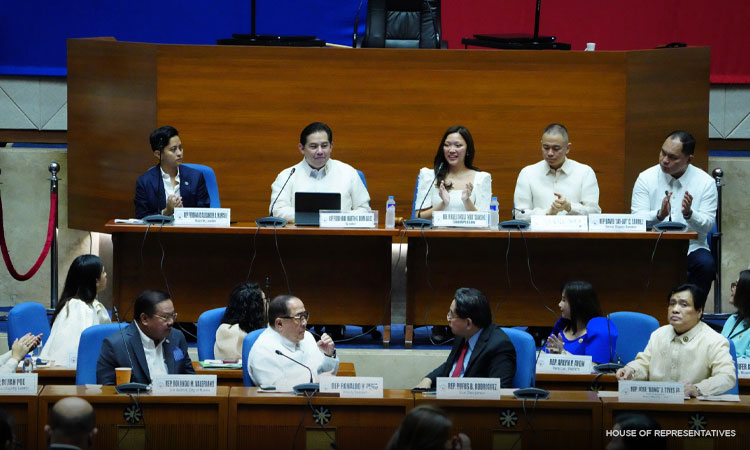

Metro Manila, Philippines – The House of Representatives began scrutinizing the proposed P6.7-trillion 2026 national budget on Monday, Aug. 18.
The House appropriations committee kicked off its discussion with the spending plan laid out by the Development Budget Coordination Committee, which consists of the Department of Budget and Management; Department of Economy, Planning and Development; Department of Finance; and Bangko Sentral ng Pilipinas.
Committee chairperson Rep. Mika Suansing (1st District, Nueva Ecija) assured participants in the briefing that the budget centers on the Filipino people.
“Mararamdaman at makikita po ninyo ito: mas maginhawang pagpapagamot, mas dekalidad na edukasyon at mga classroom, mas maraming dekalidad na mga trabaho, at mas magandang mga kalsada para sa mga magsasaka,” she said.[Translation: You will see and feel these: better health care, more quality education and classrooms, more quality jobs, and better roads for our farmers.]
‘Measly’ Visayas, Mindanao share
Cagayan de Oro City 2nd District Rep. Rufus Rodriguez questioned what he called “measly” allocation for the Visayas and Mindanao.
Of the total amount, 24.4 percent is for Luzon excluding Metro Manila, which has 13.3 percent; 11.1 percent for the Visayas; and 15.4 percent for Mindanao.
“Why will the central office reserve 10 percent? This will be the pork barrel of the Cabinet members. It should be pushed already to the regions,” he said.Budget Secretary Amenah Pangandaman explained: “Some of the projects and programs of the 2026 budget are lodged under the nationwide and central office of each of the departments.”
Small committee report
Meanwhile, Navotas Rep. Toby Tiangco asked the panel for a copy of the small committee report on the current budget.
He said two congressional districts had a huge increase in their budgets.
“Ang NEP (National Expenditure Program) nila, P2.530 billion, and then ‘pag dating sa GAA (General Appropriations Act) naging P20.999 billion. Isa pa, P1.508583 billion sa NEP, ‘pag dating sa GAA, P20.795 billion. Ang pinasok lang sa bicam dito is P5 billion and P4 billion each. Ang napasok du’n sa small committee is P13 billion, dun sa isa; ‘yung isa P14 billion,” Tiangco raised.
[Translation: One district’s NEP is P2.530 billion, but in the GAA, it became P20.999 billion. Another district’s NEP is P1.508583 billion, but it became P20.795 billion in the GAA. During the bicameral conference committee, only P5 billion and P4 billion were added. The small committee inserted P13 billion for one district and P14 billion to the other district.]
He questioned the proponent of the amendments.
Suansing replied: “The small committee is subsumed within the committee on appropriations and it is the committee on appropriations who’s required to submit the committee report. In this case, the report and the output of the committee on appropriations is the HGAB (House General Appropriations Bill).”
Tiangco, however, insisted that there should be a separate report for each committee.
The panel was unable to provide a copy of the committee report when Tiangco’s turn to inquire ended.
‘ ’42’: ‘contentWidth’: ‘100%’ ’embedCode’: ‘
2025 SMALL COMMITTEE REPORT
WATCH: Navotas Rep. Toby Tiangco, a critic of the current budget, asks for the small committee report on the proposed 2025 national budget.
The small committee is the body that gathers the institutional amendments which are discussed behind closed… pic.twitter.com/NI6jP4xkci
— NewsWatch Plus PH (@newswatchplusph) August 18, 2025