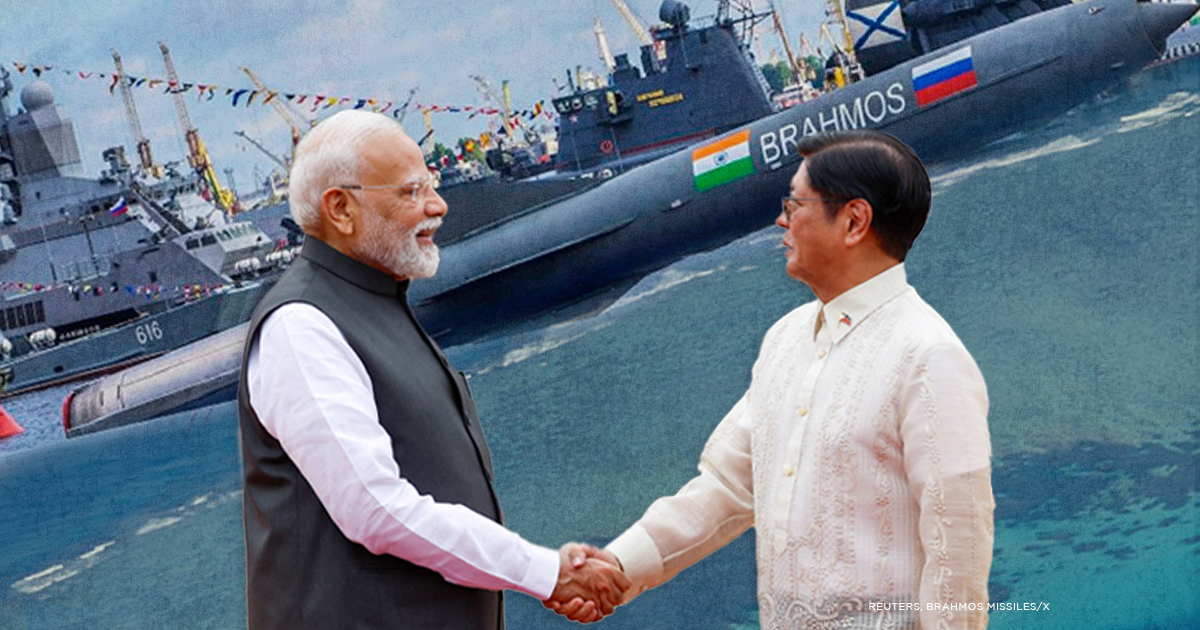

Metro Manila, Philippines – The Philippine government is thoroughly considering acquiring more BrahMos supersonic cruise missiles from India, signaling a deepening of its strategic alignment with New Delhi.
During his state visit to India, President Ferdinand Marcos Jr. said the trajectory of Manila’s defense modernization program is now closely intertwined with one of Asia’s rising powers.
In an interview with Indian outlet Firstpost, Marcos confirmed what defense insiders had long suspected: more BrahMos units may soon be on their way to the Philippine archipelago.
“I’ve spoken to the officers and men who operate the BrahMos system, and they say we need more,” Marcos revealed. “We are in the process of actually procuring more.”
This revelation follows the first batch of BrahMos missiles delivered in 2023, marking India’s first major arms export to Southeast Asia. For the Philippines, the BrahMos is more than just a weapon, it’s a symbol of strategic recalibration amid volatile Indo-Pacific geopolitics.
Evolving partnership
The defense relationship between the two nations is a culmination of 75 years of diplomatic ties, but as Marcos emphasized during his foreign policy speech at New Delhi’s Leela Palace, the bond goes much deeper.
“Despite the distance, the Philippine archipelago was touched by the Indosphere… Our civilizations bridged this chasm,” Marcos said, pointing to centuries-old cultural influences like the Maharadia Lawana, a Maranao adaptation of the Ramayana.
From shared cultural roots to shared concerns over regional security, both nations have emerged as middle powers with a stake in upholding the rules-based international order.
Marcos and Prime Minister Narendra Modi formally inaugurated the India-Philippines Strategic Partnership, only the fifth of such designations for Manila after ties with Japan, Vietnam, Australia, and South Korea.
This growing alignment is not merely ceremonial. Recently, warships from both countries completed joint maritime patrols in the South China Sea, an unprecedented gesture of unity and resolve in one of the world’s most contested waterways.
India: A reliable defense ally?
The BrahMos missile system, jointly developed by India and Russia, is a highly maneuverable, supersonic cruise missile capable of hitting sea or land targets with pinpoint accuracy. For an archipelagic nation like the Philippines–vulnerable to encroachments on its Exclusive Economic Zone (EEZ)–the acquisition of BrahMos systems offers a critical layer of deterrence.
India’s willingness to export high-grade military hardware—something many traditional Western allies have hesitated to do—has made it a more agile and responsive defense partner in the Indo-Pacific.
“Expectedly, India will have a preferential treatment in selling BrahMos missiles to the Philippines,” said geopolitical analyst Chester Cabalza.
“This is a milestone for the two strategic partners,” he added.
But questions remain on whether India, traditionally known for its non-alignment policy, can be a consistent defense partner. After all, India is a founding member of BRICS, a bloc often viewed as antagonistic to Western interests, while simultaneously participating in the US-led QUAD.
“India’s non-aligned behavior has allowed it to forge more cooperation with diverse countries, including the Philippines. It’s not about choosing sides, it’s about building strategic autonomy,” said Cabalza.
Indeed, India has publicly supported the 2016 Arbitral Award that invalidated China’s sweeping claims over the South China Sea, an important signal to Manila, which has faced escalating maritime tensions with Beijing in recent years.
The Philippines is currently undergoing an extensive military modernization program, with a focus on credible deterrence. Alongside its defense partnerships with the United States, Australia, and Japan, the Marcos administration’s outreach to India broadens its strategic options amid intensifying great power rivalries.
“We are looking to see what’s most suitable for our defensive needs,” Marcos stated, hinting that fighter jets, drones, and cyber-defense systems may also be on the table for future procurement.
India, now the world’s fourth-largest economy and among the top five global military powers, brings to the table a unique proposition: cutting-edge indigenous technology coupled with geopolitical neutrality.
According to the Global Firepower Index 2025, India ranks 4th globally in overall military strength—trailing only the United States, Russia, and China. It has one of the world’s largest standing armies, a blue-water navy, and a growing space and cyber-warfare capability.
The Philippines may never fully abandon its reliance on long-time allies like the United States, but with India as a rising and reliable partner, Manila is taking decisive steps toward diversifying its strategic alliances—with BrahMos missiles lighting the way.